
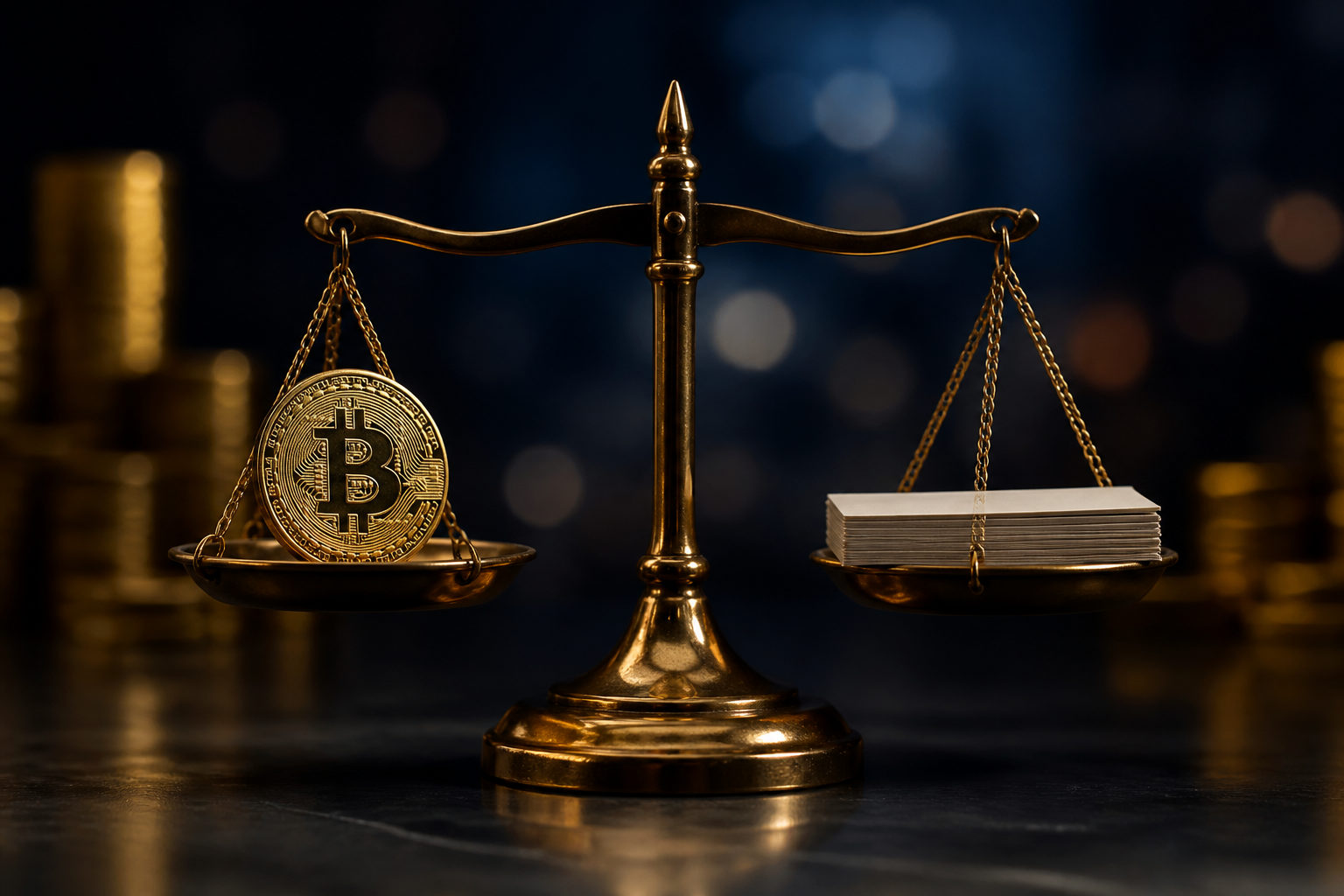
If you are asking whether Bitcoin is more stable than the US dollar, the plain answer is no in day-to-day price terms. Bitcoin and the dollar can only be compared fairly after you define what “stable” actually means.
Stability can mean several different things
Most arguments on this topic go off track because people use one word for different ideas. One person means short-term price movement. Another means long-term purchasing power. A third is talking about whether the issuance rule can change. Someone else cares about whether holding and transferring value depends on a single institution.
Once those ideas are separated, the debate gets cleaner. It is possible to say the US dollar is more stable for everyday pricing and still say Bitcoin has a more predictable supply schedule. Those are different claims, so they do not cancel each other out.
| Type of stability | Bitcoin | US dollar |
|---|---|---|
| Short-term price stability | Usually shows larger swings | Usually steadier for daily use |
| Supply rule | Public and fixed, with a cap of 21 million coins | Shaped by policy and monetary decisions |
| Long-term scarcity | Explicit upper limit | No fixed total supply cap |
| Use in ordinary payments | More limited by venue and adoption | Widely used for pricing and settlement |
| Custody model | Can be self-custodied or held with a platform | Usually held inside the banking system |
If you mean price stability, the dollar usually wins
For most people, stable means simple: the value should not move too much between now and the next bill payment. By that standard, Bitcoin is usually less stable than the US dollar. It trades as a globally watched risk asset, and that exposes it to fast shifts in sentiment, liquidity conditions, and leverage unwinds.
The dollar also benefits from something Bitcoin does not fully have in ordinary life: it is already the unit in which many wages, invoices, rent obligations, and goods are priced. When an asset is the measurement tool, its users tend to experience less day-to-day uncertainty from it. Bitcoin is more often observed as an investment position, so changes in quoted value feel sharper and matter more in the moment.
That is why the statement that Bitcoin is more stable than the US dollar usually fails in a short-term market sense. If your priority is budgeting, payroll, monthly expenses, or near-term contracts, lower volatility matters more than scarcity.
If you mean rule stability, Bitcoin offers a different kind of predictability
People who defend Bitcoin on stability grounds are often talking about the protocol rather than the market price. Bitcoin began with the genesis block in January 2009. Its creator used the name Satoshi Nakamoto, whose real identity remains unknown. The design traces back to the 2008 white paper titled Bitcoin: A Peer-to-Peer Electronic Cash System.
Its issuance schedule is public. The total supply is capped at 21 million. A new block is produced about every 10 minutes. The block subsidy halves about every 4 years, or every 210,000 blocks. The known halving years are 2012, 2016, 2020, and 2024.
That kind of predictability is real, but it should not be confused with market calm. A known supply path does not guarantee steady demand. Investors can still reprice Bitcoin quickly when risk appetite changes, when liquidity tightens, or when the market narrative shifts.
| Common claim | What it actually refers to | Does it prove price stability? |
|---|---|---|
| Bitcoin has a fixed supply cap | Its issuance path is easy to anticipate | No |
| The dollar system is mature | Payment, settlement, and pricing networks are established | Partly, yes |
| Bitcoin is decentralized | Rule enforcement does not rely on one authority | No |
| The dollar is widely accepted | It is deeply embedded in daily commerce | Partly, yes |
Purchasing power, savings, and payments are separate questions
Some readers are not really asking about daily volatility. They are asking whether one asset holds value better over a long stretch of time. That shifts the discussion from price steadiness to purchasing power. The dollar is strong as a payment and accounting tool, while Bitcoin is often examined as a scarce digital asset with a supply ceiling.
Still, scarcity does not automatically make something stable in lived experience. Bitcoin can fit a long-term thesis and still go through large drawdowns. For a holder, entry point, position size, and time horizon all shape the outcome. A person who needs the money soon will experience volatility very differently from a person building a long-duration allocation.
A more useful framework is to match the asset to the job. Money for near-term obligations usually calls for low volatility and easy access. A long-term allocation raises different questions: supply discipline, custody choices, portfolio sizing, and your ability to hold through sharp swings without being forced out.
| Use case | What matters most | Likely focus |
|---|---|---|
| Everyday spending | Low volatility, broad acceptance, familiar settlement | The dollar fits better |
| Short-term reserve cash | Predictability and quick access | Price stability matters first |
| Long-term store-of-value research | Scarcity, transparent rules, custody control | Bitcoin is often part of the discussion |
| Portfolio allocation | Position sizing, risk tolerance, holding period | The key is proportion, not slogans |
How to judge the claim without getting trapped by slogans
Start with the time frame. A view built around the next few days can differ sharply from one built around many years. Then define the kind of stability you mean: quoted price, purchasing power, or issuance predictability. After that, decide whether you are evaluating a payment tool, a savings vehicle, or an investment asset. Those jobs overlap at times, but they are not identical.
One more check matters: can you tolerate a deep drawdown without being forced to sell? If the answer is no, then even a strong long-term thesis may not help in practice. Stability is not only about theory; it is also about whether your balance sheet and behavior can survive the path.
If what you really want is the live market price, the right place to look is a major price tracker or exchange spot market, not a slogan about which asset is “more stable.” Market price is the result of trading. Stability is only one lens for understanding it.
FAQ
Why do some people call Bitcoin stable if it moves so much?
They are often referring to its issuance rules, not its market price. A fixed supply cap and a known halving schedule can be predictable even when the quoted value moves sharply.
Does a steadier dollar mean it is always better for long-term holding?
Not always. For near-term expenses and day-to-day payments, the dollar is usually the cleaner fit. For multi-year savings research, purchasing power and diversification become part of the decision.
Does the 21 million supply cap prove Bitcoin is better than the dollar?
No. It proves that Bitcoin has a clear scarcity rule. It does not prove future demand, and it does not remove the possibility of heavy volatility.
What is the biggest mistake in this comparison?
The biggest mistake is mixing different jobs into one question. Spending money, emergency reserves, and long-term investment capital should not be judged by the same standard.
A practical way to use this comparison is to separate money you may need soon from capital you can leave exposed to volatility for a long period. That distinction usually leads to better decisions than asking which one is inherently more stable.
Disclaimer: This article is for informational and educational purposes only and is not investment, financial, or legal advice. Crypto assets are highly volatile and you could lose your entire investment. Do your own research and decide carefully.