
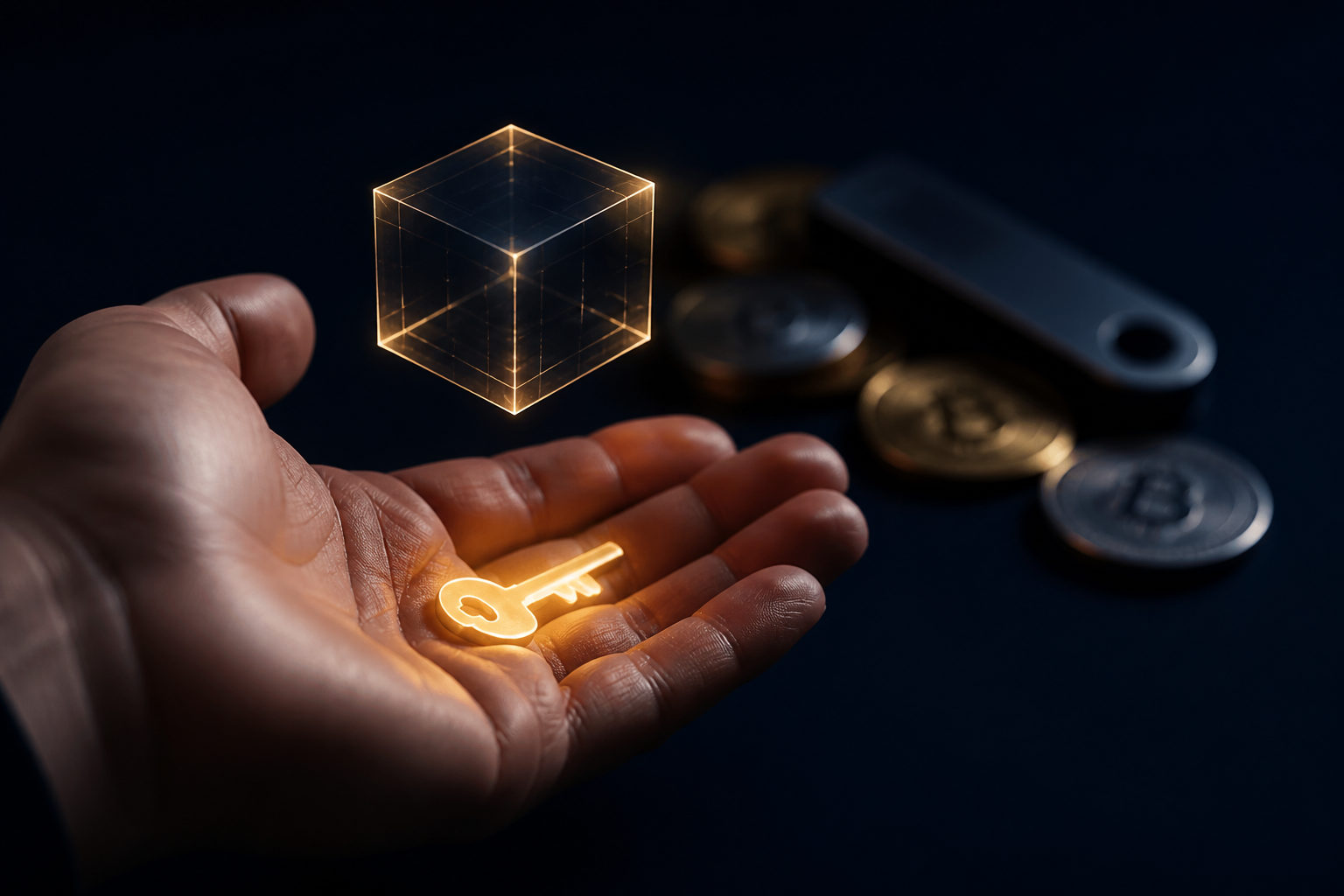
Bitcoins are not physically real in the way cash or metal coins are. When people own bitcoin, they usually own control over funds recorded on the blockchain through private keys, not a physical token issued by the network.
Why bitcoin has no standard physical form
Bitcoin was built as a digital system from the start. Satoshi Nakamoto published the white paper, Bitcoin: A Peer-to-Peer Electronic Cash System, on 2008-10-31, and the genesis block followed on 2009-01-03. The network tracks ownership through distributed records, so it has no need for printed notes or minted coins.
That design choice matters. A banknote works because an issuer creates a physical object and society accepts it in trade. Bitcoin works because the network accepts valid signatures tied to recorded outputs on the blockchain. What people call a wallet is mainly a tool for managing keys and authorizing transactions.
| Question | Answer |
|---|---|
| Does bitcoin have an official physical coin? | No. The protocol does not issue a standard physical version. |
| What does a buyer actually get? | Control over bitcoin recorded on the blockchain. |
| What does a wallet hold? | Private keys, seed phrases, or signing authority. |
| How is ownership checked? | By validating cryptographic signatures and transaction history. |
This is why bitcoin can feel abstract at first. You cannot pull out a single official coin and point to it as “the real one.” What exists is a public ledger, a set of rules, and the ability to prove control over specific funds without asking a central party for permission.
What people mean by “physical bitcoin”
The phrase often refers to one of three things: a souvenir, an educational prop, or a physical carrier for private key material. Those are very different objects, and mixing them together causes most of the confusion.
A souvenir coin with the orange B logo is just merchandise. It may look impressive on a desk, but by itself it carries no blockchain value. An educational token can be useful in classes, meetups, or beginner guides because it gives people something tangible while they learn about addresses, keys, and transfers. A key carrier is the only category that can connect to real bitcoin, because it may store the secret needed to spend funds from a specific address.
| Physical item | Is it bitcoin itself? | Main use | Main risk |
|---|---|---|---|
| Souvenir coin | No | Decoration or collecting | People may assume it has on-chain value |
| Printed card with address or QR code | No | Receiving funds or storing information | Easy to copy or photograph |
| Sealed coin with a private key | No | Offline access to real funds | Hard to verify whether the secret stayed private |
| Hardware wallet | No | Protecting keys and signing transactions | Backup mistakes can still cause loss of access |
Early physical bitcoin products sometimes hid a private key under a tamper-evident seal. If the corresponding address held bitcoin and the key had never been exposed, the object could function as a bearer-style key container. Even then, the metal piece was not the bitcoin. The spending power came from the concealed secret, not from the shape, weight, or material of the item.
If there is no physical coin, what makes bitcoin real
“Real” here does not depend on touch. Bitcoin is real in the same sense that a domain name, an encrypted file, or an account balance is real: it exists as a verifiable digital state that people can control, transfer, and check. In Bitcoin’s case, that state is maintained by a decentralized network following open rules.
Ownership is expressed through cryptography. If you control the private key, you can create a valid signature and move the funds tied to that key. If you do not control the key, holding a shiny token, a screenshot, or a printed balance does not help. This distinction is the core answer to the keyword question.
Bitcoin’s structure reinforces that idea. The smallest unit is 1 satoshi, equal to 0.00000001 BTC, which shows that bitcoin is a divisible digital unit rather than a physical object that must be split by hand. New issuance also happens through protocol rules. The target block time is about 10 minutes, the block subsidy is cut in half every 210,000 blocks, and after the 2024-04-19 halving the current block reward is 3.125 BTC. Roughly 450 BTC are added across the whole network per day, the hard cap is 21,000,000 BTC, and issuance is expected to continue until around 2140. None of this requires a mint, a vault, or a stack of coins.
When physical objects still matter to bitcoin users
Physical objects do matter, just in a different role. A steel backup can protect a seed phrase from water or fire. A paper backup can keep key material offline. A hardware wallet can reduce exposure by signing transactions without leaving secrets in a general-purpose connected device. These tools are useful because they secure access, not because they turn bitcoin into a physical commodity.
That distinction is practical. If someone offers to sell you a “physical bitcoin,” the right questions are simple: Does this object correspond to a real blockchain address? Does it contain the private key or only a public address? Has anyone else had a chance to copy the secret? Without clear answers, the item is usually just memorabilia.
The 2010-05-22 Bitcoin Pizza Day story helps here. Laszlo Hanyecz used 10,000 BTC to buy two pizzas, often cited as the first well-known purchase of a physical good with bitcoin. What changed hands on the Bitcoin side was on-chain value, not an official metal coin passed across a counter.
FAQ
Can bitcoin be held in your hand like a gold coin?
You can hold a bitcoin-themed object, but not bitcoin itself in a standard physical form. What has value is the blockchain-based control over funds.
Does a hardware wallet contain the bitcoin?
No. A hardware wallet stores or protects the keys used to authorize transactions. The bitcoin remains recorded on the blockchain.
Is a paper wallet a physical bitcoin?
No. A paper wallet is a physical piece of paper carrying key information or an address. The asset itself is still digital.
Are collectible bitcoin coins worth real BTC?
Usually not. Most are souvenirs unless they are tied to a real address and an unexposed private key.
Why do articles and ads show bitcoin as a shiny coin?
Because it is an easy visual shortcut. It helps people recognize the topic quickly, but it does not mean the network has an official minted version.
If you want to judge whether a so-called physical bitcoin has real value, ignore the design first and check the access rights: whether a real address exists, whether the secret is complete, and whether the control can be exercised independently.