
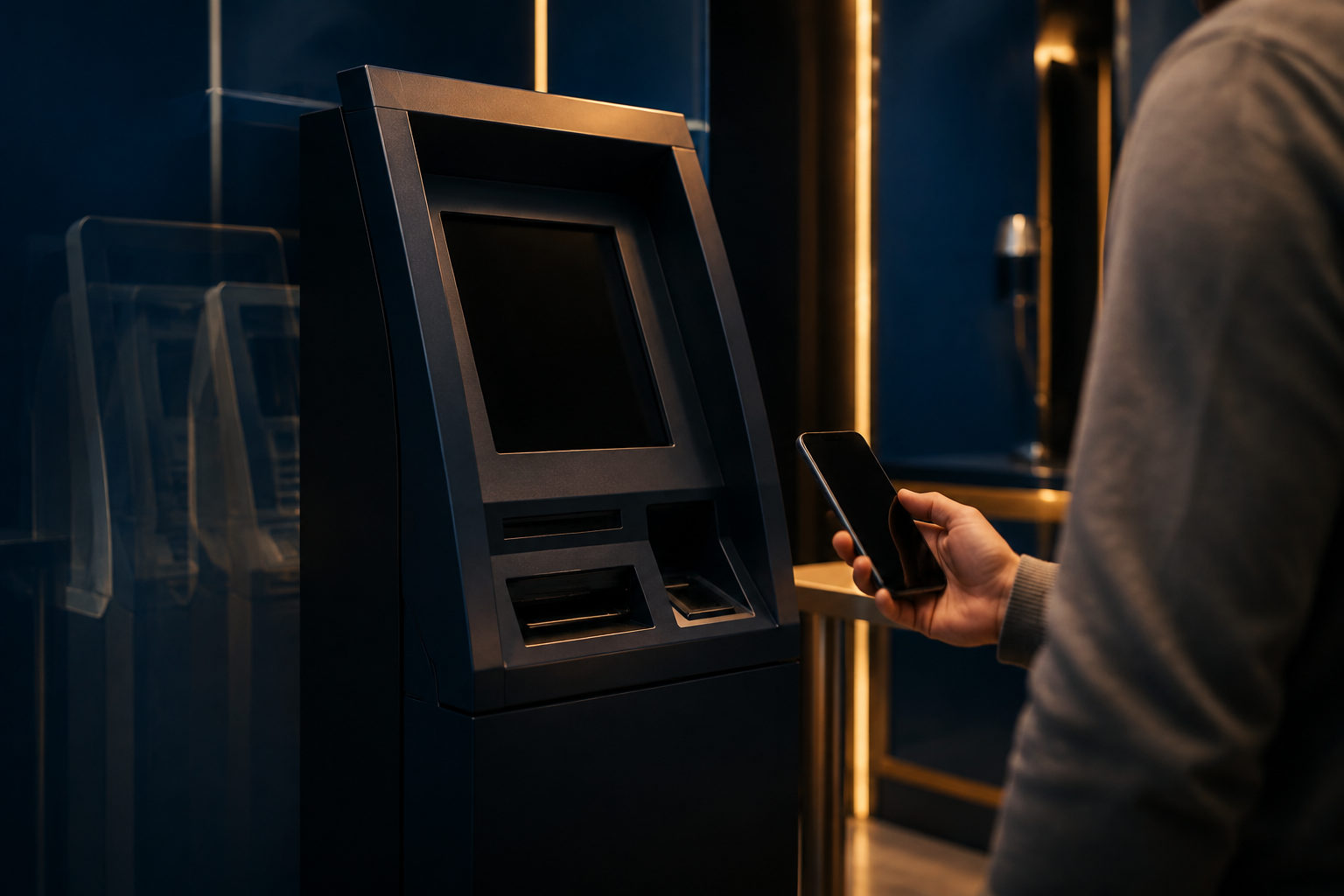
A brief history of bitcoin ATMs is really a history of how cash-for-crypto machines turned into tightly managed, scam-aware access points for people who wanted an offline way to buy or sell bitcoin.
How bitcoin ATMs started: making bitcoin visible in the physical world
In bitcoin’s earlier years, getting started often required a user to learn several unfamiliar tasks at once: setting up an account with an online service, understanding wallet addresses, choosing a payment method, and waiting through a process that felt abstract to anyone used to cards or cash. Bitcoin ATMs appeared as a simpler entry point in one specific sense. They gave people a physical screen, a scanner, and a recognizable sequence of actions.
The early appeal came from that physicality. A user could stand in front of a machine, scan a wallet address, insert cash, and expect bitcoin to be sent on-chain. That workflow made the idea easier to grasp because it linked a digital asset to a real-world action. It also introduced a risk that remains central today: if the address is wrong, the transfer usually cannot be reversed. The machine can help submit a transaction, but it does not erase blockchain finality.
It also helps to separate bitcoin ATMs from bank ATMs. A bank ATM works inside a banking system and moves balances recorded by a bank. A bitcoin ATM acts as an interface for a crypto transaction connected to a wallet address and a blockchain transfer. The machine may look familiar, yet the responsibility structure is very different. The user still needs to control the receiving wallet and understand what happens after pressing confirm.
Step by step, the machines changed: from one-way buying to broader functions
The first major shift in the story of bitcoin ATMs was functional expansion. Many early machines were built for one direction only: cash in, bitcoin out. Later, some operators added sell functions, allowing users to send bitcoin and receive cash. That sounds like a small change, though it alters the entire flow. Selling usually needs a stronger link between the machine, the operator’s back-end system, and the user’s transfer because the operator has to confirm receipt before cash is released or a payout step is completed.
For a user, that meant more screens, more instructions, and more room for confusion. Buying might be as direct as scanning a receiving wallet and feeding in notes. Selling could involve creating an order, receiving instructions, sending bitcoin to a designated address, and then finishing a cash collection process. The added complexity came from settlement control and fraud prevention, not from a design choice to make the experience awkward.
Another major change was identity verification. Over time, many bitcoin ATMs began asking for a phone number, an ID check, a photo, or some other validation step. There is a practical reason for that. A machine that turns cash into a portable digital asset can attract abuse if there are no controls around who is using it and why. For ordinary users, the useful question is not “Which machine asks for nothing?” The better question is whether the machine clearly explains what information it collects and whether the user is comfortable sharing that information in a public setting.
That stage also exposed a gap between perception and reality. The public image of a bitcoin ATM often suggests speed and convenience. Actual use can involve fees, spread, identity checks, waiting for transaction status, wallet compatibility issues, and local rules set by the operator. Bitcoin ATMs became a real access channel, but never a universal answer for every user or every situation.
If you use a bitcoin ATM today, each step should include a safety check
The first step happens before any transaction begins. Look at the machine and the environment around it. Check whether the device clearly states which assets it supports, how fees are shown, how customer support is provided, and whether there are visible scam warnings. This matters because a physical machine can create false confidence. A device placed in a shop or public venue may feel legitimate on sight, but legitimacy depends on transparent rules and traceable support, not on the fact that the machine exists.
The second step is wallet preparation. A user should arrive with a self-controlled wallet already set up and should understand how to display a receiving address or complete a send transaction if the machine supports selling. The reason is simple: the machine is usually a transaction terminal, not a long-term custody tool. The practical caution here is to avoid downloading an unknown wallet app while standing beside the machine, especially if someone nearby is “helping.” A large share of bitcoin ATM fraud does not require tampering with the device at all; it only requires steering the user into exposing wallet credentials or following bad instructions.
The third step is to read every verification request before continuing. If the machine asks for a phone number, ID, photo, or a confirmation that the transaction is voluntary, stop long enough to understand why that prompt is there. That protects the user in two ways. It reduces the chance of handing over personal information without thinking, and it can break the momentum that scammers try to create. A fake support agent, a stranger on a messaging app, or someone on the phone may pressure the victim to move quickly. Any request to share a screen, hand over a one-time code, use remote access software, or send bitcoin to a so-called safe wallet should be treated as a serious danger sign.
The fourth step is a small test transaction. Before committing a larger amount, confirm that the wallet address, the network details, and the machine’s instructions all match what you expect. That is useful because blockchain transfers usually cannot be canceled after submission. A test can reveal practical issues that do not show up in theory: a truncated address display, the wrong wallet screen open on the phone, a misunderstanding about whether the machine supports buying or selling, or confusion about when the transfer is actually sent.
The fifth step is recordkeeping. If the machine provides a printed receipt or an electronic reference, keep it and review it while still on site. A receipt can help if the transaction is delayed, if support needs a reference number, or if there is a dispute about what was submitted. Still, a receipt is not a recovery tool. It does not fix a wrong destination address, and it does not restore funds sent because a scammer gave instructions. That is why checking before the final confirmation matters more than saving paperwork after the fact.
The sixth step is post-transaction verification. After the machine says the transaction is complete, open your wallet or use a blockchain explorer to confirm the status for yourself. Completion on the machine may only mean that the order was accepted or that the operator submitted the transfer. It does not always mean that the asset is fully under your control at that moment. This step is especially important if anyone is urging you to send the newly acquired bitcoin somewhere else right away. Scams often depend on speed and on the victim acting before they pause to verify what happened.
Why scam prevention became part of the history of bitcoin ATMs
Bitcoin ATM history cannot be separated from fraud pressure. As these machines became more visible, scammers found ways to use them as a bridge between traditional money and irreversible crypto transfers. A victim might receive a call, a text, or a message from someone claiming to be from customer support, law enforcement, a tax office, a delivery service, or even a family member in trouble. The target is then told to visit a machine, buy bitcoin, and send it to a QR code or address provided by the scammer.
This pattern explains why many machines now display explicit warnings that say, in effect, do not buy bitcoin for a stranger, do not follow phone instructions, and do not send funds to a wallet presented as a verification or holding address. Those warnings are not decorative. They are direct responses to repeated scam methods. The machine itself cannot know whether the user is making an independent decision or acting under pressure from a fraudster. A warning on the screen may be the last interruption before an irreversible transfer.
There are a few signals that deserve special attention. One is urgency: someone insists the transaction must happen immediately. Another is secrecy: the user is told not to discuss the matter with family, staff, or friends. A third is guided execution: the other party supplies a ready-made QR code and asks the user to scan it without asking questions. When those elements appear together, the safest move is to stop the process entirely and verify the claim through a separate channel that you locate on your own.
This is one reason the later phase of bitcoin ATM development often looks less convenient than people expect. More checks, more warnings, and more verification prompts can feel frustrating to experienced users. For beginners and for anyone under pressure, those same friction points may be the only barrier between a recoverable mistake and an irreversible loss. The history of bitcoin ATMs is not just a story about adoption. It is also a story about how the industry learned that physical access points attract social engineering as much as genuine demand.
FAQ
Are bitcoin ATMs basically the same as bank ATMs?
No. A bank ATM works inside a bank’s account system, while a bitcoin ATM is usually an interface that helps a user buy or sell crypto through an operator’s service.
That difference matters because blockchain transfers usually cannot be rolled back in the same way a bank may handle a disputed transaction.
Do I need my own wallet before using a bitcoin ATM?
In most cases, yes. A personal wallet gives you a destination address for purchases and a place to verify that the asset actually arrived.
Going to the machine without a wallet plan often leads to rushed decisions, setup errors, or dependence on advice from strangers nearby.
Are bitcoin ATMs good for complete beginners?
They can look approachable because the process is visible on a screen, but that does not remove the need to understand wallets, addresses, and irreversible transfers.
If someone does not yet know how to check a receiving address or confirm a transaction status, learning those basics first is the safer order.
What if someone tells me to buy bitcoin at an ATM and send it to them?
That should trigger immediate caution. A legitimate payment request rarely depends on a stranger directing you to a machine and demanding a crypto transfer to a specified wallet.
The risk goes up sharply if the story involves a frozen account, a refund process, a fine, bail, or an urgent investment opportunity.
The machine says the transaction is done, but my wallet shows nothing. What should I do?
Start by checking the receipt, the destination address, and the transaction status. The machine’s completion message may only refer to order creation or submission, not final settlement in your wallet.
If there is a long delay, contact support through the official details shown on the machine itself rather than any phone number or message found through random search results.
Can I treat the bitcoin ATM quote as the market price of bitcoin?
Not automatically. A machine’s quote may include service charges, spread, or other operator costs, so it reflects the machine’s transaction terms rather than a single market-wide reference.
If you want a live bitcoin price, compare it with mainstream market data services first and then decide whether the machine’s terms make sense for your situation.
If you plan to use a bitcoin ATM, do the learning at home and the confirmation on site: set up your wallet first, know how to recognize your own address, and walk away the moment someone tries to direct the transaction for you.