
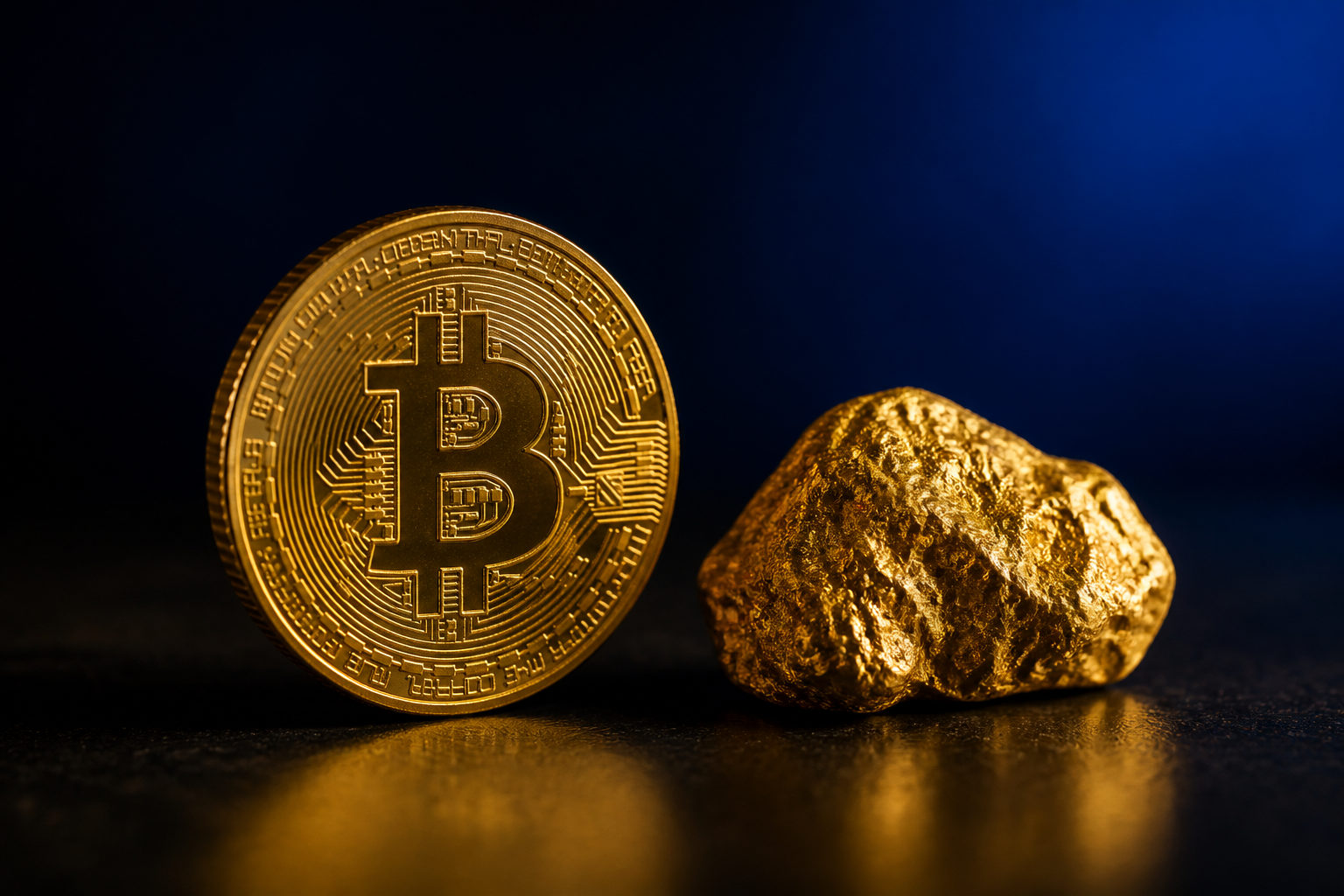
Is bitcoin scarcer than gold? If scarcity means a hard supply cap, a public issuance schedule, and easy rule verification, bitcoin usually comes out ahead. If scarcity means physical rarity, extraction difficulty, and centuries of social acceptance, gold still has a strong case.
Scarcity is not just one thing
People often use the word as if it settled the whole debate. It does not. Scarcity can refer to a known maximum supply, a predictable flow of new supply, resistance to sudden expansion, or the ease with which outsiders can verify those claims.
Bitcoin and gold score differently on each point. That is why the question matters: it forces a distinction between rule-based scarcity and physical scarcity, which are related but not identical.
| Dimension | Bitcoin | Gold |
|---|---|---|
| Supply ceiling | Hard cap of 21 million coins | No publicly fixed final upper limit |
| New supply | Issued by protocol on a known schedule | Affected by mining, recycling, cost, and discoveries |
| Verification | Rules can be checked on the blockchain | Depends more on custody, audits, and physical testing |
| Divisibility | Down to 1 sat, or one hundred millionth of 1 BTC | Divisible, but practical use depends on form and market channels |
| Supply elasticity | Low in both the short and long run | Higher prices can pull more supply into the market |
Why bitcoin is often described as scarcer
The strongest argument for bitcoin is not simply that it is limited. Many assets are limited in some vague sense. Bitcoin is different because the limit is explicit and built into the system from the start.
The network began with the genesis block in January 2009. Its monetary policy is public: blocks arrive about every 10 minutes, and the block subsidy is reduced roughly every 4 years, or every 210,000 blocks. The halving years so far are 2012, 2016, 2020, and 2024. That schedule gives holders a supply path that is unusually clear.
This matters because markets care about surprise. With bitcoin, there is far less room for a sudden increase in issuance. Participants can disagree on demand, regulation, or future use, but the supply framework is much easier to inspect than the supply path of most other assets.
Verification is another major point. Bitcoin’s issuance rules are open and consistent. A person does not need to trust a vault operator, a central warehouse, or a refinery report to know the asset has a capped supply. Gold can be authenticated, of course, but verifying stockpiles, purity, storage, and claims on the same bars often requires layers of external trust.
Why gold still has a real scarcity claim
Gold’s scarcity comes from the physical world. It must be found, extracted, refined, transported, and stored. None of that happens by decree. The asset exists under natural constraints, which gives gold a form of rarity that does not depend on software rules.
Its total above-ground stock is not governed by a fixed public ceiling. Even so, that does not mean supply can expand freely. New output depends on geology, capital, technology, permitting, and the willingness to recycle. Gold supply can respond over time, but not instantly and not without cost.
Gold also has an attribute bitcoin does not share: it remains a physical object outside digital systems. No internet connection is required for it to exist. For some investors, that quality is part of the appeal, especially when they think about long holding periods, institutional reserves, or failure scenarios in financial infrastructure.
That is why the debate often gets tangled. Some people say “scarce” when they really mean “hard to create.” Others mean “hard to increase on a known schedule.” Others are talking about trust, durability, or acceptance. Gold and bitcoin do not line up neatly because they solve different problems.
The real dividing line is predictability of supply
If the question is narrowed to supply certainty, bitcoin is usually the stronger answer. Its cap is defined. Its issuance schedule is known. Its smallest unit is precise: 1 sat equals one hundred millionth of 1 BTC. That level of divisibility does not make bitcoin scarcer by itself, but it does make a fixed supply easier to use across many transaction sizes.
Gold, by contrast, has a supply curve shaped by economics and physical reality. Higher prices can encourage more mining and more recycling. That does not erase scarcity; it simply means scarcity is expressed through production difficulty rather than hard-coded monetary policy.
This distinction helps avoid a common mistake. “Bitcoin is scarcer than gold” can be a reasonable statement if the subject is rule-based supply. It does not automatically mean bitcoin must have a higher price, lower volatility, or better short-term performance. Scarcity affects one side of valuation. Demand, liquidity, risk appetite, and market structure affect the rest.
| Question | Answer leans toward bitcoin | Answer leans toward gold |
|---|---|---|
| Which asset has the clearer maximum supply? | Bitcoin | Gold has no fixed public final cap |
| Which asset has the more predictable issuance path? | Bitcoin | Gold supply changes with real-world conditions |
| Which asset is scarcer in a physical sense? | Weaker case | Gold |
| Which asset is easier for outsiders to verify at the rule level? | Bitcoin | Gold needs more external processes |
| Which asset relies more on long historical acceptance? | Less | Gold |
How to think about the question without getting stuck in slogans
A useful test is to ask three things. First, is total supply bounded in a clear way? Second, can new supply be expanded if prices rise? Third, can ordinary participants verify the supply story without depending too much on intermediaries?
By that standard, bitcoin is extremely strong on bounded supply and verification. Gold is strong on physical rarity and historical acceptance. Those are not interchangeable qualities. One is native to code and consensus rules. The other is native to material reality and long social use.
For readers trying to form an investment view, the main takeaway is narrower than many headlines suggest. Bitcoin is generally scarcer than gold in the sense that its supply is more fixed and more transparent. Gold remains scarce in the sense that it is difficult to produce and impossible to conjure by rewriting a protocol. Both claims can be true at the same time.
FAQ
Does bitcoin’s fixed cap automatically make it scarcer than gold?
It makes bitcoin more clearly scarce in monetary design. Whether that settles the whole issue depends on whether you count physical rarity and non-digital holding properties as part of scarcity.
Why is gold still called scarce if it has no fixed maximum supply?
Because its supply is constrained by nature and production difficulty. New gold cannot be created on demand; it has to be found, mined, refined, and brought to market.
What does halving have to do with bitcoin scarcity?
Halving slows the rate at which new bitcoin enters circulation on a known schedule. That makes future supply easier to estimate, which strengthens the asset’s scarcity profile.
Which one is easier to verify, bitcoin or gold?
At the rule level, bitcoin is easier to check because issuance follows public blockchain rules. Gold can be verified too, but physical custody and quality checks add more dependence on third parties.
Does greater scarcity mean higher price performance?
No. Scarcity shapes supply expectations, but price also depends on demand, liquidity, and market mood. An asset can be very scarce and still go through long weak periods.
If you want a clear answer, define scarcity before comparing the assets. Ask whether you mean fixed supply, low supply elasticity, physical rarity, or ease of verification. Once the definition is clear, the bitcoin-versus-gold debate becomes much easier to judge.
Disclaimer: This article is for informational and educational purposes only and is not investment, financial, or legal advice. Crypto assets are highly volatile and you could lose your entire investment. Do your own research and decide carefully.