
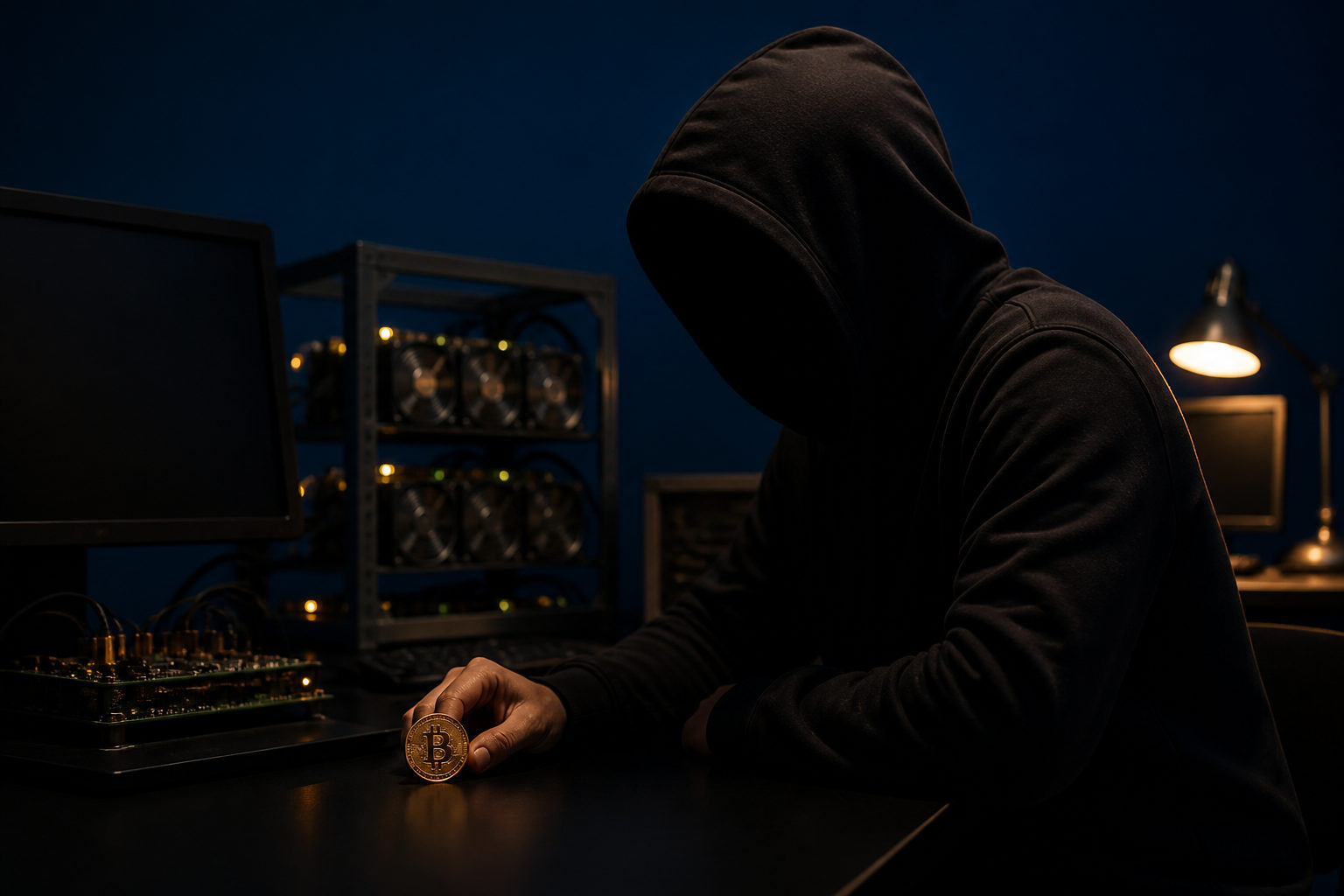
How many bitcoins does the creator have? There is no publicly confirmed number. The careful answer is that Satoshi Nakamoto likely mined in bitcoin's early days, but outside observers still cannot verify an exact personal holding.
What can be stated as fact
Satoshi Nakamoto is the name attached to bitcoin's origin. The white paper, Bitcoin: A Peer-to-Peer Electronic Cash System, appeared in 2008, and the genesis block was created in January 2009. Since the network had to be started by someone, it is reasonable to say Satoshi was among the earliest participants.
That does not give the public a full wallet list. Bitcoin records blocks and transactions, yet it does not attach a civil identity to each address. People often jump from “Satoshi was there at the beginning” to “we know exactly how many coins Satoshi has,” and that jump is larger than it looks.
A timeline of why the number remains uncertain
2008: the design was published, not a balance sheet
The white paper explained how a peer-to-peer cash system could work without a central operator. At that stage, the public could see the design, the name on the paper, and the monetary rules built into the system. None of that revealed a confirmed bitcoin balance for the creator.
This matters because authorship and ownership are different questions. A person can publish the design for a network without giving the world a map of every address that person may later control.
January 2009: the network launched, creating an obvious early-mining question
Once the genesis block appeared, bitcoin mining began to matter in practical terms. New blocks are produced about every 10 minutes, and in the earliest period there were far fewer participants than in later years. That is why many readers assume the creator accumulated a large amount of bitcoin in the opening phase.
The assumption may be understandable, but it still does not produce a verified total. A block reward can be seen on-chain; the real-world identity behind every early address usually cannot.
Later years: analysts started grouping early blocks and addresses
As bitcoin history drew more attention, researchers examined early mining behavior, block timing, and address patterns to estimate which coins may have been mined by the same entity. This is the root of many widely repeated claims about the creator's holdings.
Those claims should be handled with care. Pattern analysis can suggest that certain blocks look related, yet suggestion is not proof of legal or personal ownership. Without a public signature from the relevant keys or a clear admission from the holder, the result stays in the category of inference.
What to trust, and what to treat as an estimate
| Claim type | Safe to treat as fact? | Why |
|---|---|---|
| Satoshi Nakamoto is the named creator of bitcoin | Yes | This is part of bitcoin's basic historical record |
| Satoshi likely took part in early mining | Yes | The creator was present when the network started |
| The creator holds an exact known amount of bitcoin | No | There is no public, verified list of all controlled addresses |
| A specific cluster of early addresses definitely belongs to Satoshi | No | Address clustering is analysis, not identity confirmation |
| The creator still fully controls all early coins often linked to Satoshi | Unknown | Private-key control is not visible from the outside |
Two mistakes appear again and again in articles on this subject. The first is turning a famous estimate into a settled fact. The second is assuming that long-dormant coins must still be available, or must be permanently inaccessible. On-chain silence does not answer either point by itself.
The genesis block adds to the confusion. It is central to bitcoin's history, but historical importance does not create a current balance statement. A symbolic starting point and a verifiable present-day holding are different things.
Why a transparent blockchain still leaves this unresolved
Bitcoin is transparent in one sense and opaque in another. Everyone can inspect blocks and transactions, but addresses do not come with built-in identity labels. You can usually tell whether coins moved; you usually cannot tell who controlled them unless the holder reveals that link.
Early network conditions also complicate attribution. Because the system was small, several participants could have used similar software, similar settings, or similar operating habits. That can create patterns that look unified even when more than one person was involved.
Private keys are the center of the ownership question. If there is no public signing event tied to an address, outside observers are left with probabilities rather than direct confirmation. For this topic, that distinction matters more than any dramatic headline.
| Question | Can the blockchain answer it directly? | Explanation |
|---|---|---|
| Did a given block reward exist? | Yes | Block data is public |
| Did those coins later move? | Yes | Transaction history is visible |
| Who controls a given address? | Usually no | Addresses do not include real-name identity by default |
| Do multiple early addresses certainly belong to one person? | No | Clustering can suggest links, but it cannot prove identity on its own |
What this question really means for readers
Most people searching for “how many bitcoins does the creator have” are asking more than a trivia question. They usually want to know whether a large early stash could affect market psychology, and whether the lack of a public identity makes bitcoin harder to assess.
The better use of this topic is as a test of evidence quality. If an article gives a very precise number, ask what the number is based on. If it points to old addresses, ask whether it has direct proof of ownership or only behavioral grouping. That single check filters out a lot of weak content.
It also helps to separate three levels of certainty: confirmed facts, reasoned analysis, and rumor. Articles that blur those layers tend to sound confident while saying more than the evidence allows.
FAQ
Did Satoshi Nakamoto probably mine bitcoin early on?
Yes, that is a reasonable reading of bitcoin's start. Satoshi created the system and was active when the network began, so early mining participation is widely considered likely.
Why is there no exact public number for the creator's bitcoin?
Because bitcoin addresses are public, but identity links are not automatic. Without an explicit message signed by the private keys or another direct disclosure, analysts cannot turn patterns into a confirmed personal balance.
Can old unmoved coins be counted as Satoshi's holdings?
No, not with confidence. A lack of movement shows that no spending transaction has appeared on-chain, but it does not prove who owns the coins or whether the keys remain under anyone's control.
Does the genesis block tell us how many bitcoins the creator has now?
No. The genesis block marks the start of the network, yet it does not function as a present-day inventory of the creator's assets.
How should I read articles that claim to know Satoshi's holdings?
Check whether the piece distinguishes between direct evidence and address-pattern analysis. If it presents an exact figure without explaining the proof standard, treat the claim as an estimate rather than a confirmed fact.
If you want one practical takeaway, use this rule: separate what the blockchain openly shows from what an analyst infers from those records. That habit will help you evaluate any future claim about the creator's bitcoin holdings without relying on rumor.