
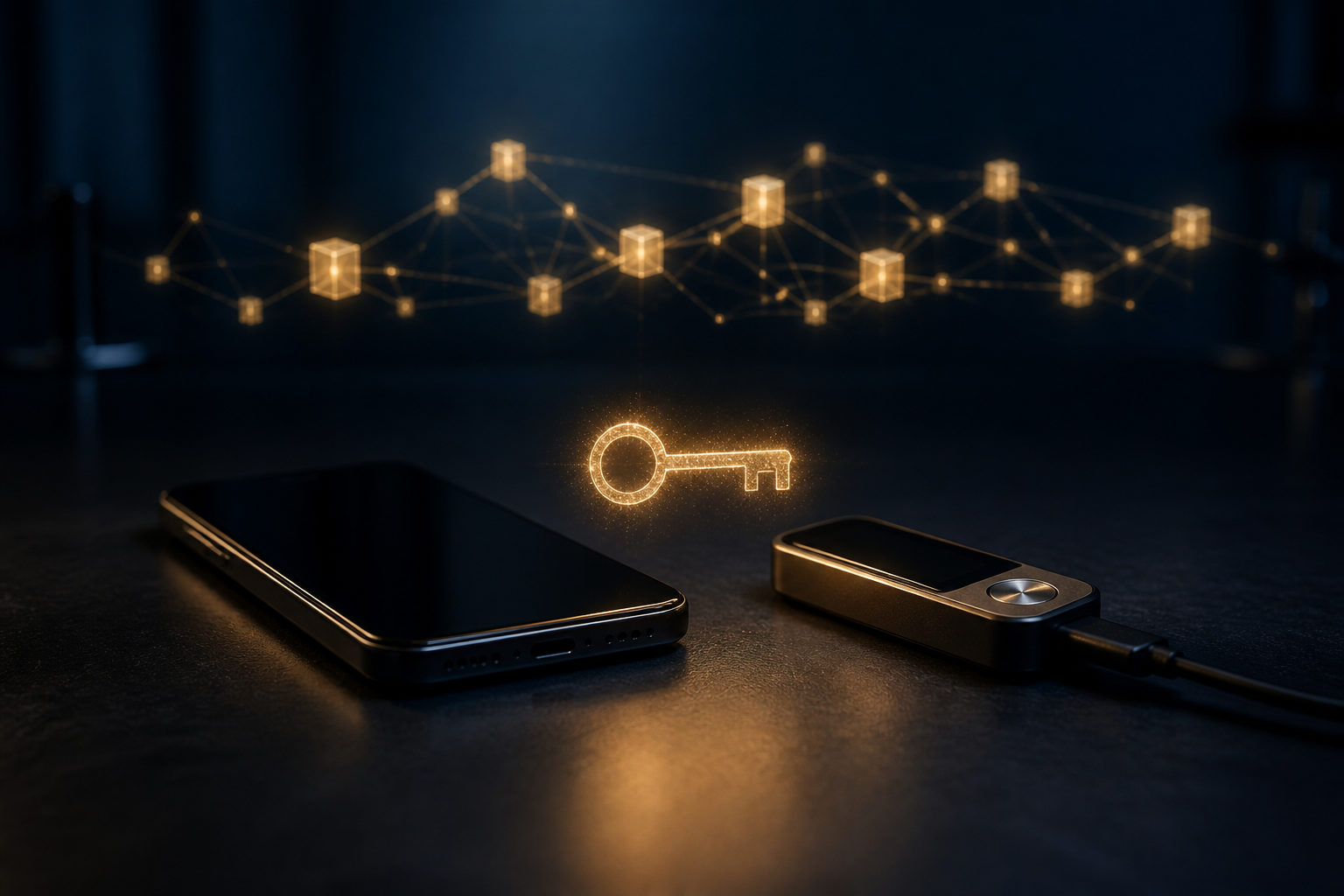
Bitcoins are not kept inside a phone, laptop, or USB drive. They exist as records on the Bitcoin blockchain, and what you actually store is the private key that lets you control those records.
Where bitcoins really exist
The shortest correct answer is simple: bitcoins are kept on the Bitcoin blockchain. That does not mean there is a physical vault or a hidden file with coins inside it. It means the network maintains a public ledger that shows which addresses can spend which amounts.
This point matters because many beginners picture Bitcoin as if it were a document saved on a device. It is not a file you drag into a folder. Ownership is tied to cryptographic control. If you can produce a valid signature with the right private key, the network accepts that you are authorized to spend the bitcoin linked to that address.
That is why your device is only an access tool. Your phone, computer, or hardware wallet does not contain the bitcoin itself. It contains the credentials used to view balances, generate addresses, and sign transactions that move funds already recorded on-chain.
| Item | What it is | What it does | What happens if it is lost |
|---|---|---|---|
| Blockchain | Public ledger | Records balances and transaction history | Your coins do not disappear because your device breaks |
| Private key | Control credential | Signs transactions | If exposed, someone else may spend your bitcoin |
| Seed phrase | Human-readable backup | Restores wallet access | If lost with no backup, recovery is usually impossible |
| Wallet app or hardware wallet | Management tool | Lets you interact with on-chain funds | Can be replaced if your backup still exists |
| Exchange account | Custodial account | Platform manages access for you | Your access depends on the platform and its rules |
What a Bitcoin wallet actually stores
A wallet stores secrets and metadata, not coins in the ordinary sense. The key material may be a private key, a seed phrase, or data derived from them. The wallet then scans the blockchain and shows which unspent outputs or address balances belong to you.
People often say, “my bitcoin is in my wallet,” because that is how it feels in day-to-day use. From a technical view, the wallet is more like a control panel. It helps you access what is already on the blockchain.
A public address is not the same thing as a private key. You can share an address to receive bitcoin. That does not give anyone the right to spend from it. Spending requires the private key, or the wallet structure built from it.
Bitcoin can also be divided into very small units. The smallest unit is 1 satoshi, equal to 0.00000001 BTC. Even at that level, the funds are still tracked on-chain, not inside a gadget.
Common places people think they keep bitcoin
In practice, people usually mean one of two things when they talk about keeping bitcoin somewhere: self-custody or third-party custody. Self-custody means you control the private keys yourself. Third-party custody means an exchange or service provider holds the keys on your behalf.
That difference is more important than the device category. A mobile wallet, desktop wallet, and hardware wallet can all be self-custody options if you control the keys. An exchange account may look similar from the user side because it shows a balance on a screen, but the legal and operational reality is very different.
| Storage method | Who controls the keys | Best fit | Main advantage | Main trade-off |
|---|---|---|---|---|
| Exchange account | The platform | Frequent traders, beginners | Convenience | Platform risk and withdrawal limits |
| Mobile wallet | You | Small everyday holdings | Quick access | Phone malware or poor backup habits |
| Desktop wallet | You | Users managing funds on a computer | Broader features | Computer security matters a lot |
| Hardware wallet | You | Longer-term holders | Key isolation | Bad backup practice can still ruin access |
| Paper or metal backup | You | Disaster recovery planning | Offline storage | Physical damage, theft, or misplacement |
If you keep bitcoin on an exchange, what you directly control is an account with the platform. The exchange manages the underlying wallet infrastructure and usually pools operational security on the back end. That can be convenient, but it also means access depends on the service remaining available and willing to process your withdrawal.
If you use self-custody, the responsibility changes. You gain direct control, but you also take on the burden of backup, recovery, and basic operational security. For some users that is the right trade. For others, it is a source of avoidable mistakes.
Why a lost device does not always mean lost bitcoin
Once you understand that the coins are on the blockchain, a lot becomes clearer. If your phone stops working, your bitcoin does not vanish from the network. If your laptop dies, the blockchain does not forget your funds. The question is whether you still have the information needed to prove control.
That information is usually the seed phrase or private key. If your wallet was properly backed up, you can often restore access on a different device. If the only copy was on the old device, recovery may fail even though the bitcoin is still sitting on-chain under the same address control conditions.
For that reason, the real risk is not “my device broke.” The real risks are key exposure and bad backups. A stolen seed phrase can be more dangerous than a stolen phone. A perfect hardware wallet with no reliable recovery plan is still fragile.
Good storage practice starts with clear separation between access tools and control credentials. A wallet app can be reinstalled. A hardware device can be replaced. Lost private key material is a different class of problem.
How the blockchain keeps the record alive
Bitcoin has worked through a public ledger model since the genesis block on 2009-01-03. New transactions are grouped into blocks, and the network targets about 10 minutes per block. That process keeps extending the ledger that records who can spend what.
The issuance schedule follows fixed rules as well. Bitcoin has a hard cap of 21,000,000 BTC, expected to be fully issued around 2140. The block reward halves every 210,000 blocks, roughly every 4 years. Halvings took place on 2012-11-28, 2016-07-09, 2020-05-11, and 2024-04-19. After the 2024 halving, the current block reward is 3.125 BTC, and daily new issuance across the network is about 450 BTC until the next halving around 2028.
Those newly issued coins are not deposited into a single machine somewhere. They appear as new on-chain records under the rules of the protocol. The same storage logic applies whether a coin was mined recently or moved many times before.
Mistakes people make when “storing” bitcoin
One common mistake is treating a screenshot, cloud note, or email draft as a proper backup. Those methods increase exposure because they place recovery data into connected environments. Another mistake is confusing an app password with true recovery material. An app password may unlock local access, but it does not replace a seed phrase.
People also overfocus on brand names and underfocus on recovery. A wallet can have a polished interface and still be a poor fit if the user does not understand where the seed phrase is, how to restore it, and what happens if the device is gone. The storage plan matters more than the packaging.
| Practice | Why it helps | What users miss |
|---|---|---|
| Write the seed phrase offline | Reduces online exposure | A single wrong word or wrong order can break recovery |
| Store backup separately from the device | Lowers the chance of one incident wiping out everything | Overcomplicating the setup can confuse the owner later |
| Test with a small amount first | Confirms address handling and wallet flow | You still need to verify the backup itself |
| Separate trading funds from long-term holdings | Limits repeated exposure of the main balance | Users sometimes send to the wrong destination during transfers |
There is no universal answer for everyone. Someone making regular trades may accept custodial exposure for speed. Someone holding for years may prefer stronger self-custody habits and slower access. The right choice depends on use case, discipline, and comfort with backup responsibility.
FAQ
Is bitcoin stored in a wallet or on the blockchain?
Technically, bitcoin is stored on the blockchain. The wallet stores the keys and data needed to interact with those on-chain records.
That is why two different devices can show the same balance after restoration. The balance comes from the chain, not from the device itself.
Can bitcoin be stored on a USB drive?
A USB drive can hold a wallet file, a private key backup, or a seed phrase record. It does not hold the bitcoin itself.
If the backup on that drive is the only copy and the drive fails, access can be lost. The coins remain on-chain, but control may be gone.
Do I really own bitcoin on an exchange?
You usually have a claim to the balance shown in your exchange account, but the platform controls the private keys. That means you are using custodial storage.
For active trading, that may be acceptable. For long-term holding, many users prefer to withdraw to a wallet they control directly.
Is a hardware wallet safer than a phone wallet?
In many cases, yes, because the private keys stay isolated in dedicated hardware. That can reduce routine exposure during signing.
Still, safety depends on the whole setup. A badly stored seed phrase can defeat the benefits of good hardware.
What happens if I lose my phone?
If your wallet was backed up with the correct seed phrase or private key, you can often restore it on another device. Losing the phone alone does not erase your bitcoin from the blockchain.
If the lost phone held the only usable copy of your recovery material, the situation becomes much more serious. Recovery planning is what decides the outcome.
Before choosing where to keep bitcoin, decide whether you need trading access or long-term control. Then check your backup method, recovery path, and who actually holds the keys; that is the practical answer behind the storage question.