
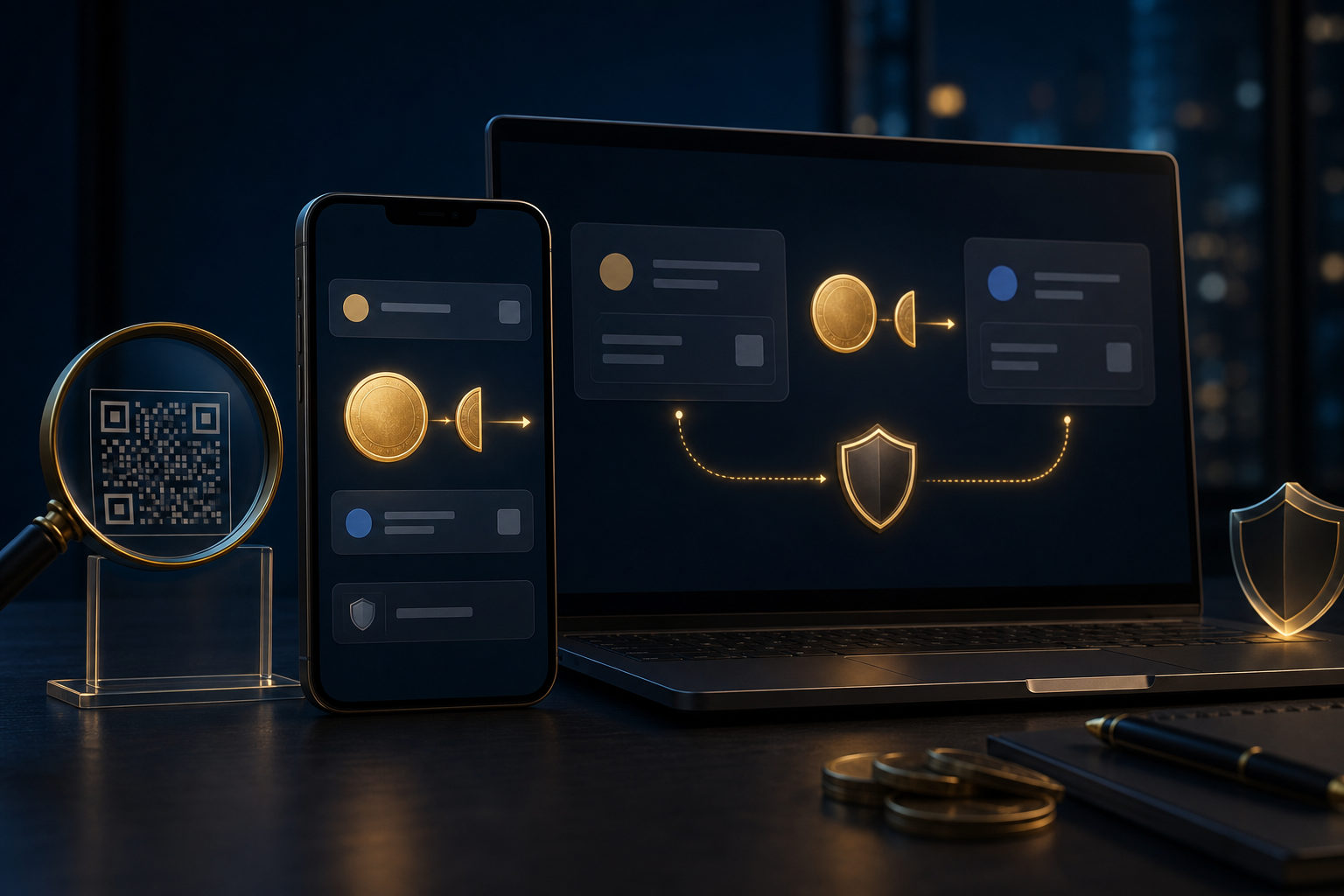
When you see a Bitcoin address shown with “0.5,” the usual meaning is simple: someone is asking for a payment of 0.5 BTC to that address. The address identifies where funds should go, while the amount describes the intended payment. They often appear together, but they are not the same thing.
What this kind of string is usually trying to say
A string like “1cyh3snskkzskgoxjw42fmqbkhxk2xgeb6 amount 0.5” often comes from a payment request, a copied wallet prompt, a chat message, or a fragment pulled from webpage code. It may look technical, yet in many cases the real message is just “send 0.5 BTC to this Bitcoin address.”
If the text also includes “href,” that often points to a web link attribute rather than anything special on the Bitcoin network itself. A site may have used a payment link that opens a wallet app with the address and amount already filled in. If that code gets copied as plain text, it can leave a messy string behind.
That matters because many people read too much into the formatting. A string can suggest a payment request without proving that any transaction has been sent, confirmed, or received. It also does not tell you who controls the address or whether the payment request is legitimate.
Address, amount, and transaction record are different things
A Bitcoin address is not a balance label
One common mistake is to assume that a number beside an address shows how much Bitcoin is currently sitting there. That is not a safe assumption. A Bitcoin address is a destination for receiving funds. To check balance, incoming transfers, or spent outputs, you need wallet data or a blockchain explorer.
So if an address appears with 0.5, that number may be the requested amount for a payment. It may also be a suggested amount set by a website, or just a note added by a person who copied the address. It is not a built-in property of the address itself.
An amount shows intent, not proof of payment
On the Bitcoin network, what counts is an actual signed and broadcast transaction that gets recorded in blocks. Writing “0.5” beside an address only tells you that 0.5 BTC is the intended amount. The sender might send a different amount, or never send anything at all.
For that reason, screenshots, chat logs, and copied strings are not enough to confirm payment. If you need to verify that funds were really sent, look for a transaction ID, wallet notice, or blockchain explorer record showing the transfer and its confirmation status.
“href” is often just leftover webpage code
Many users search odd strings because they copied them from a page and are trying to understand what they mean. In web pages, “href” is commonly used for links. A merchant or website may create a Bitcoin payment link that opens a wallet with an address and amount prefilled.
That setup can be convenient, but it should not be treated as trust by default. A webpage can suggest a destination and amount, yet the final decision still happens in your wallet when you review and approve the transaction.
If you plan to send 0.5 BTC, what should you check first?
Bitcoin transfers are generally irreversible. If you send funds to the wrong address, recovery is often difficult or impossible. So the key task is not decoding the string perfectly. The real task is checking the payment details with care before you approve anything.
Make sure the address is complete and from a trusted source
Do not verify only the first and last few characters. Copy errors, message truncation, OCR mistakes from screenshots, and clipboard malware can all lead to the wrong destination. Before sending, confirm that you have the full Bitcoin address and that it came from a source you trust.
If you copied the address on a device you do not fully trust, check it again after pasting it into your wallet. Clipboard replacement malware is a known risk. The address can change between copy and send without an obvious warning.
Check the unit carefully
The “0.5” in a request usually means 0.5 BTC, but users should still confirm how the wallet displays units. Bitcoin can be divided into smaller units, and 1 satoshi is one hundred millionth of 1 BTC. If a wallet, payment tool, or exchange withdrawal page is set to a different display mode, entering the same number can lead to a very different result from what you intended.
This becomes more important when moving between different apps. Never assume all interfaces use the same default display. Read the unit label before you approve the transfer.
Confirm that the recipient wants an on-chain Bitcoin payment
A Bitcoin address usually points to an on-chain payment, but the wider payment flow may still be confusing. Some platforms combine internal transfers, withdrawal requests, and blockchain payments in one interface. A new user can easily mix them up.
If you are buying from a stranger, paying an informal seller, or sending funds after a social media conversation, take extra care. A valid-looking address does not make the overall transaction safe.
Use a small test payment first
When the intended transfer is meaningful to you, a small test transaction is often a sensible step. If the test arrives as expected, you can proceed with better confidence. It does not remove every risk, but it can catch address mistakes, process confusion, and communication errors before the full amount is sent.
After the test, review the final payment again. The address and amount in the main transaction should match the verified details exactly.
What does 0.5 BTC actually represent?
0.5 BTC means half of one bitcoin. Bitcoin has a supply cap of 21 million coins, and its smallest unit is the satoshi, where 1 satoshi equals one hundred millionth of 1 BTC. That makes Bitcoin divisible enough for both large transfers and small denominations.
People also ask what 0.5 BTC is worth in cash terms. Without live market data, there is no fixed number to give. The price of Bitcoin changes with market activity. If you need the current value, check a major exchange, a market data site, or a wallet app that shows live quotes, then account for fees as well.
Another point that causes confusion: seeing “0.5 BTC” in a request does not guarantee that the receiver will display that exact amount as final settled funds at every stage. Wallets and services can present pending transactions, incoming notices, and fee effects differently. The cleanest check is the actual on-chain transaction record.
Common mistakes and security warnings
- Mistake one: assuming that “0.5” beside an address means the address balance is 0.5 BTC.
- Mistake two: assuming that a clickable payment link is automatically safe.
- Mistake three: treating a screenshot as proof that payment was completed.
- Mistake four: rushing because the amount feels urgent, instead of verifying the details.
These mistakes often show up in scams. Fraud does not always look obviously fake. A bad actor may present a realistic payment string, a copied address, and a neat amount to make the request feel routine. That is why review matters more than appearances.
It is also important to separate public receiving information from private wallet secrets. A Bitcoin address can be shared for receiving funds. A private key or seed phrase must never be shared. Anyone asking for those details under the excuse of support, verification, or manual release of funds should be treated as unsafe.
FAQ
Does 0.5 beside a Bitcoin address mean that address holds half a bitcoin?
Usually no. In most cases, it means someone wants a payment of 0.5 BTC sent to that address. To check whether the address has received funds, use a wallet record or a blockchain explorer.
Can I send funds right away if I see an address and an amount together?
You should verify the source first. Confirm the full address, make sure the unit is BTC, and check that the payment request is genuine. For a meaningful transfer, a small test payment is often a smart first step.
If the text includes “href,” does that mean the transaction already exists?
No. It often means the text came from a webpage payment link. A real Bitcoin transaction exists only after it has been signed, broadcast, and recorded by the network.
How can I find what 0.5 BTC is worth right now?
You need live market pricing for that. Check a major exchange, a market data platform, or a wallet app with current quotes. Do not rely on an old screenshot or a fixed number copied from somewhere else.
Why does the address I pasted look different in my wallet?
Stop before sending. It could be formatting, a copy error, or clipboard malware replacing the address. Go back to the original source, verify the full string again, and use another device if anything feels off.
If you are dealing with a Bitcoin address shown with 0.5, the safest practical routine is straightforward: verify the full address, confirm the unit, and send a small test first. Those three checks prevent many costly errors.