
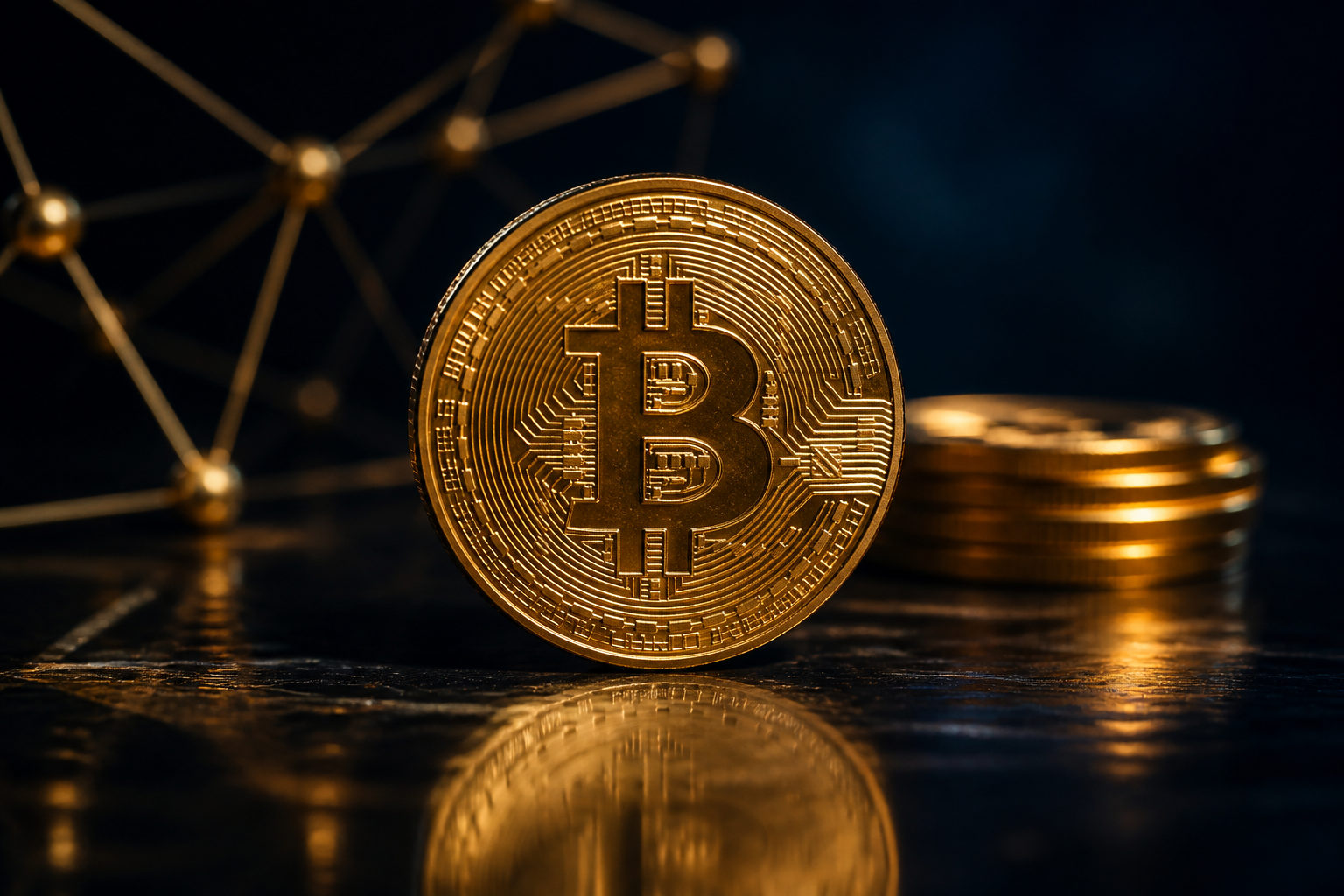
Where do bitcoins get their value? The short answer is that Bitcoin draws value from scarce supply, market demand, network reliability, and its usefulness as a transferable digital asset.
Bitcoin's value starts with rules people can verify
Many people first approach Bitcoin by asking why something without a physical form can be worth anything at all. That sounds like a challenge to Bitcoin, but it is also a broader question about money and assets. Plenty of things hold value because people can identify them, exchange them, and trust that others will accept them later.
Bitcoin fits that pattern in its own way. Its supply rules are public, and the total limit is 21 million coins. That does not guarantee value by itself. Scarcity only matters if there is demand. Still, a fixed upper bound gives the market something rare in finance: a supply schedule that participants can inspect rather than guess.
That predictability is a major part of the story. If an asset can be created at will, holders face ongoing uncertainty about dilution. Bitcoin removes much of that concern at the protocol level, so the market debate shifts toward demand, utility, and trust in the system.
The main sources of Bitcoin's value
| Factor | How it supports value | What to examine |
|---|---|---|
| Scarcity | Supply is capped and issuance follows known rules | Whether the supply framework is credible |
| Market demand | Buyers and sellers give the asset liquidity and price discovery | Trading activity and willingness to hold |
| Network security | A hard-to-alter ledger increases trust in ownership records | System stability and decentralization |
| Transferability | Value can move across borders and between users | Custody options and transaction usability |
| Portability and divisibility | It can be held in small units and moved digitally | Whether it works for small and large holdings |
| Regulatory environment | Access conditions shape adoption and trading convenience | Account rules, reporting duties, and market access |
Demand is the first practical layer. Bitcoin has no issuer promising redemption, and it does not produce cash flow like a business. Its value therefore depends heavily on whether people want exposure to it, want to trade it, or want to hold it over time. If enough participants see Bitcoin as useful or desirable, a market price can form and persist.
Security is the next layer. Bitcoin runs on a distributed blockchain, with records maintained by a network rather than a single administrator. For most readers, the technical takeaway is simple: if ownership records are difficult to tamper with and no single party can rewrite balances at will, confidence in the asset rises. Confidence is not the same thing as price, but it is one of the foundations that allow price to exist.
Transferability also matters more than new users often expect. Bitcoin can be moved digitally, and its smallest unit is 1 satoshi, or one hundred millionth of a BTC. That divisibility means it does not need to be used in whole-coin amounts. The combination of divisibility, portability, and direct custody gives Bitcoin a set of properties that some users find valuable even before they form an opinion on price direction.
Access channels shape how people experience Bitcoin's value
Two people can both say they “own Bitcoin” while facing very different risks. One may hold it through a trading platform account. Another may move it into a self-custody wallet. A third may only buy a financial product linked to Bitcoin's performance. These are not small distinctions, because the channel affects control, convenience, and the kind of risk being taken.
| Access channel | Typical use case | Main advantage | Main risk |
|---|---|---|---|
| Platform account | Frequent buying and selling | Convenience and often better on-screen liquidity | Counterparty risk, withdrawal rules, account restrictions |
| Self-custody wallet | Direct control over holdings | User controls the private keys | User bears backup and operational risk |
| Indirect financial product | Exposure through a traditional brokerage setup | No need to manage on-chain custody directly | Product structure risk and possible lack of coin withdrawal |
This is where many debates get muddled. Some critics are really reacting to platform failures, account freezes, or poor user experience. Others are assessing Bitcoin itself as a network and asset. Those are related topics, but they are not identical. A bad custody choice does not prove Bitcoin has no value, just as a smooth trading app does not prove the asset is sound.
The brief for this article emphasizes trade-offs across channel types, and that is the right lens. Bitcoin's market value may be quoted on a screen, but the way a person accesses it changes what “value” feels like in practice. Convenience can come with dependency on an intermediary. Direct control can come with a higher burden of responsibility. Indirect exposure can fit some investors while failing to deliver actual access to the asset itself.
Why some people see strong value while others remain unconvinced
Supporters usually focus on a few points. They like that Bitcoin's monetary rules are transparent. They value the option to hold an asset outside a single institution's control. They also see cross-border transferability as useful, even if they do not use Bitcoin for day-to-day purchases. In their view, Bitcoin's value comes from a mix of scarcity, independence, and market acceptance.
Skeptics focus on a different set of facts. Price volatility can weaken Bitcoin's appeal as a stable unit for everyday transactions. The learning curve is real as well. Wallet setup, private key management, and transaction handling are not effortless for beginners. Regulation can add friction too, especially when account access, reporting duties, or product availability change by jurisdiction.
Both sides are reacting to genuine features of the asset. Bitcoin does not need universal agreement to have value. It only needs a large enough market of participants who continue to buy, sell, hold, secure, and transfer it under known rules. That is often how market value works in practice: not unanimous belief, but persistent participation.
How to judge whether Bitcoin's value thesis is actually durable
A useful way to assess Bitcoin is to break the big question into smaller ones. Is the supply rule transparent? Can users move the asset without relying on a single gatekeeper? Is there enough liquidity for entry and exit? Does the custody method match the user's skill and risk tolerance? These are more informative than asking whether the latest price move proves anything.
| Question to ask | Why it matters | Common mistake |
|---|---|---|
| Are the supply rules clear? | Scarcity only matters if the market trusts the limit | Assuming scarcity from marketing language alone |
| Can the asset be transferred freely? | Real utility depends on actual mobility | Treating internal platform balances as the full story |
| Is there meaningful liquidity? | Value is easier to trust when entering and exiting is possible | Looking only at headline price quotes |
| Who controls custody? | Risk changes depending on whether the user or an intermediary holds the keys | Thinking purchase and secure ownership are the same step |
| What access rules apply? | Regulatory conditions shape practical usability | Ignoring account, reporting, or withdrawal friction |
It also helps to separate value from price. Price can swing on sentiment, positioning, and news flow. Value is the deeper question of whether the asset still offers a mix of scarcity, security, transferability, and demand that people care about. Short-term moves can be loud. They do not settle the long-term case on their own.
Bitcoin also goes through supply changes on a known schedule. The block subsidy halves about every 4 years, or every 210,000 blocks, and past halving years include 2012, 2016, 2020, and 2024. Market participants watch that schedule because it affects new supply, though it does not mechanically dictate future price direction.
FAQ
Why does Bitcoin have value if it is not backed by a physical commodity?
Value does not have to come from a physical object. Bitcoin combines verifiable scarcity, transferable ownership, and ongoing market demand, which together can support a price even without commodity backing.
Is Bitcoin's value based only on belief?
Belief matters, but it is not empty belief. It rests on a functioning network, records that are difficult to alter, and a market where participants keep trading and holding the asset.
Does Bitcoin's fixed supply automatically make it valuable?
No. Scarcity is only one part of the picture. An asset can be scarce and still fail if there is little demand or if users do not trust the system that tracks ownership.
Does holding Bitcoin on a platform mean I truly control it?
Not always. If the platform controls withdrawal conditions and custody, your access depends on that intermediary. Direct control is stronger when you can move holdings to a wallet you manage yourself.
How should I check Bitcoin's live price if this article gives no number?
Use major market data sites or regulated trading services that display real-time quotes. When you check the price, also compare bid-ask spread, withdrawal terms, and market depth instead of staring at one headline figure.
If you want to decide whether Bitcoin is worth studying further, start by identifying your real goal: easy trading, long-term holding, or direct control over the asset. That choice will tell you which risks matter most and which source of value matters most to you.
Disclaimer: This article is for informational and educational purposes only and is not investment, financial, or legal advice. Crypto assets are highly volatile and you could lose your entire investment. Do your own research and decide carefully.