
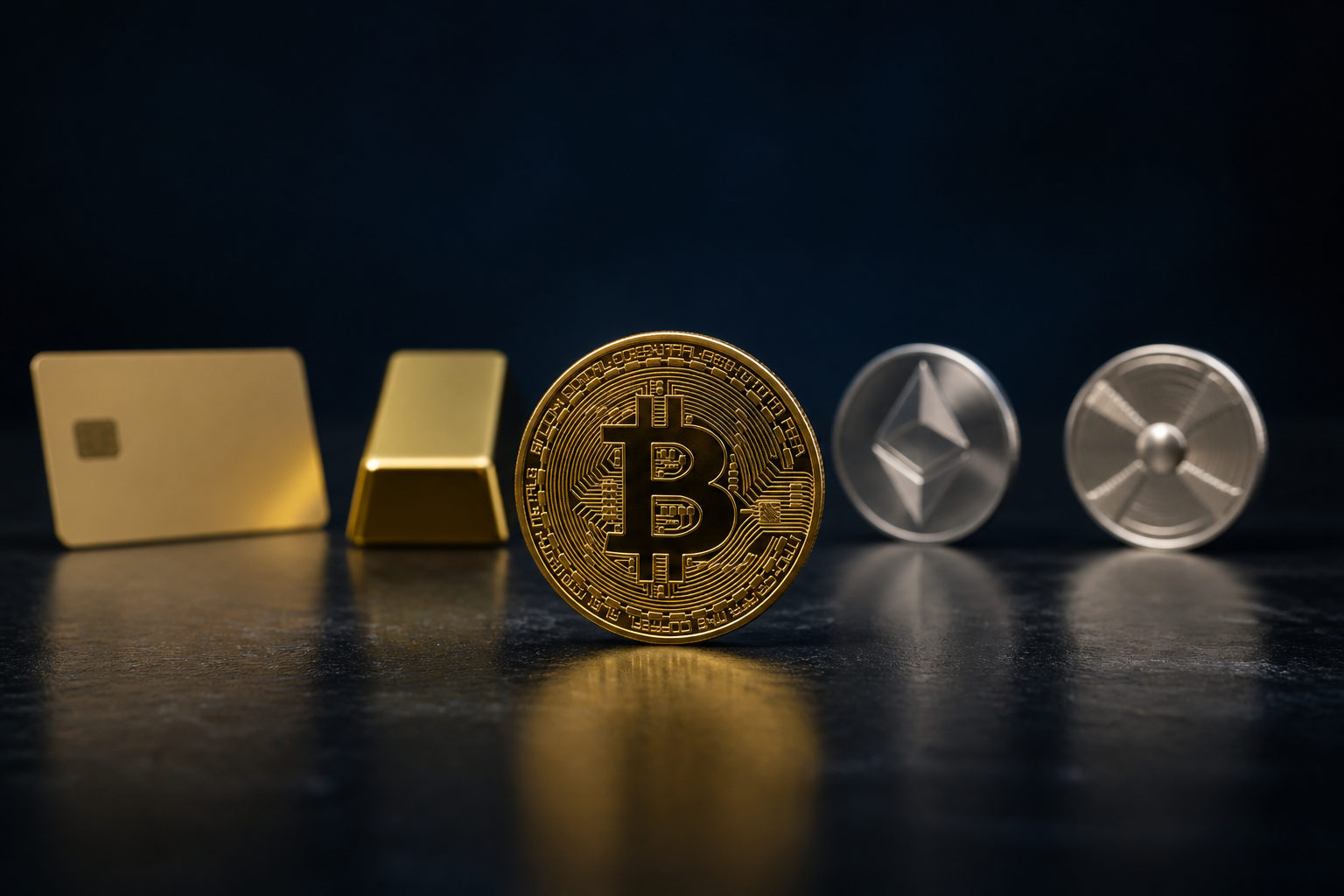
Bitcoin’s competition depends on what you think Bitcoin is for. If you see it as money, it competes with payment systems; if you see it as a store of value, it competes with gold, cash, and other scarce assets; if you see it as a blockchain network, it competes with other crypto networks.
Start with the boundary: competition changes by use case
Beginners often hear “Bitcoin competitors” and assume the answer is simply “other cryptocurrencies.” That is only part of the picture. Bitcoin is a digital asset, a peer-to-peer cash system, and a settlement network, so it can be compared with very different tools depending on the job people expect it to do.
Someone looking for everyday payments may compare Bitcoin with stablecoins, bank transfers, or card networks. Someone building a long-term portfolio may compare it with gold or cash holdings. Someone focused on moving value on-chain may look at other blockchains that offer different trade-offs in usability, programmability, or network design.
| How Bitcoin is being used | Main competing category | What users compare |
|---|---|---|
| Long-term holding | Gold, cash, scarce assets | Store-of-value logic, volatility, custody |
| Payments and transfers | Bank rails, payment networks, stablecoins | Convenience, price stability, ease of use |
| On-chain settlement | Other blockchain networks | Security, decentralization, available features |
| Portfolio allocation | Crypto assets and traditional assets | Liquidity, market conviction, risk profile |
The main groups Bitcoin competes with
Other cryptocurrencies
This is the most obvious category. Many crypto assets compete with Bitcoin for capital, attention, and belief. Some are promoted as faster to use. Some focus on smart contracts or broader application layers. Some aim to serve niche functions inside crypto markets.
Still, “other crypto” is too wide to treat as one direct rival. Bitcoin has a narrower and more stable identity than many networks. Its supporters often value the fixed supply cap of 2100万枚, the long-running network, and a rules-first design. Other coins may focus on feature expansion, experimentation, or application growth. That means overlap exists, but it is not complete.
Stablecoins and payment systems
In payment discussions, Bitcoin often faces stronger competition from tools that are easier to price in and easier to explain to ordinary users. Stablecoins are a clear example. If the goal is to send value without large short-term price swings, many people will view a stablecoin as a simpler fit.
Traditional payment systems are part of the same picture. Most users do not wake up wanting “decentralized settlement” in the abstract. They want to pay, get paid, or move funds with as little friction as possible. In that setting, Bitcoin competes with whatever already feels familiar and predictable.
Gold, cash, and other stores of value
When Bitcoin is framed as “digital gold,” the competition shifts again. It is then compared with gold, cash balances, and sometimes other assets used for defensive positioning. The appeal of Bitcoin in this frame comes from traits such as a public monetary rule, a supply cap, divisibility down to 1 聪 = 一亿分之一 BTC, and the ability to hold it directly.
The counterargument is also easy to see. Gold has a long social history as a store of value. Cash is familiar and simple. Bitcoin, by contrast, is known for sharp price swings and strong disagreement about valuation. So the competition here is about who earns the role of preserving purchasing power in the eyes of different users.
| Competing category | Why people compare it with Bitcoin | Bitcoin’s relative strength | Common concern |
|---|---|---|---|
| Other cryptocurrencies | They are all tradable crypto assets | Clear monetary rules, strong market identity | Narrower feature set |
| Stablecoins | They also move value on-chain | Fixed supply policy, stronger decentralization story | Higher price volatility |
| Payment networks | They solve payment and transfer needs | No reliance on one settlement operator | More learning required |
| Gold and cash | They can serve as stores of value | Portable, divisible, digitally transferable | Large price swings, mixed public acceptance |
Common misunderstandings about “Bitcoin competition”
One mistake is to ask which coin will “beat Bitcoin” as if there must be a single winner. That framing hides the real issue. Competition is split by function. A network may be better for applications. A stablecoin may be easier for pricing and payment. Gold may feel safer to a conservative saver. None of those points settles every use case at once.
Another mistake is to assume that more features automatically mean stronger competition. With Bitcoin, many holders care about restraint. A system that changes slowly can be attractive when people want predictable rules. In that sense, rapid feature expansion and strong competition are not the same thing.
A third mistake is to confuse market noise with substitution. A project can attract attention without taking over Bitcoin’s role in long-term saving, censorship-resistant transfer, or monetary credibility. Real competition matters when users are willing to switch behavior, not only when they switch headlines.
A simple way to judge whether something is a Bitcoin competitor
First, ask whether it serves the same need. If two tools are trying to solve the same user problem, there is competition. If your goal is storing value, then Bitcoin, gold, and cash belong in the same comparison set. If your goal is sending value with little short-term volatility, stablecoins belong there too.
Second, ask where trust comes from. Bitcoin depends on open rules and a distributed network. Bank balances depend on financial institutions. Stablecoins often involve an issuer model and reserve structure. People compare these options through the kind of trust they are comfortable relying on.
Third, ask how hard it is to switch. Even a tool with strong theory can lose on habit. If users must learn wallets, keys, tax treatment, or new payment behavior, many will stay with what they know. Competition in money is never only technical. It is also practical and psychological.
| Question to ask | What it helps you identify | Why it matters |
|---|---|---|
| What need am I trying to solve? | The right category of competitor | Different needs produce different rivals |
| What kind of trust am I accepting? | Whether the substitute really fits | Trust model shapes user choice |
| How costly is the switch? | Whether competition is realistic | Adoption depends on behavior, not theory alone |
FAQ
Is Bitcoin mainly competing with other cryptocurrencies?
Only in some contexts. For long-term holding, gold and cash can be closer comparisons; for payments, stablecoins and existing payment rails may be the more direct alternatives.
Are stablecoins part of Bitcoin’s competition?
Yes, especially for transfers and payments. They appeal to users who care more about price stability and simple accounting than about Bitcoin’s monetary design.
Why is gold often mentioned as a Bitcoin competitor?
Because both can be discussed as stores of value. People comparing them usually care about scarcity, custody, portability, and how much volatility they are willing to accept.
Does a more advanced blockchain automatically replace Bitcoin?
No. A richer feature set can make another network better for specific tasks, but Bitcoin’s role is tied to monetary rules, market conviction, and long-term credibility, not only feature breadth.
How should a beginner think about Bitcoin versus other crypto assets?
Start with purpose, not branding. If you know whether you are evaluating payment utility, long-term saving, or blockchain applications, it becomes much easier to see which alternatives are true competitors and which ones are solving a different problem.
If you want a practical test, write down the exact job you expect Bitcoin to do. Then compare it only with tools that fight for that same job, the same user trust, or the same pool of capital. That is the clearest way to understand Bitcoin’s competition without getting lost in coin lists.
Disclaimer: This article is for informational and educational purposes only and is not investment, financial, or legal advice. Crypto assets are highly volatile and you could lose your entire investment. Do your own research and decide carefully.