
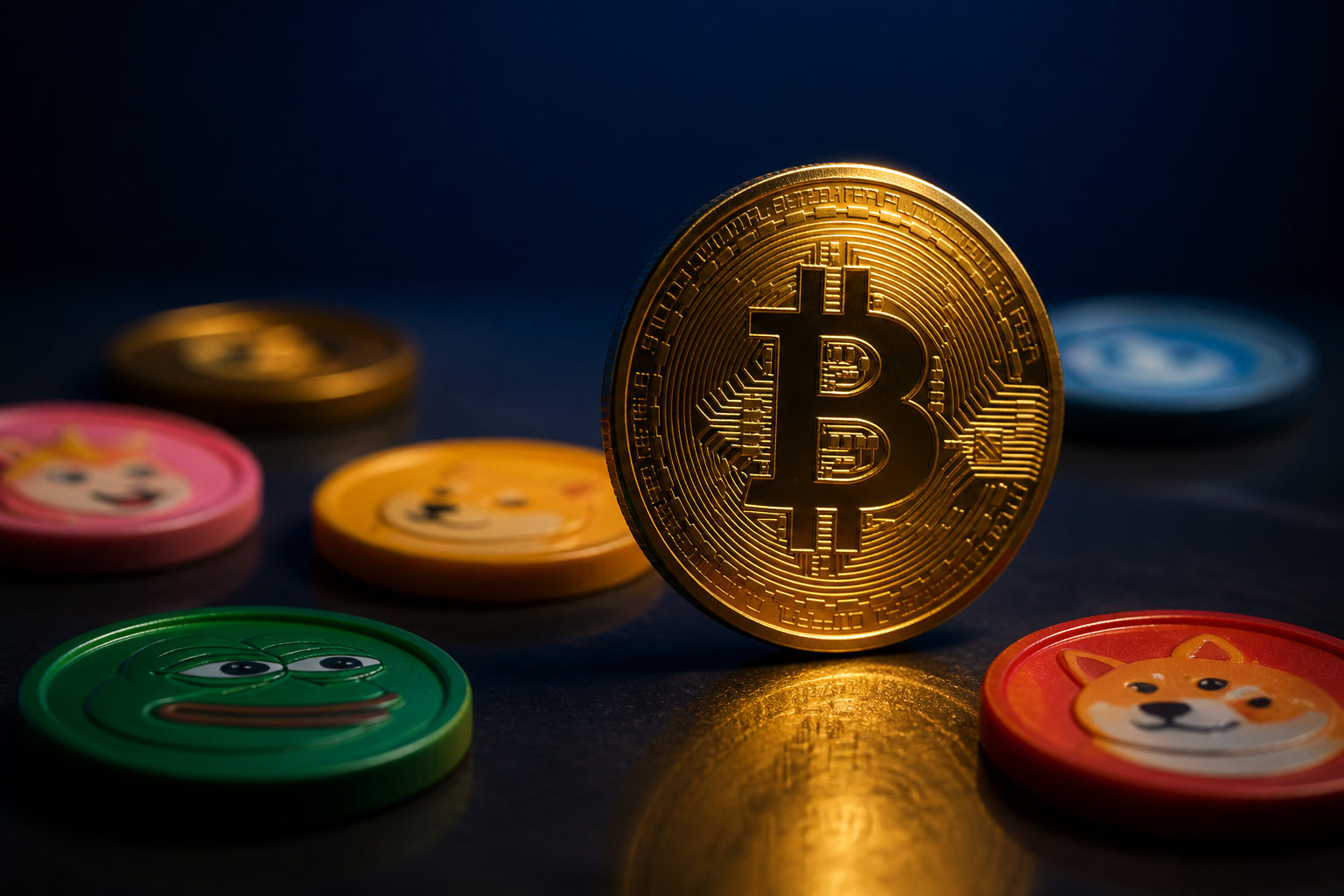
Bitcoin is generally not a meme coin. It has a defined monetary design, a working network, and a long-running thesis that goes well beyond internet jokes or short bursts of attention.
Why people ask whether Bitcoin is a meme coin
The question makes sense on the surface. Bitcoin trades in the same broad market as meme coins, its price can move sharply, and social platforms often turn it into a cultural symbol. Someone who is new to crypto may see excitement, volatility, and nonstop online commentary and assume the whole category works the same way.
That shortcut misses the reason an asset exists. Meme coins usually gain traction from internet culture, community humor, celebrity associations, or a fast-moving social narrative. Bitcoin came into the world with a different purpose. Its white paper, Bitcoin: A Peer-to-Peer Electronic Cash System, was published in 2008, and the genesis block appeared in January 2009. From the start, the project was framed as a decentralized form of electronic cash, not as a token built around a joke.
Confusion also grows because Bitcoin itself has become a meme in the broader sense of the word. People use slogans, images, and online shorthand when they talk about it. That does not turn Bitcoin into a meme coin any more than a popular stock becomes one just because people post jokes about it.
What actually defines a meme coin
The useful test is not whether a coin is popular. The better test is what sustains attention over time. If a token depends mainly on virality, character branding, and community excitement, and if its identity is hard to separate from that social energy, it fits the meme coin label more closely.
Bitcoin has a very different foundation. Its supply is capped at 21 million coins. Its smallest unit is 1 satoshi, which equals one hundred millionth of a BTC. New issuance follows transparent rules, with a new block produced about every 10 minutes and a halving about every 4 years, or every 210,000 blocks. Those features give users and investors a framework for thinking about scarcity, issuance, and network security.
Meme coins may also have supply rules and active communities, but the center of gravity is often elsewhere. The main conversation is frequently about whether the trend can keep spreading, whether community momentum can hold, or whether online attention can be refreshed. With Bitcoin, even critics usually focus on different questions: censorship resistance, self-custody, settlement, monetary credibility, and long-term demand.
This distinction matters because market behavior can look similar while the underlying driver is not. Two assets can both rise and fall quickly, yet one may be reacting to a shifting macro view of digital scarcity while the other is reacting to a wave of social enthusiasm that can vanish just as fast.
Where Bitcoin and meme coins differ in practice
Bitcoin is often discussed as a bearer asset and as a payment network. People use it to think about self-custody, borderless transfer, and an alternative system that does not rely on a central issuer. There are disagreements about how well it performs each role, but the roles themselves are clear.
Meme coins usually live closer to entertainment, identity, and speculation. Their communities can be energetic and creative, and that energy can have market value for a while. The weakness is that the story can become fragile if it rests on attention alone. When the joke loses force, the token may lose its main engine of demand.
Bitcoin still carries real risk. Its price can suffer deep drawdowns. On-chain transfers are generally irreversible. Users who mishandle wallet backups or private keys can lose access permanently. Regulatory treatment, exchange failures, tax obligations, and simple user mistakes also shape outcomes. Calling Bitcoin a non-meme asset should never be confused with calling it safe.
The difference is in the structure of those risks. With Bitcoin, debate tends to center on adoption, valuation, monetary use, technical tradeoffs, and policy pressure. With meme coins, the biggest unknown is often whether the community story can stay alive. Sentiment affects both, but it does not play the same role in each case.
Why some critics still use the meme label for Bitcoin
Part of the criticism comes from valuation. Bitcoin does not fit neatly into old models used for operating companies, and it does not produce cash flow in the traditional equity sense. Because of that, some observers reduce it to a belief-driven asset and stop there. They are picking up on something real: expectations and narrative do matter in Bitcoin markets.
That observation still does not settle the classification. Many assets rely on collective acceptance, including money itself, precious metals, and collectibles. Consensus is not a special feature of meme coins. What makes Bitcoin different is that its scarcity rules, issuance schedule, and verification process are embedded in an open network that anyone can inspect and participate in.
Another reason the meme label sticks is rhetorical convenience. It is easier to dismiss a complex asset by grouping it with the loudest and most speculative corners of crypto. That move hides the questions that actually matter. When you evaluate Bitcoin, the serious issues are whether its monetary policy remains credible, whether the network continues to function as designed, and whether people keep finding reasons to hold or use it beyond a social trend.
There is also a social angle. Bitcoin has a strong online culture, and some of its supporters communicate in ways that can look tribal, theatrical, or exaggerated. Outsiders may mistake the culture around the asset for the asset itself. A noisy fan base can distort perception, but it does not rewrite the underlying mechanics.
FAQ
How is Bitcoin usually classified if not as a meme coin?
It is commonly described as a decentralized digital currency or a scarce digital asset. Different users emphasize different functions, but it is not usually treated as a textbook meme coin.
If Bitcoin is so volatile, why doesn’t that make it a meme coin?
Volatility describes price behavior, not the full nature of an asset. Classification depends more on design, purpose, supply rules, and the reasons people keep paying attention to it.
Do Bitcoin and meme coins both depend on belief?
Yes, but in different ways. Bitcoin depends on belief in its rules, network security, scarcity, and usefulness, while meme coins are more likely to depend on cultural momentum and social buzz.
Can Bitcoin ever trade like a meme coin?
For short periods, parts of the market can treat almost any asset as a momentum trade. That does not erase the longer-term distinction between an asset with a monetary thesis and one driven mostly by internet virality.
How can I judge a new token without getting fooled by hype?
Look for a clear purpose, transparent supply rules, and a real network role. If the conversation is almost entirely about jokes, mascots, and excitement, the token deserves extra caution.
What to check before you form your own view
Start with the project’s reason for existing. If you cannot explain what problem the network is trying to solve without repeating marketing slogans, classification becomes easier. A token built on attention alone deserves to be treated very differently from one built around an operating monetary system.
Then check how supply works and whether that process is transparent. Bitcoin’s rules are public and widely discussed, which gives market participants a basis for independent judgment. In weaker projects, the story can dominate because the structure underneath it is thin.
Finally, match the asset to your own goal. If you are considering Bitcoin as a long-term holding, focus on custody, wallet backups, platform risk, and your tolerance for volatility. If you are trading short-term, be honest that you are dealing with a fast market where sentiment can overwhelm analysis for stretches of time. That distinction matters more than any label.
Disclaimer: This article is for informational and educational purposes only and is not investment, financial, or legal advice. Crypto assets are highly volatile and you could lose your entire investment. Do your own research and decide carefully.