
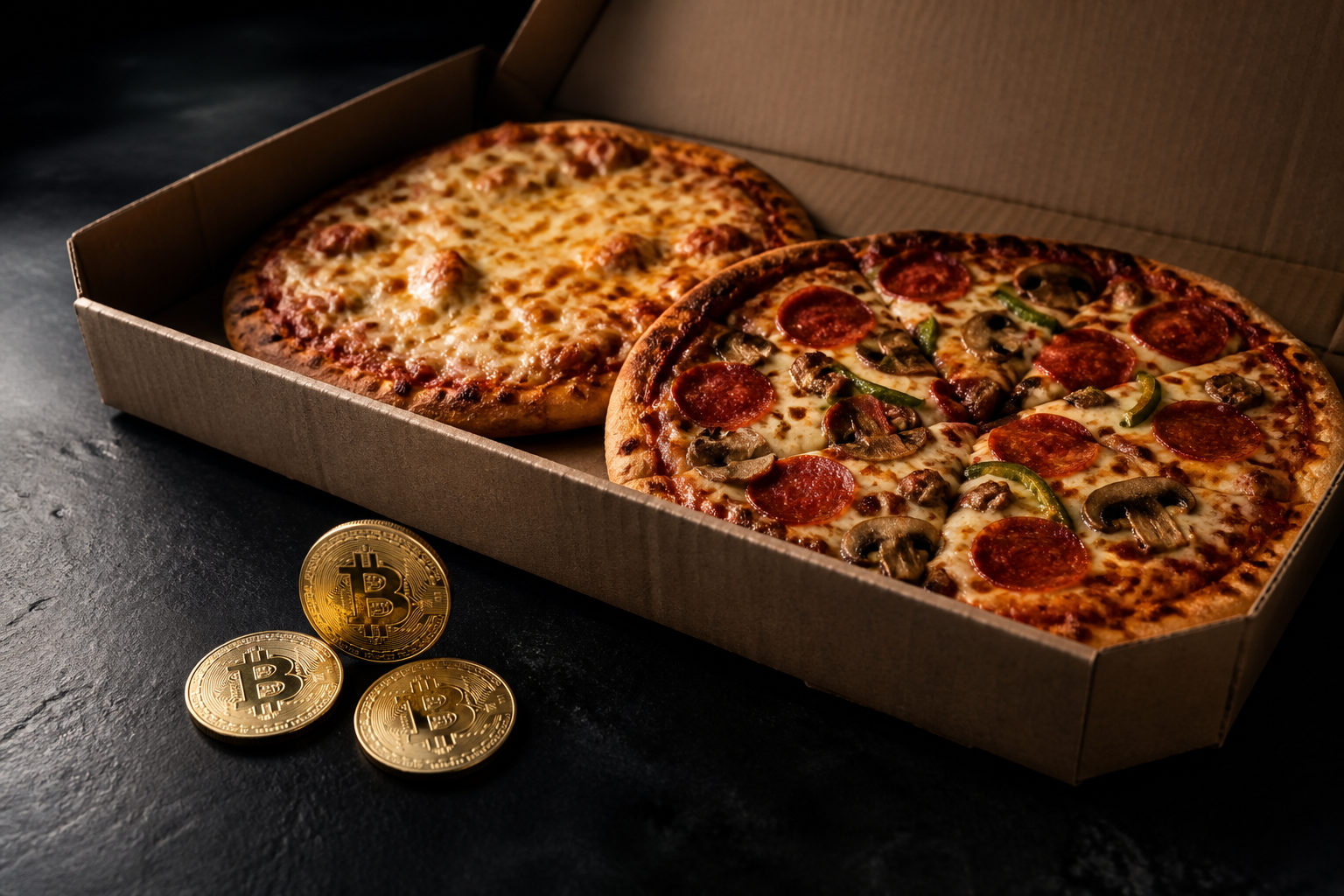
“Pizza Bitcoin” usually refers to Bitcoin Pizza Day, the record of 10,000 BTC being used to buy two pizzas on May 22, 2010. The story matters because it showed, in a simple real-world example, that Bitcoin could function as a medium of exchange rather than only a technical experiment.
What “pizza bitcoin” actually means
People who search for “a pizza bitcoin” are often trying to understand the famous pizza transaction, not asking for a fixed exchange rate between pizza and BTC. The accepted account is that Laszlo Hanyecz obtained two pizzas for 10,000 BTC on May 22, 2010, and that date is now widely known as Bitcoin Pizza Day.
This event is commonly described as the first well-known recorded purchase of a physical item with Bitcoin. That is why it stays relevant in beginner education. It gives a concrete example of Bitcoin leaving the stage of code, forums, and theory and entering an actual buying situation that anyone can picture.
Why two pizzas became a lasting Bitcoin symbol
Every money system needs some point where people accept it for goods or services. Bitcoin had already been introduced through the white paper, Bitcoin: A Peer-to-Peer Electronic Cash System, published by Satoshi Nakamoto on October 31, 2008, and the genesis block arrived on January 3, 2009. Still, technical creation and economic use are different steps. The pizza purchase became famous because it made that second step visible.
Many retellings focus on hindsight and ask whether spending 10,000 BTC was a mistake. That question is emotionally powerful, but it can distract from the practical lesson. Without early users willing to spend bitcoin, accept bitcoin, and discuss what goods were worth in BTC terms, price discovery would have had far less grounding in real exchange.
| Question | What the pizza purchase showed |
|---|---|
| Could Bitcoin buy a real item? | Yes, at least one documented transaction showed someone accepted it for goods. |
| Why is this date remembered? | It turned an abstract network into a story ordinary readers could understand at once. |
| What did it add to Bitcoin's early history? | It gave the market a visible example of value being negotiated through trade. |
What this story teaches about Bitcoin itself
The pizza story is useful because it explains several core Bitcoin ideas without relying on jargon. First, Bitcoin is transferable between users. Second, it is divisible: the smallest unit is 1 satoshi, equal to 0.00000001 BTC, so payments do not require a whole coin. Third, Bitcoin operates under a fixed supply framework, with a hard cap of 21,000,000 BTC expected to be fully issued around 2140.
The story also helps answer a modern question: how much bitcoin should one pizza cost today? There is no permanent answer. Bitcoin does not have an official fixed price, and a pizza seller does not follow a universal BTC menu. The amount of bitcoin needed for a purchase depends on the live market price, the merchant's pricing method, and when the payment is settled.
It also makes sense to place the pizza purchase inside Bitcoin's broader issuance rules. The network targets roughly one block every 10 minutes. The block subsidy halves every 210,000 blocks, which is about every four years. The halvings already took place on 2012-11-28, 2016-07-09, 2020-05-11, and 2024-04-19. After the 2024 halving, the current block reward is 3.125 BTC, and the next halving is expected around 2028. Those rules do not explain pizza culture by themselves, but they do shape how users think about spending, saving, and supply over time.
What people often get wrong about Pizza Day
A common mistake is to treat the event as nothing more than a cautionary tale about spending too early. That view is too narrow. The lasting lesson is that new forms of money need real transactions before they can develop broad trust, better pricing, and wider recognition.
Another confusion is to assume that one famous purchase proves Bitcoin is best understood only as payment money. The pizza story shows that Bitcoin can be used in payment. It does not settle the separate question of whether users prefer to spend it often, hold it for longer periods, or move it for other reasons. Merchant acceptance, settlement methods, and user preferences all affect that answer.
| Common misunderstanding | Better way to read the story |
|---|---|
| The event means Bitcoin's main purpose is buying food. | It showed Bitcoin could buy goods; it did not limit Bitcoin to that role. |
| 10,000 BTC proves Bitcoin was simply “cheap” then. | It points more clearly to an early market still forming its own value references. |
| Repeating the same act today carries the same historical meaning. | The original importance came from timing and novelty, not from pizza itself. |
FAQ
When is Bitcoin Pizza Day?
Bitcoin Pizza Day is observed on May 22 each year. It marks the 2010 transaction in which Laszlo Hanyecz used 10,000 BTC to get two pizzas.
Why do people care so much about this purchase?
Because it is easy to understand and easy to remember. A real food purchase says more to most readers than a technical description of peer-to-peer digital cash.
Can you still buy pizza with Bitcoin now?
In some cases, yes, if a merchant or payment processor accepts it. The amount of BTC required is not fixed and must be calculated from the live market price and the seller's checkout setup.
Does the pizza story tell us what Bitcoin is “really worth”?
No. It shows an early moment of real-world exchange, which helped value formation, but it does not create a permanent benchmark for price.
What is the main lesson for beginners?
The useful lesson is not regret. It is understanding that adoption becomes easier to grasp when a digital asset is used in a real purchase people can visualize.
If you only want the key facts
Keep three details in mind: May 22, 2010; 10,000 BTC; two pizzas. If your real question is how much bitcoin a pizza costs today, the correct approach is to check live BTC pricing and the merchant's current payment terms rather than use this historical story as a rate card.
Disclaimer: This article is for informational and educational purposes only and is not investment, financial, or legal advice. Crypto assets are highly volatile and you could lose your entire investment. Do your own research and decide carefully.