
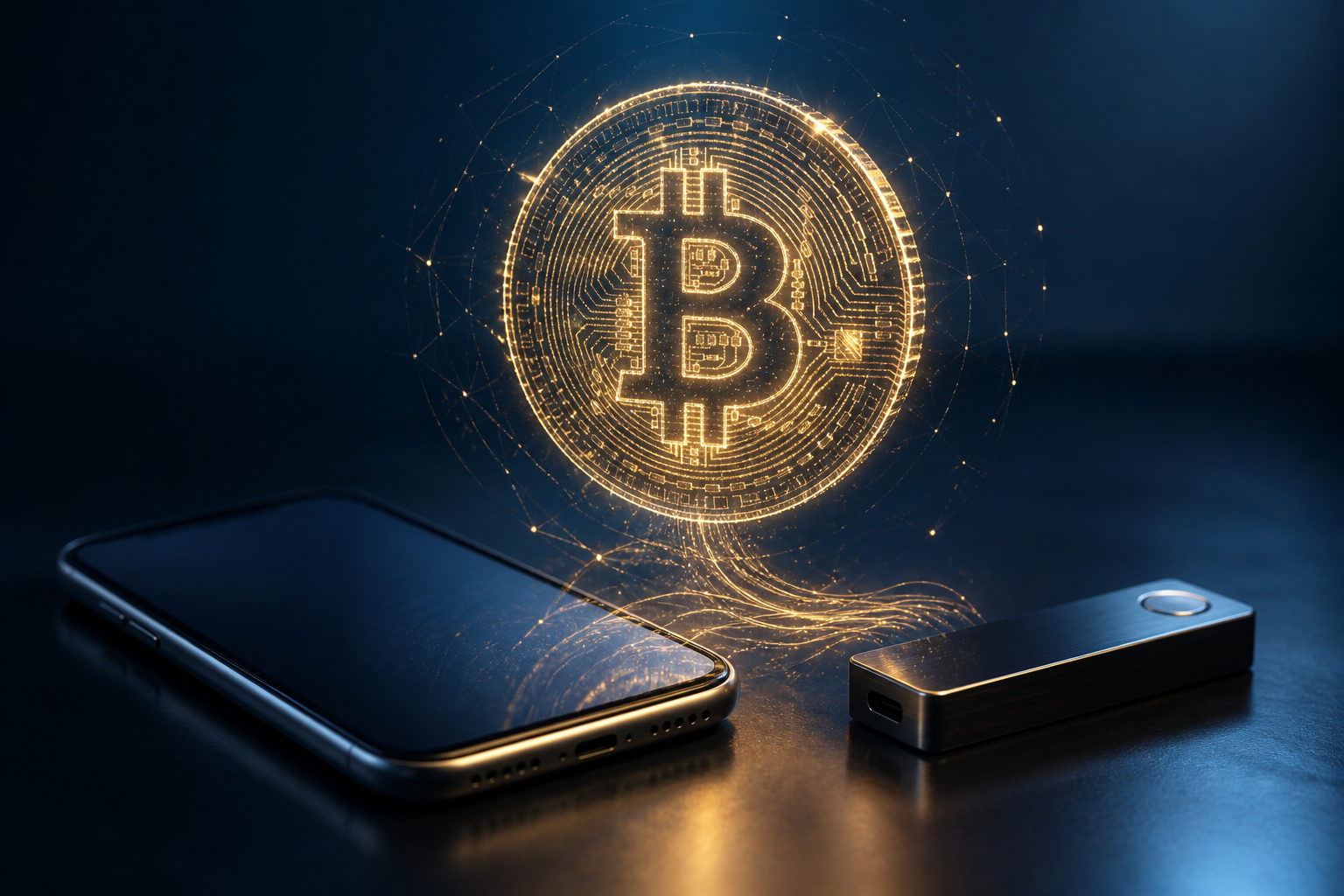
Bitcoins are not physical coins in normal use. Bitcoin is a digital asset recorded on a blockchain, and ownership is tied to control of private keys rather than possession of a metal object.
Why people picture Bitcoin as a coin
The confusion starts with the word “coin.” For many first-time readers, that word suggests something round, metallic, and easy to hold in your hand. News graphics add to that idea by using gold token images with the Bitcoin symbol stamped on them.
Those images are usually just visual shorthand. They help identify the topic quickly, but they do not show the form in which Bitcoin actually exists.
Bitcoin began with the genesis block in January 2009 and was introduced as a peer-to-peer electronic cash system. The design was never about shipping metal tokens to users. It was about creating a shared ledger that no single central issuer controls.
If Bitcoin is not a physical coin, what is it?
Bitcoin is a digital unit recorded on a public blockchain. What people “own” is the ability to control specific funds associated with addresses, usually through private keys and valid digital signatures.
That distinction matters. Your wallet app is not the Bitcoin itself, and an exchange account is not the network. Those tools simply give you a way to view balances, receive funds, and send transactions.
So when someone asks whether there are actual bitcoins, the answer is yes, but not as physical coins. Actual bitcoins exist as verifiable entries in the network’s transaction history and current spendable state.
A simple way to think about it
- Ledger layer: the blockchain records valid transactions.
- Control layer: private keys, public keys, and addresses determine who can move funds.
- User layer: wallets and exchange interfaces help people interact with the system.
Many beginner mistakes come from mixing up those layers. A balance displayed on a screen is not the asset’s physical form. It is a view into a digital system.
What about physical Bitcoin collectibles?
You may come across metal pieces called Bitcoin coins, Bitcoin tokens, or physical bitcoins. In most cases, they are souvenirs, props, or collectibles. They may look impressive, but the object itself is not the same thing as BTC on the blockchain.
Some collectibles have been made with embedded private key access or a hidden code tied to on-chain funds. In that case, the metal shell is not the source of value. The real issue is whether the key is still secret, whether anyone copied it, and whether the associated funds are still under the expected control.
That is why a shiny physical item should not be treated as proof of Bitcoin ownership by itself. Without secure control of the related private key, the object may be little more than a themed keepsake.
Why Bitcoin can be scarce and transferable without a physical form
Bitcoin does not need a physical body to be tradable. It works because the network checks signatures, rejects invalid spending attempts, and adds valid transactions to new blocks. A new block is produced about every 10 minutes, which keeps the ledger moving forward.
Its scarcity also comes from rules, not metal production. Bitcoin has a maximum supply of 21 million coins, and the smallest unit is 1 satoshi, which is one hundred millionth of a BTC. The issuance schedule is built into the protocol, with halvings occurring about every 4 years, or every 210,000 blocks; known halving years are 2012, 2016, 2020, and 2024.
The 2008 white paper, Bitcoin: A Peer-to-Peer Electronic Cash System, described a digital payment system. It did not describe a warehouse full of coins waiting to be distributed.
How to tell the difference between real BTC and marketing fluff
A practical test is simple: can the asset be verified on-chain, and can the holder control it through a private key or a trusted account structure? If all you are being shown is a coin-shaped object, a decorative package, or a promotional image, that does not mean you own Bitcoin.
Another useful check is to separate custody from appearance. A self-custody wallet gives you direct control responsibilities. A custodial platform may manage those controls on your behalf. In either case, what matters is the relationship to the blockchain record, not whether something looks like a coin.
For beginners, this is the part worth learning first. Once you understand private keys, seed phrase handling, and the difference between a wallet app and the network itself, the “actual coin” question becomes much easier to answer.
FAQ
Is Bitcoin an actual coin you can hold?
Not in the usual sense. Bitcoin is a digital asset, so what exists is a blockchain record and the ability to control it, not a standard physical coin.
The coin-shaped images you see online are mostly symbols used in media and marketing.
Are there any real physical bitcoins?
There are physical collectibles branded around Bitcoin, but that does not make them the same as BTC on the network. A collectible can exist in the real world while still being separate from the digital asset itself.
If a physical item claims to contain access to funds, the key question is whether the private key is secure and unused.
Is a bitcoin an actual object somewhere?
Not as a single metal piece stored in one place. A bitcoin is better understood as a digital unit recognized by the network and controlled through cryptographic keys.
That is why people can hold fractions of BTC without needing a whole physical coin.
How is ownership proven if there is no physical coin?
Ownership is shown through control. If you can authorize a valid transaction with the right private key, the network accepts that you can spend those funds.
In practice, this makes key management far more important than possession of a themed object.
Where should I check the Bitcoin price if I cannot see a physical coin?
You can check live market prices on major market data sites, regulated trading platforms, or wallet apps that include pricing tools. Use a source with clear updates and avoid relying on random screenshots.
The fact that Bitcoin is digital does not make its market price any less real. It only means the asset itself is not a physical token.
What matters more than finding a “real coin”
If you are learning about Bitcoin for the first time, focus on custody, private keys, wallet setup, and address checks before sending funds. That will tell you far more about what Bitcoin really is than any metal replica ever could.