
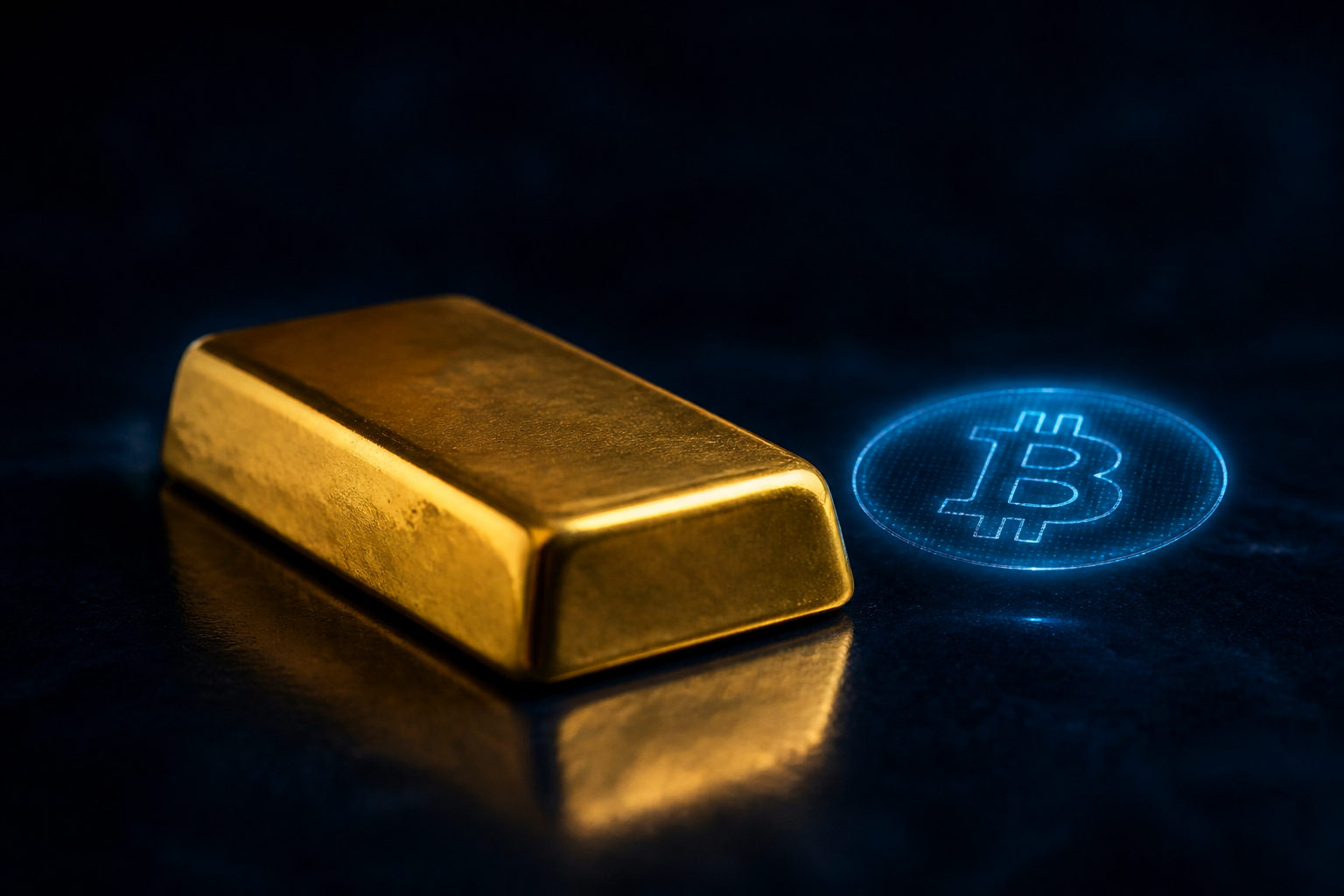
Bitcoin is like gold in some important ways, especially scarcity and long-term store-of-value appeal. It is not gold in digital form, though, because price behavior, custody, and market structure are very different.
Why people compare Bitcoin to gold
The comparison starts with scarcity. Bitcoin has a fixed supply cap of 21 million coins, written into the protocol. Gold is also scarce, but for a different reason: it is hard to find, mine, and refine. In both cases, supply cannot be expanded on demand with a simple policy decision.
The second reason is investor intent. Many buyers hold gold as a defensive asset or a long-term reserve rather than as a daily spending tool. Bitcoin attracts a similar audience. Some holders see it as an asset outside the control of any single issuer, which gives it a role that can resemble gold in a portfolio.
The third reason is supply discipline. Bitcoin launched with the genesis block in January 2009, and new coins are issued on a visible schedule. A new block is produced about every 10 minutes, and the issuance rate is cut in half about every 4 years, or every 210,000 blocks. The halving years so far are 2012, 2016, 2020, and 2024. That pattern strengthens the idea that Bitcoin is engineered to be scarce.
Where the analogy breaks down
Gold is a physical asset. Bitcoin is a digital asset secured by a decentralized network and controlled through private keys. That difference affects everything from storage to transfer to failure modes. Gold can be held in your hand or stored in a vault. Bitcoin depends on software, backups, wallet design, and your ability to protect access credentials.
Price behavior is another major split. Gold is an older and more established market, with a long record as a reserve and defensive asset. Bitcoin is much newer and usually more volatile. Someone who calls Bitcoin digital gold may be talking about long-term monetary properties, not claiming that its short-term price moves look like gold.
Liquidity and settlement also work differently. Bitcoin can be transferred across borders through the network, which gives it a portability advantage. Gold is heavier, slower to move physically, and more dependent on storage and transport arrangements. At the same time, Bitcoin's portability comes with technical and operational risk that gold holders often do not face in the same way.
| Feature | Bitcoin | Gold |
|---|---|---|
| Form | Digital asset on a blockchain | Physical commodity |
| Scarcity source | Protocol-enforced cap of 21 million | Natural scarcity and mining limits |
| Transfer method | Network settlement with private keys | Physical delivery or custodial transfer |
| Custody focus | Wallet security, backups, key control | Storage, authenticity, theft protection |
| Typical volatility | Usually higher | Usually lower |
| Common role | Investment, reserve asset thesis, transfer rail | Reserve asset, hedge, jewelry, allocation |
The answer depends on what you mean by “like gold”
People often use the phrase without defining the comparison. If you mean a scarce asset that is hard to inflate away, Bitcoin has a strong case. Its supply rules are public, auditable, and not tied to a central bank. Gold shares the broad scarcity idea, but its supply responds to physical extraction and market incentives rather than code.
If you mean a crisis hedge with a long and widely accepted history, gold has the clearer record. Bitcoin may be treated by some investors as a store of value, yet its market is still more sensitive to sentiment, liquidity shifts, and policy headlines. That does not make the comparison useless. It means the comparison works better at the level of monetary traits than at the level of day-to-day price action.
If you mean portability, Bitcoin has an edge. A holder who controls private keys can move value without shipping a physical object. Gold still offers a kind of certainty that many people prefer: it exists outside software, internet access, and wallet interfaces. The trade-off is simple to describe and harder to live with. Bitcoin is easier to move, but easier to mishandle if you do not understand custody.
Who may find the “digital gold” idea useful
The phrase can be useful for investors trying to place Bitcoin within a broader asset framework. It signals that Bitcoin is often discussed less as a payment tool and more as a scarce asset with long-term holding appeal. For that audience, the label is a shortcut, not a final conclusion.
It is less useful for people who care most about low volatility or familiar ownership models. Gold ownership is intuitive to many buyers. Bitcoin asks you to think in terms of private keys, wallet types, backups, and platform risk. Those are not minor details. They shape the real experience of owning the asset.
There is also a frequent mistake in the way the label is heard. Some people take “digital gold” to mean “safe by default.” That is too broad. Bitcoin's scarcity narrative may explain why some investors hold it for the long run, but it does not remove market drawdowns, custody errors, or the impact of changing rules in different jurisdictions.
| Investor priority | Bitcoin may fit better | Gold may fit better |
|---|---|---|
| Cross-border portability | Yes | No |
| Preference for physical ownership | No | Yes |
| Tolerance for sharp volatility | Needed | Less demanding |
| Comfort with digital custody | Needed | Less central |
| Interest in fixed supply design | Strong match | Partial match |
FAQ
Is Bitcoin actually a safe haven like gold
Not in a simple one-to-one sense. People use the gold comparison mainly to describe scarcity and store-of-value potential, while Bitcoin's short-term market behavior can be much more volatile.
Can Bitcoin replace gold completely
That is unlikely to be a clean yes-or-no outcome. The two assets overlap in some investment narratives, yet they serve different preferences, custody models, and market roles.
Why do some investors call Bitcoin “digital gold” instead of digital cash
Because many holders focus on scarcity and long-term holding rather than everyday spending. The fixed supply cap and halving schedule support that framing more than a pure payments narrative.
Do I need technical knowledge to hold Bitcoin as a long-term asset
You do not need to be an engineer, but you do need to understand basic custody. Wallet choice, private key control, and backup practices matter because ownership depends on them.
Which is better for diversification, Bitcoin or gold
The better fit depends on what kind of risk you are trying to diversify. If you want an older and more familiar defensive asset, gold may feel more suitable; if you want a scarce digital asset with different transfer properties, Bitcoin may deserve a closer look.
A practical way to think about the question is to stop asking whether Bitcoin is gold and start asking which gold-like traits you care about. If scarcity and portability matter most, study Bitcoin custody before buying. If stability and familiarity matter more, weigh that against what gold already offers.
Disclaimer: This article is for informational and educational purposes only and is not investment, financial, or legal advice. Crypto assets are highly volatile and you could lose your entire investment. Do your own research and decide carefully.