
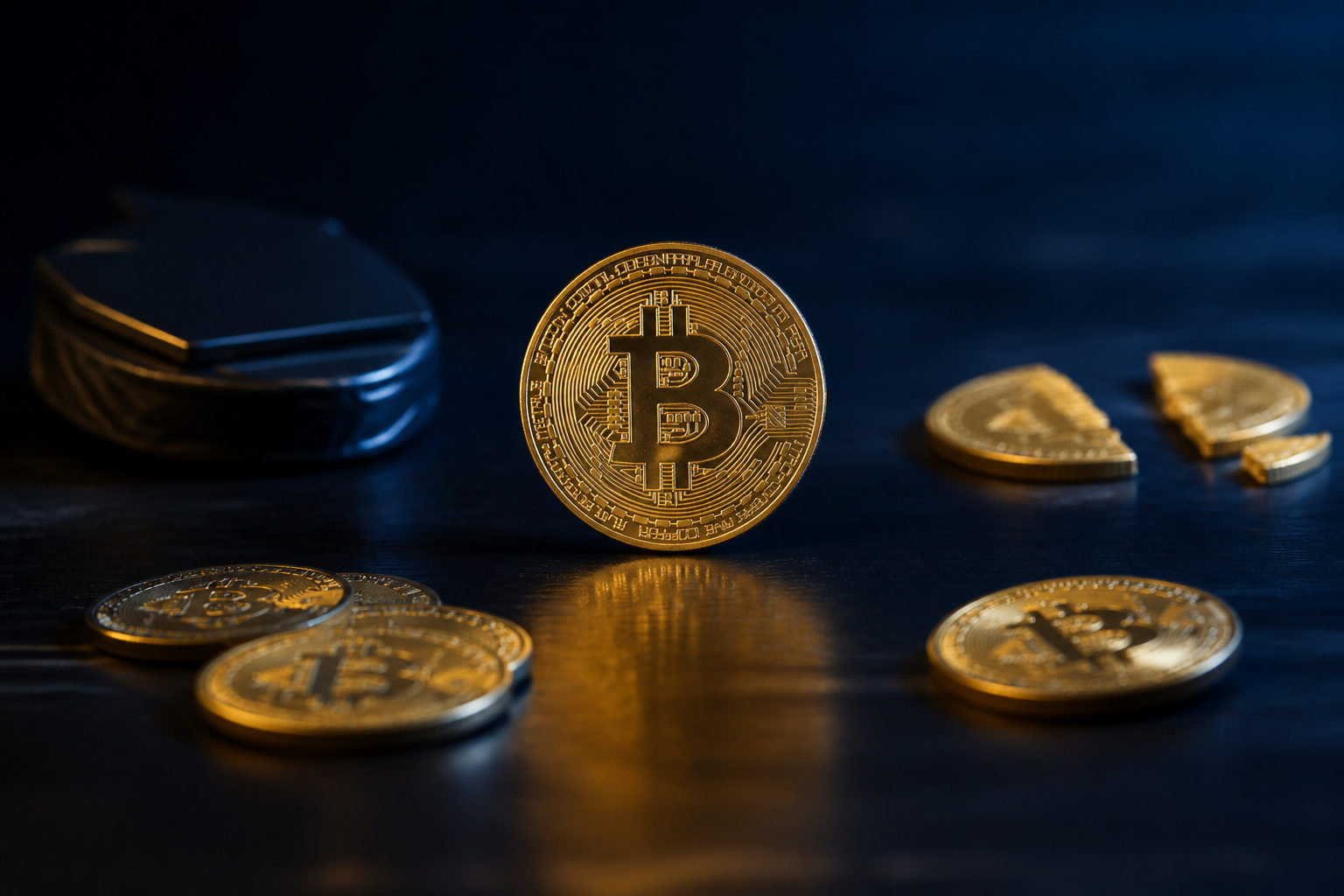
There is only one Bitcoin as a native asset, but people use “different bitcoins” to mean three very different things: units of the same asset, different ways of holding it, and other coins that borrow the Bitcoin name or history.
Start by separating three kinds of difference
When someone asks how many different bitcoins there are, they are often mixing several ideas together. A wallet may show balances one way, an exchange may show them another way, and a coin with “bitcoin” in its name may look connected even when it is not the same asset.
That makes the question harder than it sounds. One meaning is about denomination: the same Bitcoin balance can be displayed in different units. Another meaning is about custody or representation: what you see as BTC on one platform may be a direct on-chain holding, while somewhere else it may be an account claim or a tokenized form. The third meaning is about separate assets, such as forked coins that came from Bitcoin’s code base or history but no longer operate as Bitcoin itself.
| What people see | What it actually refers to | Is it a different Bitcoin? |
|---|---|---|
| BTC | The native asset on the Bitcoin network | No, this is standard Bitcoin |
| Sats or satoshis | Smaller units of Bitcoin | No, same asset |
| BTC balance on an exchange | A platform record of your claim | Usually no, but you should check withdrawal options |
| A coin with Bitcoin in the name | Could be a fork, wrapped version, or branding choice | Often no |
Bitcoin itself is one asset, even though it can be counted in different units
If you mean the asset defined by the Bitcoin protocol, there is one Bitcoin. It began with the genesis block in January 2009, the name attached to its creation is Satoshi Nakamoto, and its supply cap is 21 million coins. Those features describe one monetary system, not several parallel versions of the same base asset.
A lot of confusion comes from unit changes. Bitcoin can be shown as BTC, but it can also be divided into much smaller parts for payments and accounting. The smallest unit is the satoshi, and 1 satoshi equals one hundred millionth of 1 BTC. That does not create another class of bitcoin any more than cents create a different kind of dollar.
This is the easiest place to remove confusion. A smaller displayed amount, a wallet setting, or a different unit label changes how the balance looks on screen. It does not change what the asset is.
| Term | Role | Does it change the asset? |
|---|---|---|
| BTC | Main unit for Bitcoin | No |
| Satoshi | Smallest unit | No |
| Wallet display setting | User interface choice | No |
What changes more often is the way you hold Bitcoin
Two people can both say they own BTC while holding it in very different forms. One person may control private keys in a self-custody wallet. Another may only see a balance inside an exchange account. Both screens may say BTC, but the rights behind those balances are not identical.
Direct Bitcoin ownership usually means the asset can move on the Bitcoin network and the holder controls the keys or controls access through a setup they chose. By contrast, an exchange balance often represents an internal account entry until a withdrawal is made. You are relying on the platform’s systems to honor that claim.
There are also versions of Bitcoin exposure that sit on other networks or inside other products. A wrapped or mapped version may try to track Bitcoin’s value, but it adds another layer of rules and trust. If the product depends on an issuer, custodian, or bridge, that matters. The label BTC alone does not settle the question.
| Holding setup | What you see | What to check |
|---|---|---|
| Self-custody wallet | BTC | Do you control the keys? |
| Exchange account | BTC balance | Can you withdraw to the Bitcoin network? |
| Wrapped or mapped asset elsewhere | May still mention BTC | Is it native Bitcoin or a representation? |
Forked coins and lookalike names are where the real mix-up happens
Bitcoin’s code is open source. That means other groups can copy it, change some rules, launch a separate chain, and give the resulting asset a name that sounds close to Bitcoin. Once that happens, the new coin is no longer the same asset as BTC on the Bitcoin network.
A simple analogy helps here. Imagine a recipe that other cooks are free to copy. One cook keeps the original dish. Another changes ingredients and method, then serves a new dish under a similar name. The two dishes share ancestry, but they are not the same meal. Forked coins work in a similar way: they may share history with Bitcoin, yet they are separate assets with separate rules.
There is also a simpler category: products that use the word Bitcoin mainly for marketing. A token, a yield product, or a community label can sound familiar and still have little to do with native Bitcoin. To judge what you are looking at, check which network it lives on, whether it has its own issuance rules, and whether it depends on a third party to keep functioning.
| Category | Relationship to BTC | Same asset as Bitcoin? |
|---|---|---|
| Native BTC on the Bitcoin network | Original asset | Yes |
| Forked coin | Shares history, now separate | No |
| Wrapped or represented version | Tries to mirror BTC exposure | Usually not directly the same |
| Name-based imitation | Only sounds related | No |
How to tell whether what you own is actually Bitcoin
The most useful habit is to stop looking at the name first. Start with the network. If the asset settles on the Bitcoin network, that is a strong sign you are dealing with native Bitcoin. If it exists somewhere else, you need to ask what stands behind it.
Next, look at control. Who holds the private keys? If the answer is a platform, issuer, or custodian, then your position may be a claim rather than direct control of on-chain BTC. After that, check transferability. Can it be withdrawn to a standard Bitcoin address, or does it only move inside one app or one ecosystem?
One more check helps: ask where the rules come from. Native Bitcoin follows the Bitcoin protocol. A represented version may rely on custody promises, mint-and-burn processes, or bridge mechanics. Those are not small details. They determine whether you hold Bitcoin itself or an instrument built around it.
| Step | Question to ask | What it clarifies |
|---|---|---|
| Check the network | Does it settle on Bitcoin? | Native asset or something else |
| Check control | Who holds the keys? | Direct ownership or platform claim |
| Check withdrawals | Can it go to a standard Bitcoin address? | Real on-chain mobility or internal balance only |
| Check the rules | Does it depend on an issuer or custodian? | Bitcoin itself or a representation |
FAQ
Are satoshis a different kind of bitcoin?
No. A satoshi is just the smallest unit of Bitcoin, much like a smaller denomination used to express the same asset more precisely.
Is BTC on an exchange the same as BTC in a self-custody wallet?
The ticker may be the same, but the structure can differ. In self-custody, control depends on your keys; on an exchange, your balance is usually an account claim until you withdraw.
Does every coin with Bitcoin in its name count as Bitcoin?
No. The name can point to a historical link, a wrapped representation, or simple branding. You need to inspect the network and the operating rules.
Should forked coins be treated as different bitcoins?
A better way to say it is that they are separate assets related to Bitcoin’s history. They are connected by origin, not identical in present-day function.
What is the fastest way to verify what I am buying?
Check the withdrawal page, the supported network, and the address format before you buy or transfer. If a platform cannot clearly show that the asset can move to the Bitcoin network, the name alone is not enough.
If you want one practical rule to remember, use this order every time: check the network, check who controls the keys, then check whether it can move to a standard Bitcoin address. That process will clear up most of the confusion around “different bitcoins.”
Disclaimer: This article is for informational and educational purposes only and is not investment, financial, or legal advice. Crypto assets are highly volatile and you could lose your entire investment. Do your own research and decide carefully.