
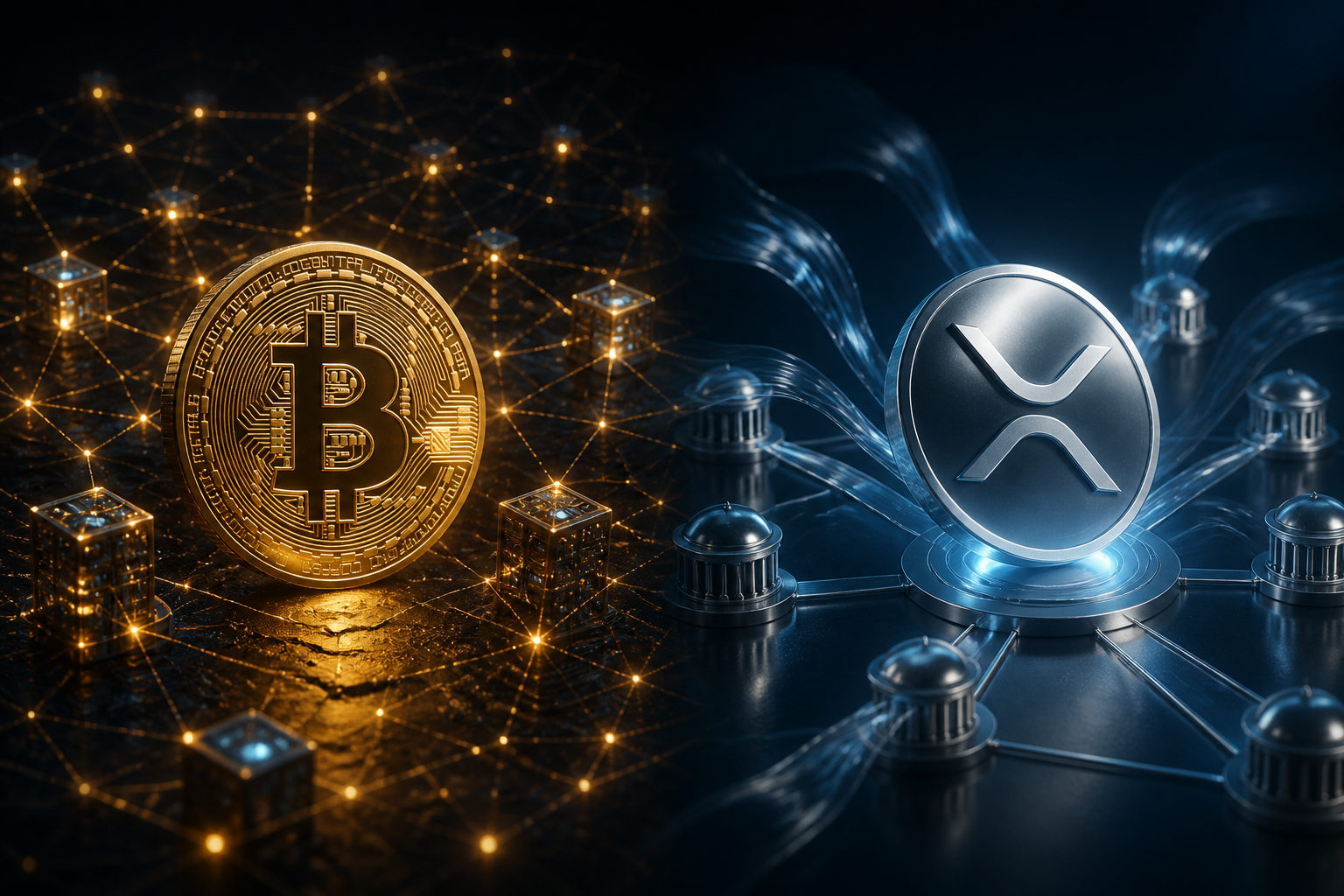
Bitcoin and XRP are not the same kind of asset: Bitcoin is best understood as a decentralized digital money system and store-of-value asset, while XRP is often discussed in connection with payment flows and value transfer efficiency.
Start with the core distinction
If you are new to crypto, the easiest mistake is to treat Bitcoin and XRP as interchangeable because both are traded and both are called cryptocurrencies. That broad label is not useless, but it hides the part that matters most. Bitcoin was designed around a monetary network that can operate without a single controlling institution. XRP is usually framed around moving value across payment networks more efficiently.
That does not mean one is automatically better. It means they solve different problems and ask users to care about different trade-offs. Once you see that, the comparison becomes much clearer.
Bitcoin is a monetary network; XRP is a native asset in a different system
| Aspect | Bitcoin | XRP |
|---|---|---|
| System and asset | Bitcoin can refer to the Bitcoin network and to its native asset, BTC. | XRP belongs to a separate system with its own design choices. |
| Origin and framing | It was introduced in the 2008 white paper titled Bitcoin: A Peer-to-Peer Electronic Cash System, under the name Satoshi Nakamoto, whose identity remains unknown. The genesis block appeared in January 2009. | For a beginner, the most useful thing to understand is simple: XRP is not a faster version of Bitcoin, and it is not Bitcoin with a few settings changed. It comes from a different starting point, and that affects how people judge its role. |
| Supply and issuance | Bitcoin also has a fixed supply cap of 21 million coins, and new coins enter circulation through mining under public protocol rules. | XRP belongs to a separate system with its own design choices. |
This is why a shallow comparison often goes wrong. Asking only which one is faster, cheaper to move, or lower in unit price skips the real issues. A better comparison looks at issuance, network structure, trust assumptions, and intended use.
Four major differences between Bitcoin and XRP
1. Their issuance models are different
| Aspect | Bitcoin | XRP |
|---|---|---|
| Monetary policy and supply | Bitcoin’s monetary policy is written into the protocol. The maximum supply is 21 million. | XRP is usually not discussed through the lens of mining. |
| How new units enter circulation | A new block is produced about every 10 minutes, and the block subsidy is cut roughly every 4 years, or every 210,000 blocks. The halving years so far are 2012, 2016, 2020, and 2024. | Beginners often assume every crypto asset comes into existence the same way, then get confused when that assumption fails. A better first question is: how is this asset issued, how does it enter circulation, and who maintains the rules around it? |
| Why people care | This predictable supply schedule is one reason many people view Bitcoin as a scarce digital asset. | A better first question is: how is this asset issued, how does it enter circulation, and who maintains the rules around it? |
2. Their network priorities are not the same
| Aspect | Bitcoin | XRP |
|---|---|---|
| Core priority | One of Bitcoin’s defining ideas is minimizing reliance on a single issuer or operator. | XRP is more often judged in terms of transaction flow, settlement efficiency, and payment utility. |
| User role and network participation | Users can hold their own coins, verify the rules for themselves, and participate in the network by running nodes. | The center of gravity is different. |
| How it is commonly evaluated | Because of that, people often evaluate Bitcoin through openness, resistance to control, and long-term monetary credibility. Bitcoin is usually evaluated as permissionless money. | That does not mean the only valid question is which network is faster. It means the center of gravity is different. XRP is more often evaluated as an asset connected to transfer efficiency within payment-related use cases. |
| Trust emphasis | Bitcoin users often place more weight on transparent rules and independent network operation. | People interested in XRP are often more focused on how the asset functions in transfer and liquidity settings. |
3. Their common use cases are different
| Aspect | Bitcoin | XRP |
|---|---|---|
| Common associations | Bitcoin is commonly associated with long-term holding, self-custody, cross-border transfers, and serving as the entry point into the crypto market. | XRP is often discussed in relation to cross-border payments, transfer rails, and movement of value. |
| Typical expectation | Many people buy Bitcoin not because they expect to spend it on daily purchases, but because they see it as a scarce digital asset with a strong monetary narrative. | That does not mean XRP has only one use, or that Bitcoin cannot be used for payments. The point is that these assets are usually approached with different expectations. |
| How to judge it | A tool for efficient transfer and an asset held for long-term monetary properties do not need to win the same test. | A tool for efficient transfer and an asset held for long-term monetary properties do not need to win the same test. |
4. The market talks about them in different ways
| Aspect | Bitcoin | XRP |
|---|---|---|
| Common discussion topics | When people discuss Bitcoin, common topics include halving, fixed supply, miners, self-custody, and network security. | With XRP, the conversation more often turns to payment use, circulation, and regulation. |
| How valuation gets shaped | Those discussion patterns shape how each asset is valued, even before any technical comparison begins. | Those discussion patterns shape how each asset is valued, even before any technical comparison begins. |
| What not to start with | That is why the answer to “what is the difference between bitcoin and xrp” should not begin with price. | A lower unit price does not make an asset cheaper in any meaningful analytical sense. Supply structure, expected demand, and the role people assign to the asset matter far more. |
Common misunderstandings beginners should avoid
| Misunderstanding | Why it is misleading |
|---|---|
| “They are both coins, so they must work the same way.” | Shared labels can hide major differences in design, purpose, and governance. |
| “The one with the lower price has more upside.” | Unit price by itself says very little. It does not explain supply, valuation, or demand. |
| “Faster transfers mean it is better than Bitcoin.” | Speed is only one metric. Openness, security assumptions, and monetary credibility also matter. |
| “Bitcoin and XRP are direct substitutes.” | They overlap in some discussions, but they do not serve exactly the same role. |
If you want a cleaner way to compare them, ask three questions in order: what problem was this asset designed to solve, how does the network try to solve it, and why does the market care about that design? That sequence is far more useful than starting with price charts.
A practical framework for comparing Bitcoin and XRP
Instead of asking which one is simply better, use the same checklist for both. That keeps the comparison grounded and helps beginners avoid mixing different categories together.
| Checklist item | What to compare |
|---|---|
| Look at the goal. | Is the asset mainly treated as money, a store of value, a payment tool, or something else? |
| Check the issuance rules. | Is supply transparent? Is the process easy to understand? Are the rules stable? |
| Study the network structure. | Can users verify the system independently, or does it rely more heavily on a smaller set of actors? |
| Match it to the use case. | Long-term holding and high-speed transfer are not the same use case, so they should not be judged by a single standard. |
Once you compare Bitcoin and XRP this way, the difference stops looking mysterious. The confusion usually comes from trying to force two different design goals into one simple ranking.
FAQ
Are Bitcoin and XRP basically the same type of crypto asset?
They are both crypto assets, but they are not functionally identical. Bitcoin is usually treated as decentralized money and a store-of-value asset, while XRP is more often discussed in payment and transfer contexts.
Is XRP a direct competitor to Bitcoin?
They can compete for attention and capital, and people often compare them side by side. Still, their main goals are different enough that they should not be treated as one-for-one replacements.
Why do people call Bitcoin “digital gold”?
That idea comes from Bitcoin’s capped supply of 21 million, its public issuance rules, and the scarcity narrative built around it over time. Whether you agree with that label depends on what you value most in an asset.
What is the biggest mistake when comparing XRP and Bitcoin?
The biggest mistake is focusing only on the price of one coin. Unit price is easy to notice, but it does not explain supply structure, market role, or why users value the network.
What should a beginner research first before comparing them?
Start with purpose, issuance model, network structure, and common use cases. If those basics are still blurry, any later decision about trading, storage, or long-term holding will rest on a weak foundation.
If you plan to study further, write down in plain words what Bitcoin is for, what XRP is for, how each asset enters circulation, and what users expect from each network; if you cannot explain those differences clearly yet, that is the next step before looking at trading or custody tools.