
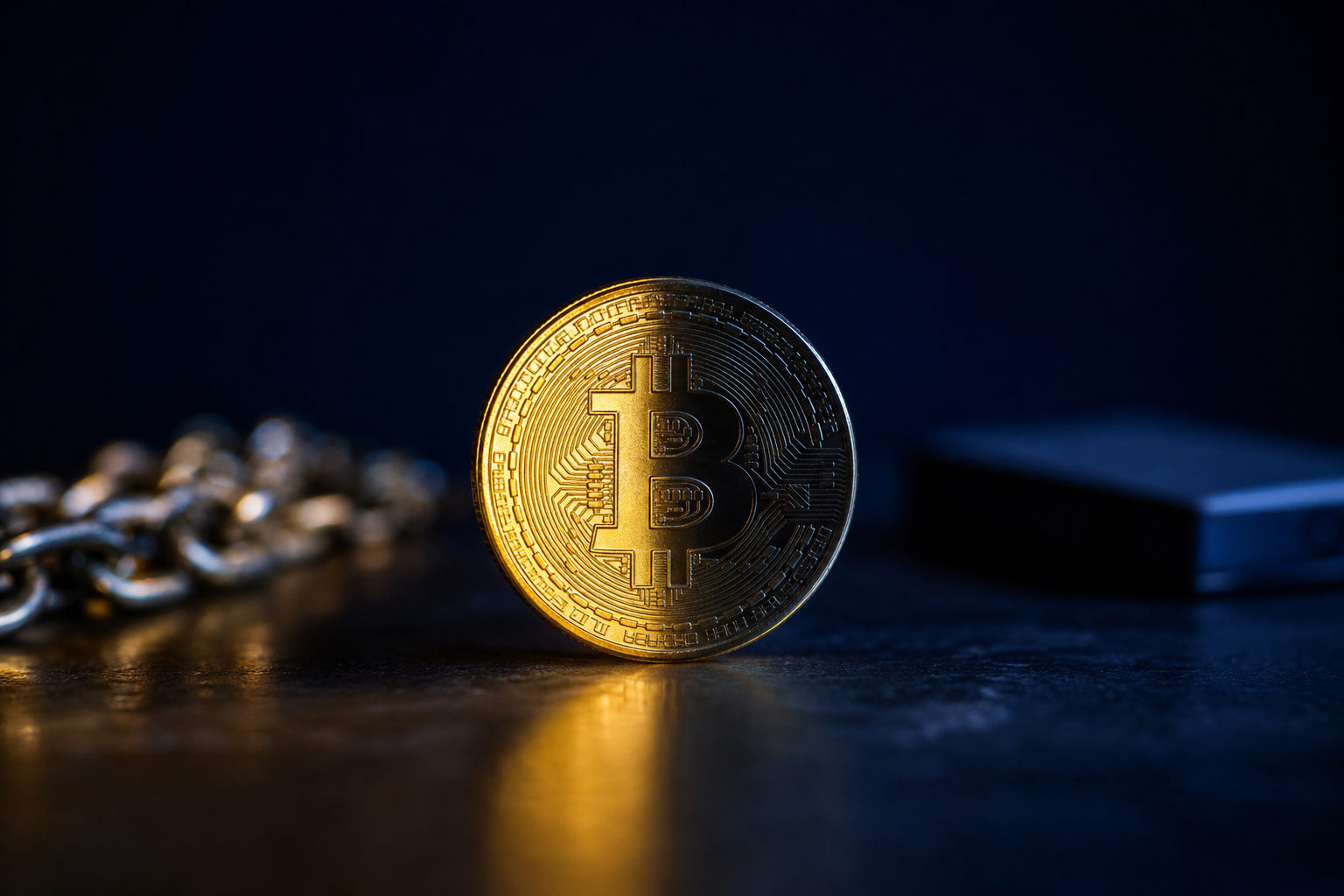
The truth about Bitcoin is less dramatic than the slogans. Bitcoin is an open monetary network with fixed issuance rules, a hard supply cap, market-based pricing, and meaningful risks tied to volatility, custody, and execution.
Bitcoin is a network with rules, not a company product
A lot of confusion starts with the wrong mental model. People often treat Bitcoin like app credits, a tech stock, or a digital token controlled by a small group. It does not work that way. Bitcoin runs on a public blockchain where transactions can be verified, new coins are issued on a preset schedule, and no central operator can decide to create more supply on demand.
That is a big part of the truth about Bitcoin. It attracts extreme claims from both sides. One side turns it into a cure-all for every weakness in the financial system. The other reduces it to a speculative object with no substance. A more accurate view sits in the middle: Bitcoin is a real network with hardcoded monetary rules, but owning it still means taking market risk and operational risk.
Its origin is clear. On 2008-10-31, Satoshi Nakamoto published the white paper, Bitcoin: A Peer-to-Peer Electronic Cash System. The genesis block followed on 2009-01-03. Since then, the system has continued to operate under rules that are publicly known rather than privately negotiated behind closed doors.
The core truth is in the supply design
If someone asks why Bitcoin keeps drawing attention, the answer starts with scarcity that can be audited. Bitcoin has a hard cap of 21,000,000 BTC, with full issuance projected around 2140. That does not tell you what the price should be today, but it does tell you the supply path cannot expand at the discretion of a manager, board, or government office inside the protocol itself.
The halving schedule matters just as much. Every 210,000 blocks, roughly every 4 years, the block subsidy is cut in half. The past halving dates are 2012-11-28, 2016-07-09, 2020-05-11, and 2024-04-19. The next one is expected around 2028. After the 2024 halving, the current block reward is 3.125 BTC. With a target of about 10 minutes per block, that puts new daily issuance for the entire network at about 450 BTC.
Those figures explain a lot of what people call the truth about Bitcoin. Demand can change quickly. Supply does not. When new buyers rush in, or when fear causes people to sell, price can move hard because the issuance curve is relatively rigid.
| Rule | Known fact | Why it matters |
|---|---|---|
| Supply cap | 21,000,000 BTC | Supply cannot expand without bound |
| White paper date | 2008-10-31 | The design was published openly |
| Genesis block | 2009-01-03 | The network has a clear starting point |
| Halving schedule | Every 210,000 blocks, about 4 years | New issuance declines over time |
| Current block reward | 3.125 BTC | Applies after the 2024 halving until the next one |
| Target block time | About 10 minutes | Transaction settlement into blocks has a natural rhythm |
| New coins per day | About 450 BTC | This is a network total, not a miner guarantee |
| Smallest unit | 1 satoshi = 0.00000001 BTC | Bitcoin is highly divisible |
That last point clears up one common myth. You do not need to buy a whole bitcoin. The asset can be split into satoshis, and 1 satoshi equals 0.00000001 BTC. For most people, the real barrier is not unit size. It is whether they understand the trade-offs involved.
Price is not the same thing as value
When people search for the truth about Bitcoin, many are really asking whether it is worth anything beyond speculation. The honest answer is that price and value are related but not identical. Without live market data, nobody should pretend to know the exact current price. Bitcoin trades continuously, and the market quote changes with liquidity, macro sentiment, regulation expectations, and risk appetite.
Value depends on what role you think Bitcoin plays. Some people see it as a scarce digital asset. Others care about self-custody and the ability to hold value without relying on a single institution. Some focus on global transferability. Many traders care mostly about volatility. These views can coexist. They are not the same use case, and they do not lead to the same decision.
Bitcoin also has a history that shows it moved from experiment to exchange medium. On 2010-05-22, Laszlo Hanyecz used 10,000 BTC to buy two pizzas. The story is often told as a lesson about price hindsight. The deeper point is that Bitcoin was used to acquire a real-world good, which gave it a concrete place in economic history.
| Common claim | Closer to the truth | What to check |
|---|---|---|
| Bitcoin is only speculation | Speculation is a major part of the market, but the network and its rules are real | Separate protocol facts from trading behavior |
| Bitcoin always preserves value | It has a scarcity thesis, but it also has sharp drawdowns | Decide whether you can tolerate volatility |
| Bitcoin has no practical use | It can be used for transfer, custody, and trading | Utility does not mean universal fit |
| You must buy one full bitcoin | It is divisible down to satoshis | Position size is flexible |
A major truth people miss: custody changes the risk
Most public discussion centers on price swings, yet custody is where many real mistakes happen. If you control the private keys, you control the bitcoin. If the keys or seed phrase are exposed or lost, access to the asset can be lost as well. That is very different from a standard bank or brokerage setup, where account recovery often depends on an institution.
Another point that gets blurred is the difference between buying bitcoin and holding it in a way that matches your risk tolerance. Keeping bitcoin on an exchange account may be more convenient. Moving it to a wallet you control shifts more responsibility to you. Neither choice is automatically correct for everyone, but they are not the same thing.
The same need for precision applies to mining. A common misconception is that a machine will produce a steady personal output if Bitcoin keeps creating new coins. The network does add about 450 BTC per day at the current reward level, but that number belongs to the entire network. It does not translate into a fixed daily amount for any one miner, pool, or company. Results depend on hardware efficiency, power cost, mining difficulty, and pool structure.
| Risk type | How it shows up | Main question to ask |
|---|---|---|
| Price risk | Large moves can happen over short periods | Can your position survive a sharp drawdown? |
| Custody risk | Keys or seed phrase can be lost or exposed | Who actually controls the asset? |
| Execution risk | Wrong address, wrong network, poor process | Do you know the steps before moving funds? |
| Platform risk | Assets depend on third-party systems and rules | Are you choosing convenience or direct control? |
| Knowledge risk | Slogans replace careful understanding | Do you understand the mechanism before acting? |
FAQ
Is Bitcoin money or just a risky asset?
It can be viewed as both, depending on the angle. At the network level, it is a system for transferring value. In markets, it behaves like a volatile asset that can rise or fall quickly.
Why do people keep calling Bitcoin scarce?
The supply cap is fixed at 21,000,000 BTC, and the block reward is cut in half every 210,000 blocks. Scarcity refers to the issuance rules, not a promise of permanent price appreciation.
Do I need to buy one whole bitcoin to get started?
No. Bitcoin can be divided into satoshis, and 1 satoshi equals 0.00000001 BTC. The bigger question is not unit size but whether the asset fits your risk tolerance and goals.
Is holding bitcoin on an exchange the same as self-custody?
No. On an exchange, the platform usually controls the keys. In self-custody, you control the keys and take on the responsibility that comes with that control.
Does mining still offer easy income?
There is no fixed answer that applies to everyone. The current block reward is 3.125 BTC, but personal mining results depend on many variables and are not guaranteed by the network reward alone.
What is the safest way to check what Bitcoin is worth right now?
Use a major market data service or trading venue and verify that you are looking at a live USD quote. Old screenshots and forwarded messages should not be treated as current market facts.
If you want a clearer view, start with three checks
First, decide whether you are studying the protocol or considering an investment decision, because those are different questions. Second, make sure you understand the 21,000,000 BTC cap, the halving cycle, and who controls the keys. Third, judge whether you can accept large price swings before you look at live quotes or buying methods. That sequence usually leads to better decisions than reacting to hype or fear.
Disclaimer: This article is for informational and educational purposes only and is not investment, financial, or legal advice. Crypto assets are highly volatile and you could lose your entire investment. Do your own research and decide carefully.