
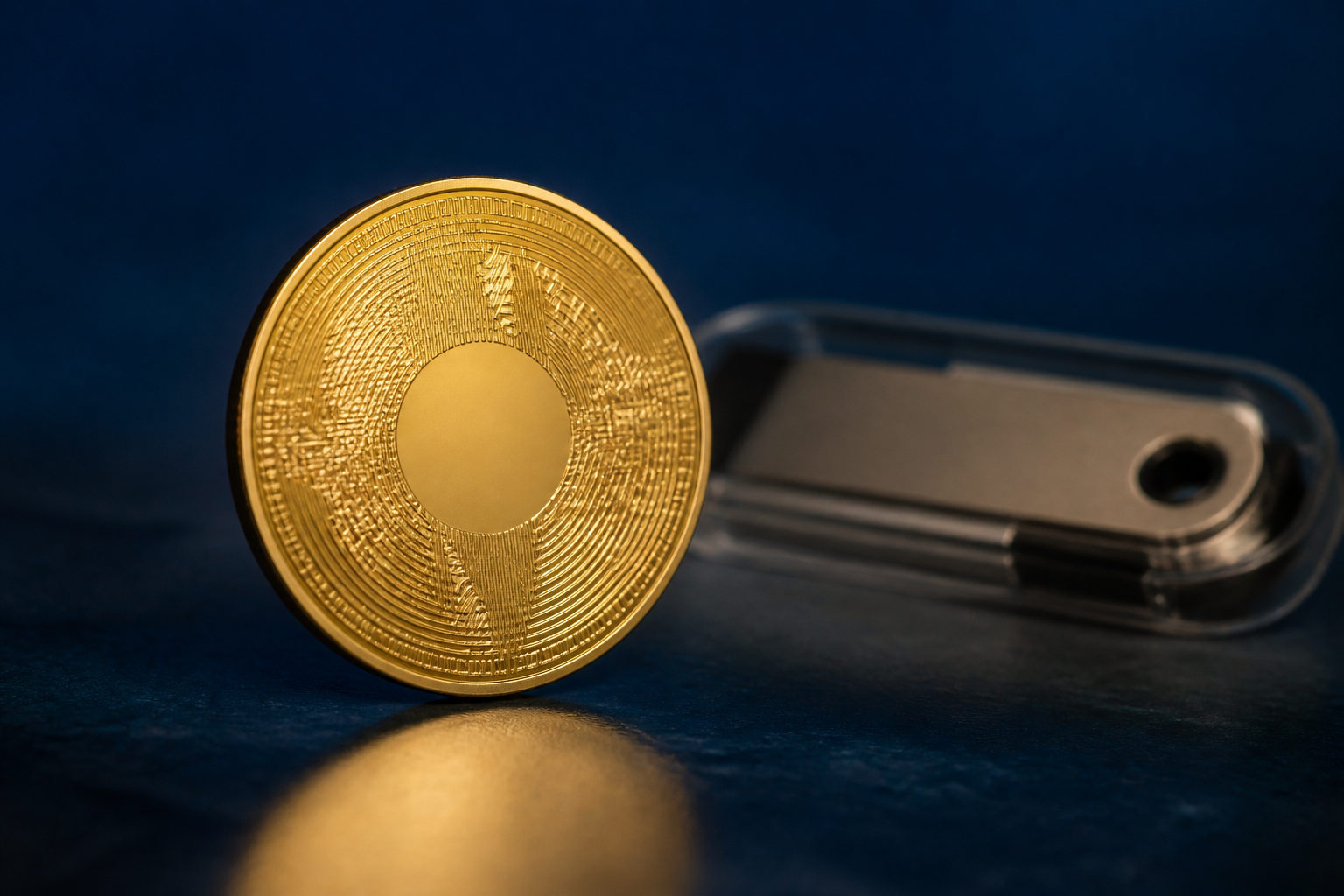
You can buy something that looks like a Bitcoin coin, but actual BTC does not live inside metal. A physical Bitcoin item is usually a collectible, and in rarer cases it carries private key data that can expose you to extra risk.
Start by separating the object from the asset
People asking whether you can get Bitcoin as a coin often mean two different things. One is whether you can own a round, tangible item with the Bitcoin symbol on it. The other is whether that item itself counts as spendable Bitcoin. Those are separate questions, and mixing them is where most confusion starts.
A physical Bitcoin product usually falls into one of a few buckets. Some are simple souvenirs: metal tokens, gift items, desk pieces, or collector rounds with no blockchain balance attached. Some are sold as loaded coins, with a hidden private key, a concealed code, or some other claim that a BTC balance can be redeemed. Others are really packaging around a claim process, such as a gift-style product that points the buyer toward an account, a redemption page, or a wallet setup flow.
Your first move should be to decide what you actually want. If you want a display piece, treat it as merchandise. If you want to hold Bitcoin, shift your focus to wallet control, key handling, and independent verification. The metal form does not add much by itself, and it can distract new buyers from the part that matters.
If you want a collectible, evaluate it like a collectible
Look at the product description before you look at the finish or packaging. Clear language helps: collectible, commemorative, souvenir, display piece, no digital balance, no redeemable BTC. A vague listing that leans on the Bitcoin name while avoiding direct statements about what is included should slow you down.
Pay close attention to any QR code, scratch-off area, serial-style marking, or “wallet” wording in the marketing. A QR code may be decorative. It may point to a product page. It may show a public address without giving the buyer any control over funds. Buyers get misled when they see a code and assume it must connect to ownership. It does not.
Think about future resale and storage as well. A purely commemorative coin is much easier to handle if the listing and packaging clearly explain what it is. If a product is presented in a way that resembles a bearer instrument or a loaded value object, later owners may assume it includes BTC even when it does not. Keep the original documentation so the item can be described accurately later.
Pricing needs a separate lens. A collectible coin may carry value because of material, finish, branding, storytelling, or buyer interest. That does not make it a proxy for Bitcoin itself. When a seller blurs those categories, the product stops being easy to assess.
If you want BTC exposure through a physical coin, treat the hidden key as the real issue
A so-called loaded Bitcoin coin only matters if it gives you control over an address and if that control belongs to you alone. Before buying, ask how the key material was created, whether anyone else could have seen it, whether the seller can prove exclusive delivery, and whether you can move the BTC to your own wallet right after receipt. If those questions are brushed aside, the design of the coin should not persuade you.
When the item arrives, do not rush to store it away unopened as if the seal itself were security. Inspect the packaging first. Look for signs that a sticker was lifted, a scratch layer was tampered with, or the presentation was reassembled. Still, even a clean package does not prove the private key was never copied. A duplicate could have been made during production, printing, packing, display, or sale.
The safer path is simple: prepare your own wallet first, verify whatever information can be checked without exposing secrets, and move the BTC out as soon as you can. After that, the coin can stay on a shelf as a keepsake. Leaving value tied to a hidden key that passed through other hands extends your risk for no good reason.
Be careful with photos. A lot of people like to share a new collectible online, especially if it looks premium or gift-worthy. If the item carries a concealed key or recovery data, close-up images can leak more than you expect through reflections, partial characters, or packaging details. If the asset matters, move it first and photograph the object later.
Common red flags that deserve an immediate pause
One bad sign is language suggesting that the coin itself exists on the blockchain. Blockchains track addresses, balances, and transaction history. They do not store a metal object. Sellers using this phrasing may be trying to make a physical product sound more secure or more “real” than it is.
Another warning sign is the claim that an unopened coin is automatically safe. A seal only tells you what the item looks like at the moment you receive it. It says nothing about whether a private key was generated in a trustworthy way or whether a copy was kept somewhere else.
Watch out for any setup flow that asks you to trust the seller’s interface instead of your own wallet. If the seller wants you to create an account on their system, keep funds under their custody, or enter sensitive wallet data into their page, you may be buying a promise rather than gaining direct control of BTC.
Verification traps are common. If a seller tells you to “check the balance” by entering a seed phrase, private key, one-time code, or any recovery material into a website, stop there. No honest validation process should require you to hand over the very information that controls the asset.
Gift presentation can also hide weak substance. Fancy boxes, certificates, engraved numbering, and premium branding may improve the experience of opening the package, but none of them prove you control Bitcoin. They can support collectible value; they cannot replace independent wallet control.
A cleaner alternative: keep the physical gift and the BTC separate
If your goal is to give someone a tangible Bitcoin-themed present, you do not need to bury the asset inside the object. You can give a commemorative coin for the visual and symbolic part, then transfer BTC through a wallet the recipient controls. That keeps the ceremony while removing the risk that a hidden key was copied before delivery.
This approach also makes education easier for beginners. The person receiving the gift learns what really matters in Bitcoin ownership: addresses, backups, wallet access, and transaction control. The physical coin stays what it should be, a display item or memento, not a confusing mix of merchandise and sensitive credential.
If you are the collector, not the giver, a clearly labeled unloaded coin is usually the simpler choice. You can store it, photograph it, show it, or resell it without worrying that some unseen key remains tied to value. That separation reduces misunderstandings and lowers the chance that a decorative object turns into a security problem.
FAQ
Does owning a physical Bitcoin coin mean I own BTC?
Not by default. A physical coin only represents spendable BTC if it is tied to a valid private key, the funds are still there, and no one else has access to that key. Many products sold as Bitcoin coins are only collectibles.
Can I cash out a Bitcoin coin just by scanning the QR code?
No. A QR code might be decorative, public-facing, or unrelated to redemption. What matters is whether you control the private key and can move the BTC into a wallet that you manage.
Why do experienced buyers move the BTC out right away?
Because the key may have been exposed before the item reached them. Moving the funds into a self-controlled wallet shortens the period during which a copied key could still threaten the balance.
Is a loaded physical coin safe if I lock it in a safe?
A safe protects the object, not the history of the key. If the private key was duplicated earlier, physical storage does not solve the main problem.
What is better for a gift: a physical Bitcoin coin or a BTC transfer?
If the recipient is new to Bitcoin, using both in separate roles usually works best. Give the coin as a keepsake, and deliver the BTC through a wallet the recipient controls.
Before buying, settle three points in order: whether the product is only a collectible or carries key material, whether you can move any BTC into your own wallet right after receiving it, and whether the process avoids every request for seed phrases, private keys, or one-time codes.