
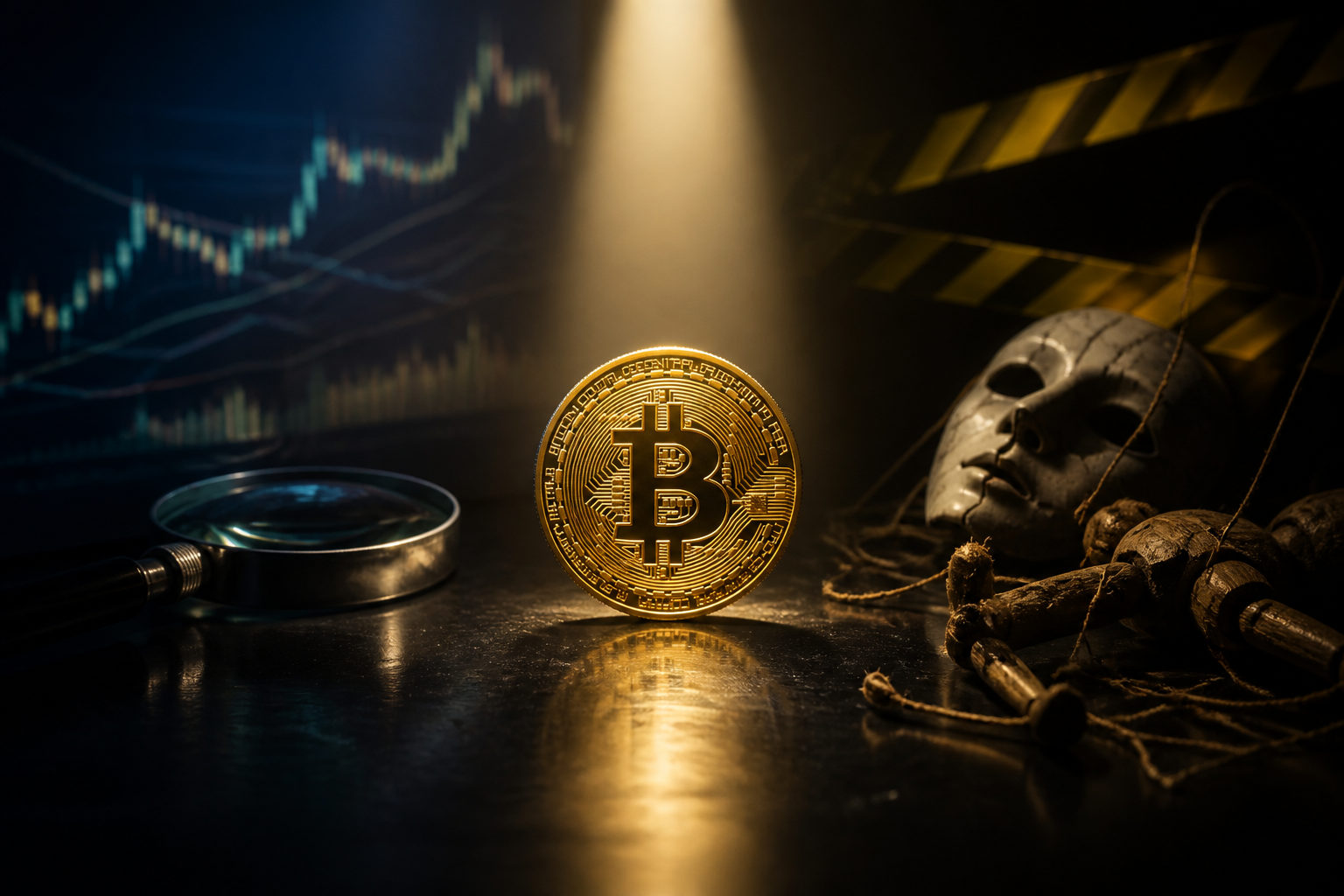
Bitcoin is not a single con, but many scams use its name. The right question is not only whether Bitcoin is trustworthy, but whether you are looking at the network itself, a risky asset, or a person trying to sell you a false promise.
Why people suspect Bitcoin is a con
Most people asking about “con bitcoin” are not looking for a technical definition. They want to know whether Bitcoin is built to trick buyers, or whether the danger comes from the way it is promoted and sold. That concern makes sense because Bitcoin is hard to value in the same way as a stock or a business, and its price can move sharply.
There is also a practical reason for the suspicion. Many losses tied to Bitcoin come from fake exchanges, account takeover schemes, paid signal groups, managed account offers, and “guaranteed return” pitches. A victim may remember that Bitcoin was part of the story, even if the real fraud was a third party using Bitcoin as bait.
Another source of confusion is the way the topic gets framed. One side treats Bitcoin as a cure for every problem in finance. The other side treats it as proof that digital assets are pure deception. Neither view helps a reader who is trying to tell the difference between an open protocol and a classic fraud.
Why Bitcoin itself does not fit the usual fraud pattern
A con usually depends on hidden rules, invented returns, restricted exits, or false claims about where money comes from. Bitcoin does not work like that at the protocol level. Its design was introduced in the 2008 white paper Bitcoin: A Peer-to-Peer Electronic Cash System, the genesis block appeared in January 2009, the supply cap is 21 million coins, and the issuance schedule is public.
That does not make Bitcoin safe, stable, or suitable for everyone. It does mean that calling it a con is often too broad to be accurate. Bitcoin does not promise fixed income. It does not require trust in a company that secretly controls the rules. It does not come with an official salesperson who can guarantee that you will profit.
So the more precise description is this: Bitcoin is a volatile digital asset with open rules and very real risks. Whether it is a good investment is one question. Whether it is a con is a different one.
Where the real danger usually appears
If you want to avoid getting burned, focus on the layers around Bitcoin. In many cases, the biggest risk sits with custody, platforms, and sales tactics rather than with the network itself.
- Guaranteed profit claims: If someone promises low risk, fixed returns, or easy money from Bitcoin, treat that as a warning sign. Bitcoin itself does not offer a built-in yield guarantee.
- Fake platforms and fake support staff: A site or app may look real and still be designed to collect deposits you cannot withdraw. Some scams also use impersonation, then pressure users into sending funds to the wrong address or account.
- Managed account and custody traps: Giving another person control over your account, private keys, or recovery phrase is not a small convenience. It is giving away the asset itself.
- Referral-driven schemes: Some operations wrap themselves in Bitcoin language while the real business model depends on recruiting new participants. If payouts rely on fresh deposits more than a verifiable product or service, the structure deserves suspicion.
- Emotion-driven buying: This is not always fraud, but it causes many people to misread what happened. They buy at a heated moment, face a sharp drop, and then decide the asset must have been a con from the start.
How to judge Bitcoin-related claims more clearly
Start by asking what the speaker wants from you. Useful education explains how Bitcoin works, what the risks are, and what control of funds really means. Manipulative pitches push you to deposit now, join a private group, install a specific app, or hand over control to an “expert.”
Next, look for claims you can verify. Sound explanations usually mention basic facts such as the 21 million supply cap, the role of private keys, the rough ten-minute block interval, and the halving schedule that occurs about every 210,000 blocks. Weak pitches avoid mechanics and focus on urgency.
It also helps to separate disagreement from deception. A person can dislike Bitcoin, think it has no lasting value, or reject it as an investment. That is not the same as proving Bitcoin is a con. A bad asset for one investor is still not automatically a fraud.
FAQ
Is Bitcoin itself a con?
No single answer fits every use case, but Bitcoin itself does not match the standard structure of a fraud. The larger problem is that many scams borrow Bitcoin language to appear modern or credible.
Why do so many people say Bitcoin is a scam?
Some people are reacting to losses caused by volatility. Others were caught by fake platforms, fake advisers, or return guarantees that had little to do with Bitcoin's actual design.
Does Bitcoin have value if it is not backed by a physical asset?
Value does not depend only on physical backing. In Bitcoin's case, people argue about scarcity, transferability, verifiability, and market demand, but none of that removes the risk of steep price moves.
How can beginners avoid Bitcoin-related fraud?
Do not hand over your recovery phrase, private keys, or account access. Be skeptical of anyone promising steady returns, and verify the service you use before sending funds.
What should I learn before buying Bitcoin?
Learn the basics of custody, private keys, transaction finality, and why the supply is limited. Once those ideas are clear, it becomes easier to judge whether a pitch is education, speculation, or a plain con.
If your real concern about “con bitcoin” is whether you can be tricked, the safest first move is simple: slow down whenever someone adds urgency, secrecy, or guaranteed outcomes. In this area, clear separation between the asset, the platform, and the promoter prevents many avoidable mistakes.
Disclaimer: This article is for informational and educational purposes only and is not investment, financial, or legal advice. Crypto assets are highly volatile and you could lose your entire investment. Do your own research and decide carefully.