
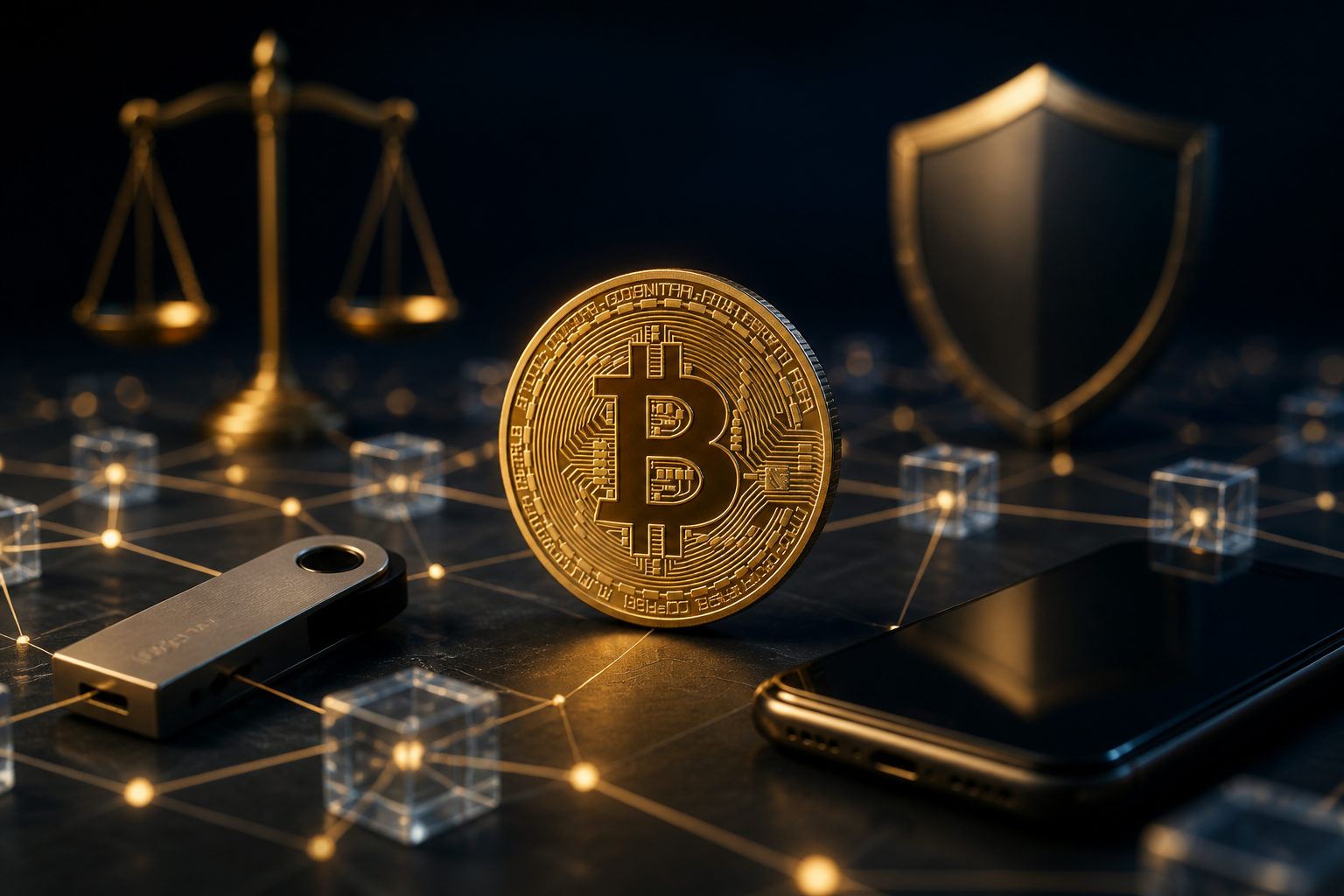
What to know about bitcoins starts with the basics: Bitcoin is a decentralized digital asset with a fixed supply cap, a public blockchain, and a history of sharp price swings.
That answer sounds simple, but most beginners run into trouble because they skip the basic structure. They focus on whether Bitcoin is worth buying before they understand what they would actually own, who controls access, and where the main risks sit. If those parts are fuzzy, every later decision gets harder.
What Bitcoin actually is
Bitcoin, often written as BTC, comes from the 2008 white paper Bitcoin: A Peer-to-Peer Electronic Cash System by the pseudonymous creator Satoshi Nakamoto. The network began with the genesis block in January 2009. Satoshi's real identity remains unknown.
At a basic level, Bitcoin is a native digital asset that operates on a public blockchain. It is not a company share, not a bank balance, and not a loyalty point inside a private app. The ledger is maintained by a distributed network rather than by one central bookkeeper.
People often mix up Bitcoin, blockchain, crypto, and tokens as if they all mean the same thing. They do not. Bitcoin is one specific asset. Blockchain is the recordkeeping system. Crypto is the broader category that includes Bitcoin and many other assets. Keeping those distinctions clear helps you read market coverage without getting lost in marketing language.
How Bitcoin works in practice
Bitcoin uses a distributed network of nodes that store and verify the ledger. Transactions are checked by the network, grouped into blocks, and added to the chain of prior blocks. The system relies on proof of work to order transactions and secure the history of the ledger.
There are a few base rules worth knowing from the start. Bitcoin has a maximum supply of 2100 million? No. The correct fixed cap is 2100 万枚 in Chinese terms, which in English is 21 million coins. The network produces a block about every 10 minutes. The block reward is cut in half roughly every 4 years, or every 210000 blocks, with halvings having taken place in 2012, 2016, 2020, and 2024.
Those facts matter because they explain Bitcoin's supply schedule. New supply does not expand on demand, and it is not adjusted by a central issuer reacting to short-term conditions. That does not make Bitcoin stable. It does make its issuance path unusually transparent compared with many other assets.
Another common misunderstanding is the idea that you need to buy a full coin to participate. You do not. Bitcoin can be divided into smaller units. The smallest unit is 1 satoshi, which equals one hundred millionth of a BTC. For most people, the first question is not whether they can buy a whole coin, but whether they understand what they are buying and how they plan to hold it.
Why Bitcoin has value and why that does not remove risk
When people ask what to know about bitcoins, they are often really asking why anyone would pay real money for them. The usual answers include scarcity, verifiability, transferability, divisibility, and the ability to move value across a global network without relying on a single issuer.
Scarcity comes from the fixed supply cap. Verifiability comes from open rules and a public ledger. Transferability means Bitcoin can be moved on-chain without depending on the operating hours of a traditional institution. Divisibility makes it usable in small amounts as well as large ones. For many holders, that mix is the core of the thesis.
Still, value is not the same as price stability. Bitcoin does not produce guaranteed income, and it does not come with a built-in promise of steady returns. Its market price is formed by buyers and sellers, and that price can move hard in either direction. Factors that often shape price include:
- Shifts in supply and demand
- Changes in investor risk appetite
- Liquidity conditions in broader markets
- Regulatory expectations and access points
- Behavior by large holders and institutions
- Security concerns, exchange events, and industry stress
That is why a simple yes-or-no answer to whether Bitcoin is worth buying is rarely useful. A person looking for short-term momentum is facing a very different decision from someone building a long-term allocation. A person who wants stability is also asking a different question from someone who can tolerate deep drawdowns.
What beginners should understand before buying or storing Bitcoin
Owning Bitcoin is not the same as having price exposure
Many newcomers think they own Bitcoin when they really hold a product linked to its price or keep everything inside a third-party platform account. Both choices may track market moves, but they are not the same in terms of control. That difference matters most when conditions turn messy.
If you hold on-chain Bitcoin, the key question is who controls the private keys or seed phrase. If that control belongs to a platform, then your access depends on that platform's systems, rules, and withdrawal process. Convenience can be useful, but it should not be confused with direct ownership.
A wallet manages keys, not coins sitting inside your phone
This point clears up a lot of confusion. Bitcoin is not stored inside your laptop or mobile device the way a file is stored in a folder. The asset record exists on the blockchain. A wallet is the tool that helps you create, store, and use the keys that authorize movement from a given address.
That is why private keys and seed phrases require strict handling. If someone else gets them, they can usually control the associated funds. Saving a seed phrase in a cloud note, sending it through a chat app, or giving it to a fake support agent are all high-risk mistakes.
Exchanges are useful, but they introduce counterparty risk
For many people, a regulated or widely used exchange is the easiest entry point. Buying, selling, and checking a portfolio are usually more straightforward there. The tradeoff is that platform risk enters the picture. Your experience then depends not only on the market, but also on the exchange's operations, controls, and withdrawal rules.
For a small learning position, a platform account may be enough. For longer-term holding, many users place more weight on direct control and backup planning. Neither route is automatically correct for everyone. The useful step is to separate market risk from platform risk before you decide how to hold.
Volatility is not a side effect
Bitcoin has a long record of sharp swings. That volatility is not a temporary glitch that disappears once you understand the story. It is part of the asset's character. Periods of strong upside can be followed by deep pullbacks, sometimes with very little warning.
Because of that, the practical question is not whether volatility exists. The question is whether your own plan accounts for it. How much can you allocate without harming your day-to-day finances? Would a large drawdown push you into panic selling? Do you plan to buy in stages, or are you treating this as a speculative trade? Those answers matter more than any slogan.
What to check when buying, storing, and tracking Bitcoin
If you plan to move from reading to action, focus on three areas: where you buy, how you store, and how you check the market. Most beginner mistakes show up in one of those places.
Before you buy
- Check whether the platform explains identity verification and security settings clearly
- Confirm whether withdrawals are supported and how that process works
- Read the fee schedule and trading rules before funding an account
- Use account protections such as two-factor authentication
A polished interface is not enough. In any money-related service, clear rules, withdrawal access, and basic security controls matter far more than design.
When you store Bitcoin
- Know the difference between an address, a private key, and a seed phrase
- Keep backups offline when possible
- Reduce single points of failure in your backup setup
- Be able to spot fake wallets, phishing pages, and impersonation scams
A large share of losses does not come from the Bitcoin protocol failing. It comes from users sending funds to the wrong network, exposing seed phrases, or trusting fake support messages. Running through the full process with a small amount before moving anything larger is the safer approach.
Where to check the live price
This is an evergreen guide, so it does not include current market numbers. If you want the live Bitcoin price, check a major market data platform, a spot trading page on a reputable exchange, or a well-known data aggregator, and compare across sources. Small differences between platforms can happen because of liquidity and pricing methods.
It also helps to confirm what you are looking at. Is the number a spot price or a derivatives quote? Is the unit correct? Has the page refreshed recently? A surprising number of mistakes start with reading the wrong market rather than with poor analysis.
FAQ
What should a beginner learn first about Bitcoin?
Start with the basics: what Bitcoin is, how its supply works, and whether the thing you bought gives you direct control or only price exposure. If those points are clear, every other step becomes easier.
Do I need to buy a whole Bitcoin?
No. Bitcoin is divisible, and the smallest unit is 1 satoshi, or one hundred millionth of a BTC. For most people, the key issue is not buying a full coin but understanding risk and storage.
Is Bitcoin the same thing as blockchain?
No. Bitcoin is a specific digital asset, while blockchain is the ledger structure that records transactions. Bitcoin uses a blockchain, but the two terms are not interchangeable.
Is it unsafe to leave Bitcoin on an exchange?
Not every platform is the same, so a blanket answer is not very useful. Exchange custody can be convenient, but it adds counterparty and policy risk. Whether it fits you depends on your size, frequency of use, and comfort with self-custody.
How can I tell if I am just following the crowd?
Ask yourself what you would do during a steep drop, whether you are willing to learn basic wallet security, and whether you have a plan beyond reacting to headlines. If you cannot answer those questions yet, more study before buying is usually the better move.
If you want a practical next step, do two things before committing serious money: learn the core terms from a reliable source, and test the full process with a small amount, including purchase, withdrawal, backup, and receipt confirmation. Until you can complete that cycle calmly, you do not fully understand your own operational risk.
Disclaimer: This article is for informational and educational purposes only and is not investment, financial, or legal advice. Crypto assets are highly volatile and you could lose your entire investment. Do your own research and decide carefully.