
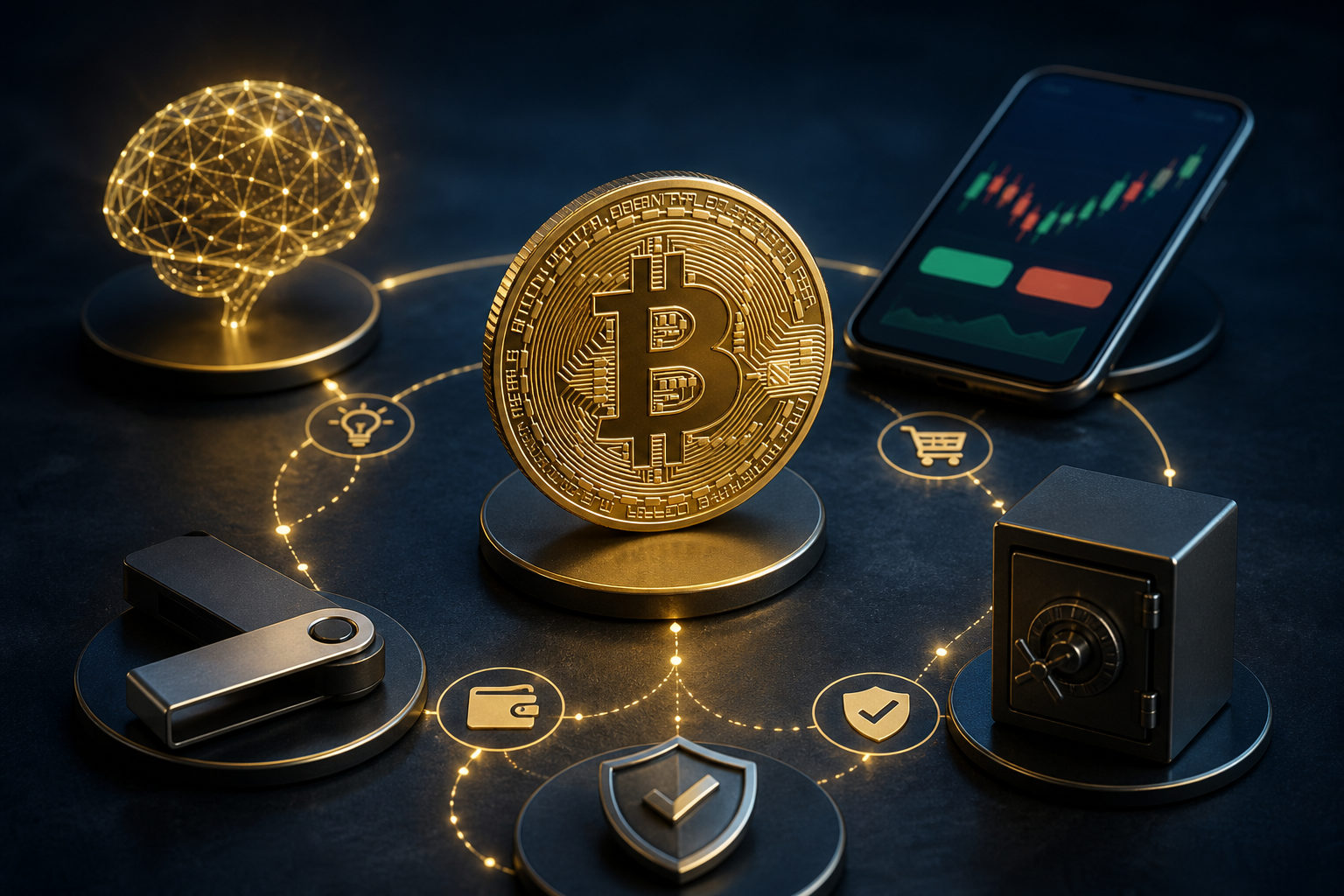
This guide to bitcoin starts with the short answer: Bitcoin is a digital asset that runs on a blockchain, without a single issuer, and users can hold it, send it, and verify the network themselves.
For beginners, the confusing part is rarely one term on its own. The trouble starts when price, wallets, exchanges, mining, and security all show up at once. Once those pieces are separated, Bitcoin becomes much easier to understand.
What Bitcoin is
Bitcoin, often written as BTC, was introduced in the 2008 paper Bitcoin: A Peer-to-Peer Electronic Cash System. Its first block, known as the genesis block, appeared in January 2009. The creator used the name Satoshi Nakamoto, though the person or group behind it remains unknown.
People describe Bitcoin in different ways. Some see it as internet-native money for direct transfers. Others treat it as a scarce digital asset. Both views matter because Bitcoin is both a payment network and an asset that trades in open markets.
Its supply has a fixed upper limit of 21 million coins. You do not need to buy a whole bitcoin to get started, since BTC can be divided into smaller units. The smallest unit is a satoshi, and 1 satoshi equals one hundred millionth of a BTC.
How Bitcoin works
You do not need to read code to understand the basics. Focus on three ideas: transactions are broadcast to a distributed network, miners package them into blocks, and nodes check whether those blocks follow the rules.
When someone sends bitcoin, that transaction is shared across the network. Miners compete to add transactions to a block, and a new block is added about every 10 minutes. Blocks link to earlier blocks, creating the chain of records called the blockchain.
Mining is the process that helps secure the network while issuing new coins under preset rules. The issuance rate drops roughly every 4 years, or every 210,000 blocks, in events known as halvings. Halvings have taken place in 2012, 2016, 2020, and 2024.
One mistake beginners make is assuming their bitcoin sits inside an app. A more accurate way to think about it is this: control comes from private keys. Wallet software gives you a way to manage those keys and sign transactions, but the asset itself is tied to the network's records.
What beginners should learn first
Know the difference between an exchange and a wallet
An exchange is mainly for buying and selling. A wallet is mainly for storage and transfers. Some products combine both functions, which is convenient, but the distinction still matters because trading access and asset control are not the same thing.
If you plan to hold bitcoin over a longer period, you should pay close attention to who controls the private keys. If you are only learning how the market works, your focus may be on fees, withdrawal rules, account protection, and how clearly the service explains its process.
Understand what moves the price
If you came here looking for a guide to bitcoin because you also want to understand the price, the key point is simple: the market sets it through ongoing buying and selling. Supply rules are easier to describe than demand, which can shift with risk appetite, regulation, macro conditions, and market mood.
That is why single-cause explanations often miss the full picture. If you want a live quote, check a major market data service or a trading platform on the day you are looking, and remember that small differences between venues can appear.
Build security habits early
For a beginner, security matters more than trying to call the next move. Turn on two-factor authentication, keep backups separate, avoid storing seed phrases on internet-connected devices, and treat unsolicited messages as suspicious.
A short rule helps here: whoever controls the private key or seed phrase usually controls the bitcoin. If that information is exposed, recovery can be extremely difficult.
How to get started with Bitcoin
The best starting plan is usually a simple one. You do not need to do everything at once, and trying to learn trading, wallets, and market timing on the same day often leads to preventable mistakes.
- Learn the basic terms first, including blockchain, wallet, private key, address, and confirmation.
- Choose a service with clear rules, visible security measures, and easy-to-find fee and withdrawal information.
- Start small so you can practice buying, receiving, sending, and checking an address without adding unnecessary pressure.
- Decide whether your goal is active trading or longer-term holding, then pick a storage setup that fits that goal.
- Keep personal notes on why you entered, what risks you accept, and what would make you change your plan.
Many people ask about the perfect time to buy before they know how to move funds safely. That order is backwards. A better first milestone is being able to complete a purchase, verify an address, make a backup, and avoid common scams without guessing.
FAQ
How should a complete beginner learn about Bitcoin?
Start with the core functions rather than market talk. If you understand what Bitcoin is, how transactions are confirmed, and why private keys matter, the rest becomes easier to place in context.
Can I buy less than one bitcoin?
Yes. Bitcoin is divisible, so you do not need to purchase a full coin. For most beginners, position size should depend on risk tolerance and budgeting, not on the idea of owning exactly one BTC.
Is a Bitcoin wallet the same as a trading app?
No. A trading app focuses on buying and selling, while a wallet focuses on holding keys and sending or receiving funds. Some services combine both, but the roles are still different.
Why is a Bitcoin transfer not always instant?
After a transaction is broadcast, it still needs to be included in a block and confirmed by the network. The waiting time can vary with network activity and the fee attached to the transaction.
Do beginners need to self-custody right away?
Not always on day one, but they should understand what self-custody means early. Even if you begin with a custodial service, learning how private keys and backups work will help you make better choices later.
Risks people often ignore at the start
Price swings get most of the attention, but beginner mistakes often come from elsewhere: fake support messages, phishing pages, unsafe downloads, lost backups, and sending funds to the wrong address. Those problems are less dramatic than market moves, yet they can be just as costly.
Before you do anything else, check two things: whether the service you use explains its rules clearly, and whether your backup method works without relying on a single device. That gives you a stronger base than chasing a chart before you understand the tools.
Disclaimer: This article is for informational and educational purposes only and is not investment, financial, or legal advice. Crypto assets are highly volatile and you could lose your entire investment. Do your own research and decide carefully.