
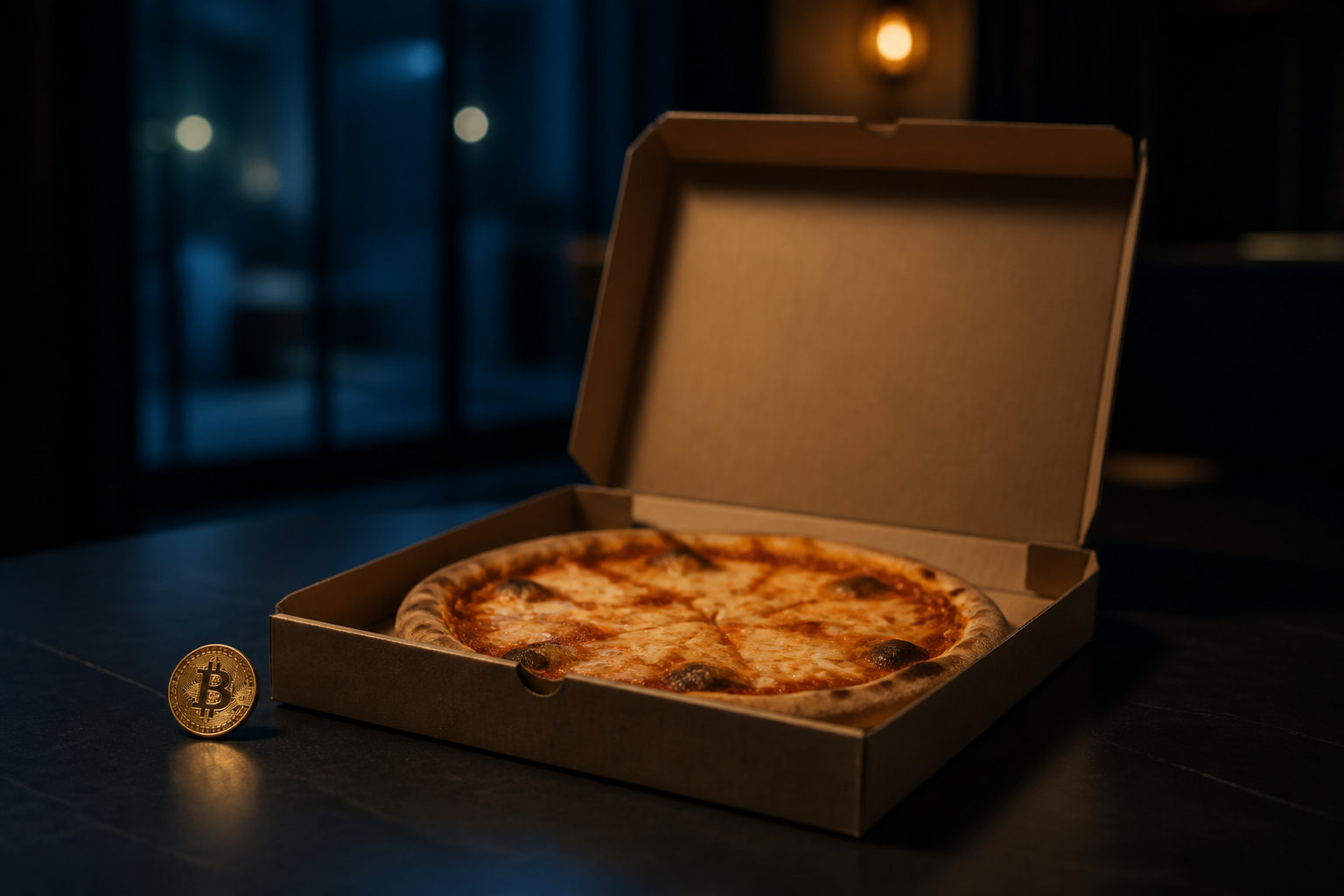
The story of a guy who bought pizza with bitcoin matters because it showed bitcoin could be used to exchange for a real product. For most readers, the useful question is not who got the pizza. It is what that event still teaches about bitcoin, payment risk, and scams.
Why this story still comes up
Bitcoin launched with the genesis block in January 2009, and its original design was described in the 2008 white paper, Bitcoin: A Peer-to-Peer Electronic Cash System. A real purchase gave people a simple way to understand something that had previously looked abstract. Instead of seeing bitcoin only as software and ledger entries, people could now point to a concrete exchange between two parties.
That is the real reason the pizza story stays alive. It showed that bitcoin could do more than move between early users. It could function as a payment instrument when both sides agreed to use it. That may sound obvious now, but for a new network, a real transaction carries a different weight from a technical demo.
The story also helps separate two ideas that are often blended together online. One is bitcoin as a network for transferring value. The other is bitcoin as an asset people hold for future upside. The pizza story belongs to the first category. Many bad articles drag it into the second without explaining the gap.
How to read the pizza story without getting pulled into hype
Step one: identify whether the writer is explaining adoption or selling urgency
When a piece mentions that a guy bought pizza with bitcoin, stop and look at what comes next. Does it explain why a real purchase mattered for bitcoin's early use, or does it rush straight into fear of missing out? A useful article will stay focused on adoption, payment use, and the role of voluntary acceptance. A weak or manipulative one will use the story as emotional bait.
This matters because historical stories lower people's guard. Readers think they are consuming culture or trivia, then get nudged toward a wallet download, a private group, or a money transfer. The shift can happen fast, especially when the story is framed as proof that huge gains always come from acting early.
Keep those claims separate in your head. A famous old transaction may be real, but that does not make today's pitch reliable.
Step two: keep confirmed facts apart from decorative details
Crypto history picks up extra details as it spreads across social media, videos, and recycled blog posts. You do not need to verify every retelling, but you should know where the firm ground is. The core facts you can rely on are bitcoin's early timeline, the white paper title, the idea of peer-to-peer electronic cash, and the broader significance of a real-world purchase.
Everything built on top of that deserves more caution, especially when the extra details are used to support a product sale or a trading promise. Scammers often mix a true historical event with a false modern conclusion. That blend works because readers stop checking once they recognize part of the story.
If a source cannot explain why the event mattered without adding dramatic claims, it is usually not trying to educate you. It is trying to move you.
Step three: treat “can be used for payment” and “works well for this payment” as different questions
One of the easiest mistakes for beginners is assuming that because bitcoin was used to buy a real item, it must fit every payment setting today. That does not follow. Bitcoin transactions settle within the rhythm of block production, with a new block about every 10 minutes. In practice, that means user experience depends on the setting, the recipient's expectations, and the way payment confirmation is handled.
A merchant, a private seller, and a friend will not all judge payment finality in the same way. Some care about seeing a transaction broadcast. Others wait for more confirmation. Some quote a price for a short time and then expect a refresh. Those details shape whether the payment feels smooth or stressful.
That is why the pizza story is helpful only if you use it to ask better questions. Who accepts bitcoin? Under what terms? What counts as paid? How much room is there for timing issues or misunderstanding? A historic example can point you toward these questions, but it cannot answer them for a current transaction.
Step four: be careful when someone offers to help you “recreate” the experience
Scam attempts often hide behind harmless curiosity. A person may say they can help you try a bitcoin purchase, source a gift card, act as a payment middleman, or walk you through your first wallet setup. The pitch sounds casual, which is part of the trap. Once you engage, the request changes from guidance to access.
Common danger signs include asking you to send bitcoin first so they can pay on your behalf, urging you to install an unknown extension, requesting a screen share, or telling you to paste your recovery phrase into a form. None of that is required for a normal bitcoin payment. If someone wants your wallet credentials, they are asking for control.
That is the point where you stop. A legitimate payment flow does not require you to surrender your recovery phrase, private keys, login codes, or device access.
If you want to try a bitcoin payment, use a cautious process
Start with wallet control before you think about shopping
The first practical lesson from the pizza story is not about food or timing. It is about understanding what a wallet actually does. A bitcoin wallet does not store coins the way a physical wallet stores cash. It manages the credentials that let you control bitcoin on the network.
If you do not understand the difference between a hosted account balance and self-custody, slow down before making any payment attempt. A balance shown inside a service is not the same thing as direct control. The same goes for recovery phrases and private keys. If they are exposed, copied, or handed to someone else, your security model breaks.
Many beginners create risk long before they send a transaction. They save sensitive wallet information in cloud notes, screenshots, chat apps, or email drafts. Those are easy places for secrets to leak. Learn your wallet's backup process first, then decide whether you are ready to use bitcoin for real payments.
Run a small test to learn the interface, not to prove speed
Your first test should be about recognition and accuracy. Confirm how your wallet displays addresses, amounts, and network prompts. Check whether you can tell the difference between BTC and smaller units. One satoshi is one hundred millionth of a BTC, and that unit difference matters when you are trying to avoid costly input mistakes.
Do this without outside pressure. A scammer posing as support may offer to guide your first transfer step by step. During that process, they may direct you toward malware, alter copied address data, or push you into approving actions you do not understand. Learning under someone else's control is not learning at all.
A calm test helps you build your own verification habits. That is more valuable than trying to make your first transaction feel fast.
Before paying anyone, clear up the payment terms in plain language
Real payment risk often sits outside the transaction itself. You should know whether the other side accepts bitcoin directly, how long a quoted amount remains valid, what they count as receipt, and what happens if the payment is delayed or sent incorrectly. If those terms are vague, the problem is not technical. It is procedural.
This is especially important in chat groups, private messages, and social marketplaces. If a seller changes the receiving address at the last minute, rushes you, or relies on phrases like “everyone does it this way,” take that as a warning. A trustworthy process can be explained clearly before funds move.
Written records matter here. Keep the terms visible before you send anything, so you are not arguing over memory after the transaction is already on the network.
After sending, verify your own records first
Once you broadcast a transaction, review the address, amount, and status shown in your own wallet before getting drawn into back-and-forth messages. People often rush to send screenshots and ask for reassurance, which can distract them from checking the details that matter most.
If something looks wrong, do not keep sending transactions in panic. Do not trust anyone who says an extra payment will reverse the previous one or release stuck funds. Bitcoin transfers have very limited reversibility, and rushed follow-up actions often deepen the loss.
Your best defense is a slow sequence: verify, compare, then communicate. That order catches more mistakes than frantic messaging ever will.
What the pizza story says about bitcoin itself
Bitcoin has a fixed supply cap of 21 million coins. Its smallest unit is the satoshi, and one satoshi equals one hundred millionth of a BTC. New blocks are produced about every 10 minutes. The issuance schedule changes through halvings that occur about every 4 years, or every 210,000 blocks, with halving years including 2012, 2016, 2020, and 2024.
Those rules matter because they shape how people think about bitcoin. Some view it mainly as a payment system. Others focus on scarcity and long-term holding. The pizza story stays relevant because it connects the rule set to actual human use. It is one thing to read that value can move peer to peer. It is another to see that someone was willing to exchange a real item for it.
That does not settle every argument about bitcoin's best use today. It does show that a network starts to matter differently once people trust it enough to use it in ordinary transactions.
FAQ
Why does the “guy bought pizza with bitcoin” story keep showing up?
Because it gives people a simple example of bitcoin being used in a real purchase. The story is remembered as a symbol of early adoption rather than as a comment on pizza itself.
Does this story mean bitcoin is ideal for everyday spending now?
No. It shows that bitcoin can be used for payment, but each payment setting has its own trade-offs. Merchant rules, confirmation expectations, and price movement all affect whether it feels practical.
What is the biggest scam risk if I want to try a bitcoin payment?
The biggest risk is handing control to someone else. If a person asks you to send funds to them first, share your recovery phrase, reveal private keys, or install unknown remote tools, stop immediately.
Why do so many articles jump from the pizza story to investment talk?
Because the story triggers regret and imagination. Marketers use that feeling to push readers toward quick decisions, even though a historical payment event does not validate a present-day offer.
Where should I check the live bitcoin price?
Use public quote pages from major market data sites or the pricing screens of services you already use, and compare more than one source. A screenshot or a price posted in a chat group should not be treated as enough.
If you want one practical takeaway from the pizza story, make it this: learn how a bitcoin payment works before you try one, and keep wallet control in your own hands from start to finish.
Disclaimer: This article is for informational and educational purposes only and is not investment, financial, or legal advice. Crypto assets are highly volatile and you could lose your entire investment. Do your own research and decide carefully.