
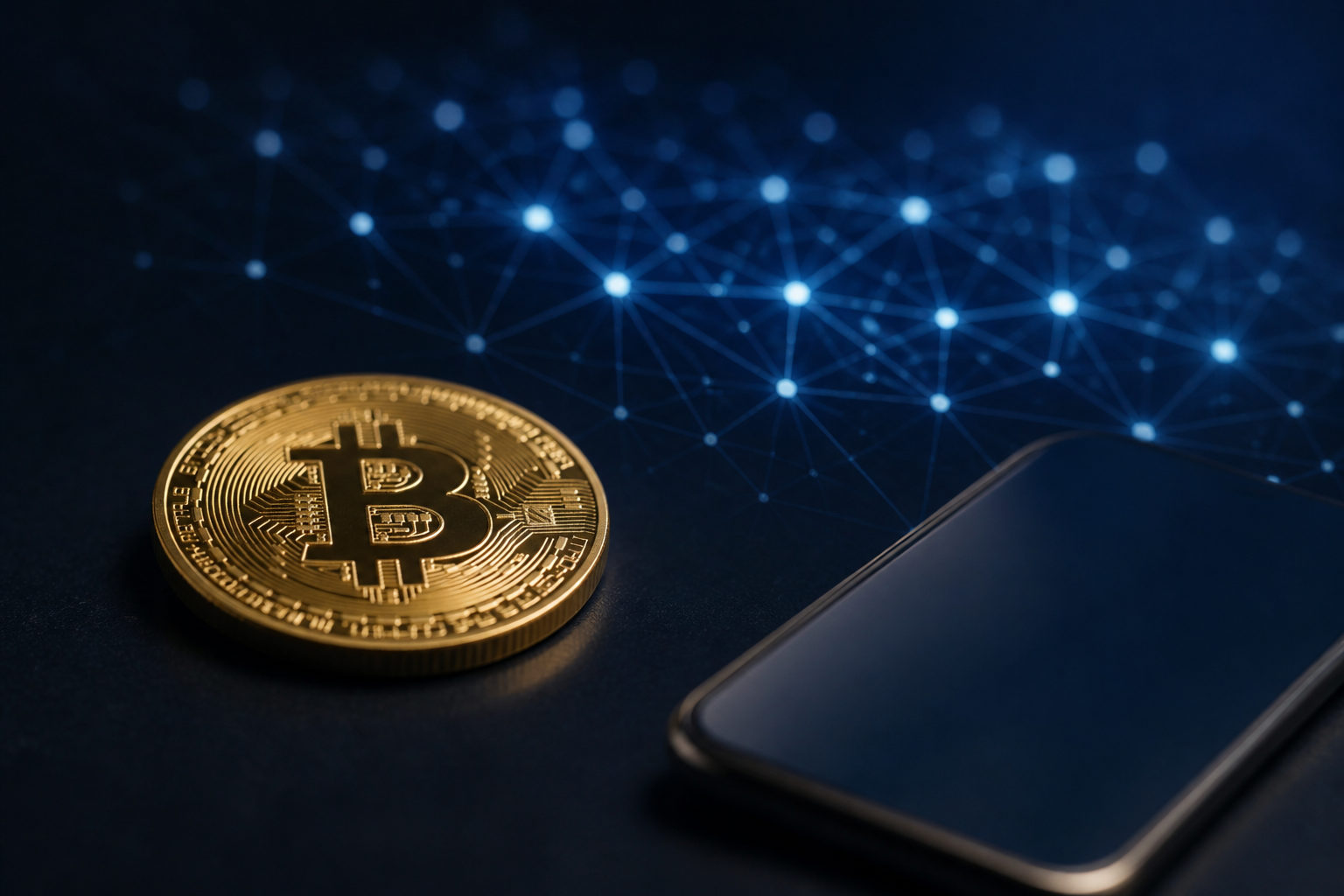
How do bitcoins look? For most people, bitcoin does not appear as a physical coin at all. What you actually see is usually a wallet balance, a receiving address, a QR code, or a transaction record on the blockchain.
Why bitcoin is often shown as a gold coin
Search for bitcoin and you will quickly run into the same image: a shiny gold coin with a large B on it. That picture is useful for headlines, app icons, and thumbnails because it tells readers the topic in a split second. It is a symbol, not the thing itself.
This matters because many beginners carry over expectations from cash. Banknotes have a standard design. Coins have shape, weight, and markings. Bitcoin does not work that way. It is a digital asset recorded on a distributed ledger, so the image people associate with it is mostly a piece of visual shorthand created by media and platforms.
That is why the answer to “how do bitcoins look” depends on context. In a news article, bitcoin may look like a stylized coin. Inside a wallet app, it looks like a balance and a list of transactions. In a blockchain explorer, it looks like structured data tied to addresses and transaction identifiers.
| Where you see it | What it looks like | What it really means |
|---|---|---|
| News image or thumbnail | Gold coin with a B symbol | Visual branding for the topic |
| Wallet app | Balance, send and receive buttons, history | Your interface for using bitcoin |
| Receiving screen | Address string or QR code | Payment destination for incoming bitcoin |
| Blockchain explorer | Transaction details and block data | Public record of network activity |
What bitcoin looks like in normal use
If you actually use bitcoin, the most common view is a software screen. A wallet usually shows your balance, recent activity, and tools to send or receive funds. When someone wants to pay you, you do not hand over a coin. You show a receiving address or a QR code that encodes that address.
After a payment is sent, what you watch for is not a coin moving across the screen in a literal sense. You look for an entry in your wallet, a pending or confirmed status, and the amount reflected in your records. For most users, this is the practical appearance of bitcoin: data presented through software.
That can feel abstract at first, especially if you are expecting something tangible. Yet this is the normal form of a natively digital asset. Bitcoin is recognized through verifiable records, not through a standard physical design.
Another common misunderstanding is to imagine that the wallet app stores visible “coins” inside it. In practice, the wallet is mainly a tool for managing keys and reading the blockchain state connected to your addresses. What you see is an interface layer that helps you act on those records.
Are physical bitcoins real bitcoins
You can buy metal tokens, souvenir coins, gift cards, and decorative items that carry the bitcoin symbol. Some look polished and official enough to convince a newcomer that they represent actual bitcoin. Many do not. A physical object can reference bitcoin without containing or controlling any bitcoin at all.
There have also been physical formats that include sensitive information linked to control of funds, such as hidden key material or recovery details. In those cases, the item is only meaningful if the related access information is authentic and has remained private. The metal, plastic, or printed design is still secondary. Control is what matters.
So when someone shows you a “physical bitcoin,” the first question is not what it looks like. The first question is whether it gives verified control over any bitcoin on the network. If the answer is unclear, the object may be only a collectible.
| Item type | How it appears | Does it equal owning bitcoin | Main thing to check |
|---|---|---|---|
| Souvenir coin | Metal token with BTC branding | No | Usually decorative or collectible |
| Printed card with address | Card with text and QR code | Not automatically | Need to verify any linked funds |
| Physical item with hidden access data | Sealed or covered information area | Possibly | Privacy and authenticity of the data |
| Wallet balance on screen | Numbers and transaction entries | Yes, this is the common user view | Who controls the wallet keys |
Why bitcoin has no single fixed appearance
Bitcoin does not come from a central issuer printing a standardized note or minting a government coin. It exists as a network with rules for ownership, validation, and transfer. Because of that, there is no official shape, color, portrait, or surface pattern that every bitcoin must have.
Different apps also choose different ways to display the same asset. One wallet may show a very simple screen with only essential actions. Another may place more emphasis on transaction details and account structure. The design can change from app to app while the underlying bitcoin remains the same.
This is also why strong visual marketing can be misleading. If a page leans heavily on glossy coin imagery but says little about addresses, transaction verification, or control of funds, it may be selling the appearance of bitcoin rather than explaining bitcoin itself.
A useful mental model is to think of bitcoin as something you confirm rather than something you inspect by shape. You verify that it has been sent, that your wallet can detect it, and that you control the keys needed to move it. That is much closer to reality than any stock image.
How to read bitcoin images without getting confused
Start by asking what role the image is playing. If it appears on an article header or social post, it is probably just a topic marker. If it appears in a wallet screenshot, look for practical elements such as a receiving address, QR code, transaction history, or confirmation status.
Then ask what claim is being implied. Some pages use a realistic coin design to make ownership feel simple and physical, which can blur the difference between a collectible item and actual bitcoin. A better check is always operational: can the funds be received, verified, and controlled through a wallet?
If your goal is to understand what bitcoin really looks like, spend more time with a wallet interface than with promotional graphics. Once you recognize how addresses, balances, and transaction records fit together, the common coin image becomes easier to place in context.
FAQ
Does bitcoin look like a gold coin with a B on it
Usually no. That image is a visual symbol used in media and product design. In real use, bitcoin is more likely to appear as wallet data and blockchain records.
If I buy a metal coin with the bitcoin logo, do I own bitcoin
Not by default. It may be only a souvenir or collectible. Ownership depends on whether you have verified control over actual bitcoin tied to a wallet or access data.
Is a bitcoin address the same thing as bitcoin itself
No. A bitcoin address is a destination for receiving funds. It helps direct a payment, but it is not the asset on its own and does not prove secure ownership by itself.
Why does my wallet show numbers instead of actual coins
Because bitcoin is tracked through digital records rather than physical units. The wallet shows the information you need to use and verify the asset, which is far more useful than a decorative coin graphic.
Can a screenshot prove that someone has bitcoin
Not reliably. A screenshot can be edited, borrowed, or taken out of context. The meaningful proof is whether the person can demonstrate control of the relevant wallet and whether the transaction records can be verified.
If you want a concrete way to understand the look of bitcoin, open a wallet and study the receive screen, the QR code, and the transaction list. Those three views will teach you more than any gold coin image ever will.