
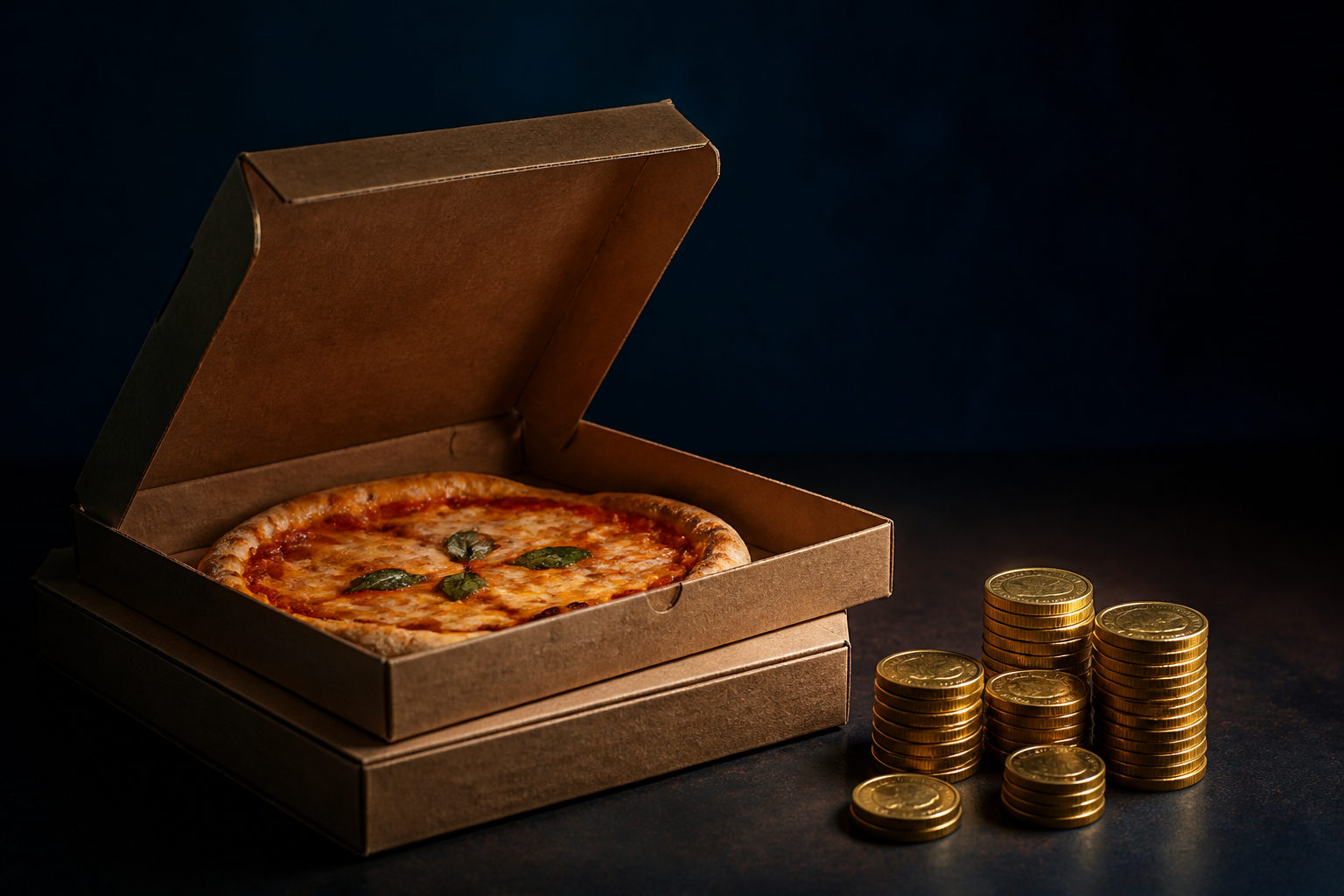
The famous pizza purchase was paid with 10,000 bitcoins. That is the short answer. The more useful answer is why people still care: the trade showed that Bitcoin could be exchanged for a real-world item, not just passed around inside a small technical community.
Start with the number, then ask what the trade actually proved
When people search for how many bitcoins the guy paid for pizza, they usually want more than a trivia answer. They want the number, the reason the story matters, and whether it means anything for decisions today. The first part is simple: 10,000 bitcoins. The other two parts are where most confusion starts.
| Question | Direct answer | Why it matters |
|---|---|---|
| How many bitcoins were used | 10,000 BTC | It is the best-known early spending example |
| Why the story is famous | Bitcoin was exchanged for a real product | It gave the idea practical meaning |
| How to read it today | As an early adoption case | It should not be reduced to hindsight jokes |
That last point is where many articles go off track. A lot of coverage treats the pizza story as a punchline about what those coins would be worth later. That reaction is easy to understand, but it strips away the part that made the event historically important in the first place.
A step-by-step way to read the pizza story without getting misled
Step one: lock in the answer, then move past trivia
The first thing to do is verify the core fact: the payment was 10,000 bitcoins. The reason is basic but important. If the central number is wrong, every later claim built on top of it becomes shaky.
The key caution here is not to stop at the number. The story matters because it attached Bitcoin to an ordinary purchase. Once a digital token can be exchanged for something tangible, people outside the original circle can understand its use more easily.
Step two: place the event in its early context
Many readers judge the trade with present-day knowledge. That creates a distorted view. Early participants were dealing with a new system that still needed real use cases, so the question was whether it could function in exchange, not whether holding every coin forever would look smart later.
This is why the story should be read as evidence of use, not simply as a tale of regret. Without early spending, there is no convincing demonstration that a monetary network can do more than exist on paper and on screens.
Step three: separate historical learning from present-day action
This topic attracts attention, and attention attracts sales pitches. Some posts use the pizza story to push sign-ups, deposits, wallet downloads, or private chat groups. They are not trying to teach history. They are using a famous example as a funnel.
The practical move is to treat the pizza purchase as a case study in adoption. It can improve your understanding of Bitcoin's early use. It should not push you into sending funds, joining a stranger's group, or handing over wallet access.
Why this trade still gets repeated so often
The story survives because it is easy to picture. Pizza is familiar. A purchase is easier to grasp than a technical explanation of peer-to-peer money. One transaction turns an abstract concept into something ordinary people can talk about.
| Reason the story lasts | What that looks like | Takeaway for readers |
|---|---|---|
| Simple setting | A common everyday product was bought | Bitcoin's use becomes easier to picture |
| Strong symbolism | Digital money met a physical good | Adoption stops feeling purely theoretical |
| Easy to retell | One memorable number and one familiar item | It became a standard beginner example |
| Easy to distort | Discussion often shifts to later value comparisons | Readers should watch for hindsight bias |
That final row matters more than it may seem. Once a story becomes famous, it often gets reused in low-quality content. Some explain what early Bitcoin adoption looked like. Others turn the story into pure emotional bait built around missed opportunity.
How to use the pizza story as a scam filter
If you are new to Bitcoin, this story may be one of the first things you learn. Scammers know that. They often attach fake offers or urgent prompts to famous topics because beginners are more likely to click when the subject already feels familiar.
| Check step | What to do | Why | Caution |
|---|---|---|---|
| Identify the real purpose | See whether the content is teaching history or pushing a money action | Scams often open with a popular story | If it quickly moves to deposits or transfers, stop |
| Protect sensitive wallet data | Never share seed phrases, private keys, or verification codes | Those details can give away control of funds | No support agent or community admin should ask for them |
| Check software sources | Only download wallet apps from trusted official channels | Fake apps can steal information or alter addresses | A themed event page does not make software safe |
| Pause before sending anything | Ask whether you are learning history or entering a live transaction | Excitement lowers attention to risk | If the process is unclear, do not send coins first |
This table may look simple, but it fits this topic well. A classic story creates trust too easily. That is exactly why it gets reused in fake giveaways, fake support chats, and wallet phishing schemes.
What beginners should actually learn from the pizza purchase
The first lesson is that history and decision-making are different tasks. Searching for the answer to this pizza question should teach you that Bitcoin gained meaning through real exchange, not through hindsight alone. That helps you understand adoption more clearly than any dramatic value comparison.
The second lesson is to verify facts in the right order. Start with the core fact, then read the context, then decide whether the story has any practical relevance for you. Reversing that order is how readers get trapped by sensational posts built to trigger fear of missing out.
The third lesson is about limits. A famous historical event can improve your understanding of Bitcoin, but it cannot tell you when to buy, where to store coins, or whom to trust online. Those are separate questions, and they need separate checks.
| Common reaction | Better response | Reason |
|---|---|---|
| Focus only on what the coins might be worth later | Study why the trade became historically important | That keeps the topic grounded |
| Feel pressure to buy immediately | Learn the basics first, then decide | Emotion is a poor guide for risk decisions |
| Join a themed promotion tied to the story | Check the source and the real goal | Famous events are often reused in marketing |
| Treat the event as investment advice | Use it as a historical example only | A case study is not a signal |
FAQ
How many bitcoins were spent on the famous pizza purchase?
The standard answer is 10,000 bitcoins. That number is what made the story memorable, but the reason it still matters is that the payment was tied to a real good.
Why is the pizza story so important in Bitcoin history?
It gave people a concrete example of Bitcoin being used in exchange rather than discussed as a technical idea alone. For newcomers, that makes the concept much easier to understand.
Does the pizza purchase prove Bitcoin works well as payment today?
It shows that Bitcoin was used in an early real-world purchase. It does not answer every modern question about spending, acceptance, or suitability for a given buyer or merchant.
Why do so many posts use this story to push offers or sign-ups?
The story carries emotion and curiosity, which makes it useful for marketing. If a historical explanation suddenly turns into a request for funds, downloads, or wallet access, treat that as a warning sign.
Do I need a wallet or an exchange account just to understand this story?
No. You can learn the core fact and the historical meaning without opening anything or sending any money. Educational content should stay educational unless you have independently decided to take the next step.
If all you wanted was the answer, it was 10,000 bitcoins. If you want the more useful takeaway, keep this order in mind: verify the fact, read the context, and protect your wallet information whenever a famous Bitcoin story is used to push action.