
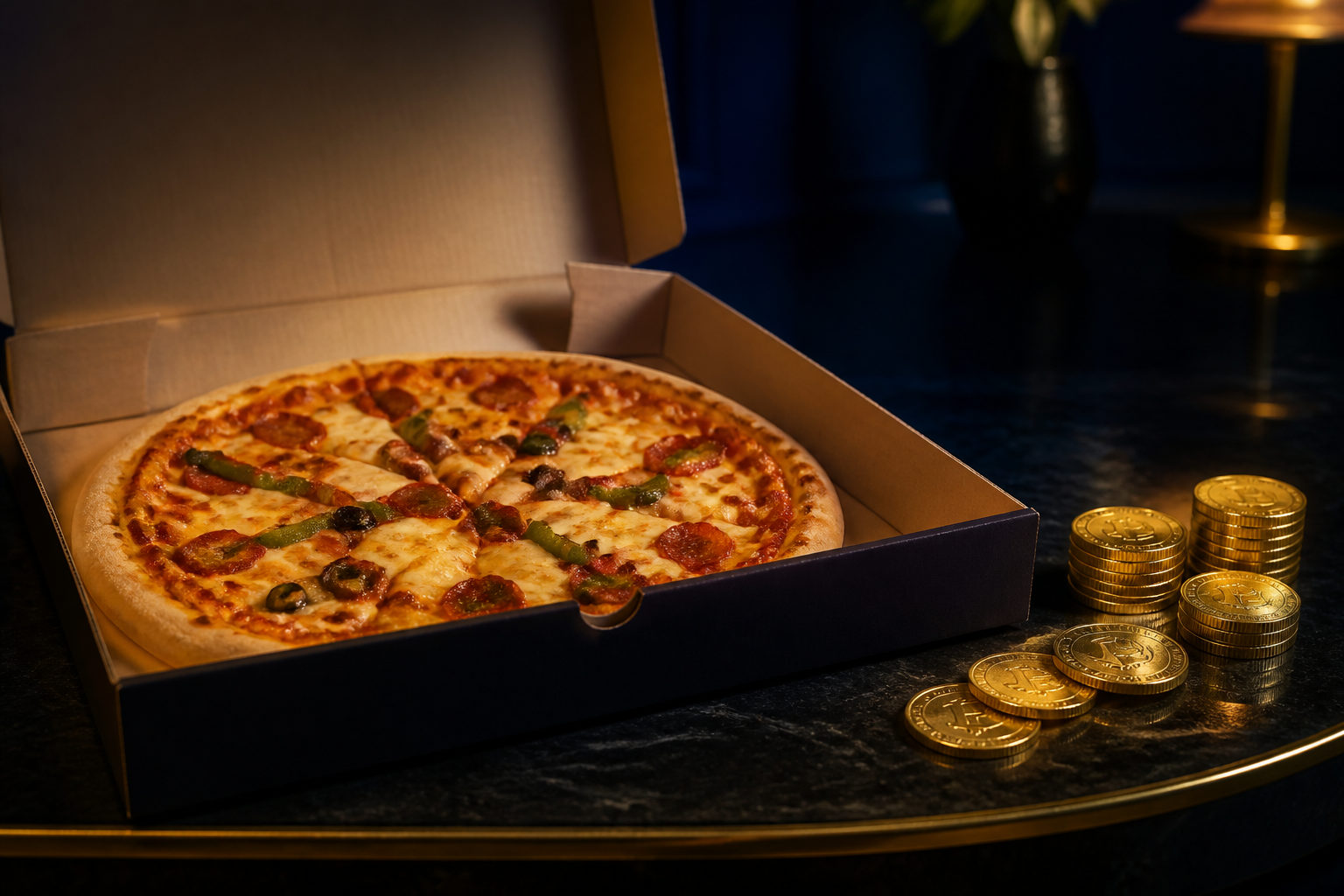
The famous pizza purchase cost 10,000 bitcoins. People still ask about it because the story gave Bitcoin one of its first clear real-world payment examples.
The short answer and why people keep asking
If your question is simply how many bitcoins the pizza cost, the answer is straightforward: 10,000 BTC. That number has become one of the best-known facts in Bitcoin history because it is easy to remember and easy to picture.
What most readers really want, though, is the meaning behind the number. A transfer on a network is one thing; getting actual goods in exchange is another. The pizza story matters because it turned Bitcoin from a technical idea into a concrete purchase that anyone could understand.
| Question | Answer |
|---|---|
| How many bitcoins were used | 10,000 BTC |
| Why is this story famous | It showed Bitcoin being used for a real consumer purchase |
| Why do people still mention it | It helps explain Bitcoin's early payment use in a simple way |
Why a pizza purchase became such a big part of Bitcoin history
Bitcoin was introduced in the 2008 white paper titled Bitcoin: A Peer-to-Peer Electronic Cash System, and its genesis block appeared in January 2009. From the start, the system was meant to support peer-to-peer value transfer. Still, design goals are not the same as social acceptance.
That is why this pizza purchase stands out. It gave people a plain, everyday example of Bitcoin being accepted for something tangible. A meal is much easier to relate to than cryptographic rules, so the story became a durable way to explain what early Bitcoin adoption looked like.
It also helped answer a practical question that every new money system faces: will anyone actually take it? Once a real item changes hands, the discussion moves beyond theory. That shift is what made the pizza transaction memorable long after the purchase itself.
Why 10,000 BTC sounds so shocking today
Most people hear that figure and react to the size of the number first. That reaction makes sense, but it often comes from viewing an early-stage event through a later-stage market lens. At the time, Bitcoin's user base, market structure, and merchant acceptance were all far less developed than they would become later.
So the main lesson is not just that the number feels large now. The more useful reading is that early participants were testing whether Bitcoin could function in actual exchange. In a new monetary network, the first successful purchases carry a kind of importance that cannot be reduced to hindsight about what the coins might have been worth later.
Bitcoin is also divisible. Its smallest unit is the satoshi, and 1 satoshi equals one hundred millionth of 1 BTC. That matters because it reminds readers that Bitcoin is not limited to whole-coin thinking. The pizza story reflects a very early period of pricing and experimentation, not a rule about how Bitcoin payments have to work.
| Common reaction today | Better way to read the event |
|---|---|
| The amount sounds enormous | Place it in the context of Bitcoin's early adoption stage |
| Focus only on later price implications | Look first at what it proved about payment use |
| Treat it as a funny anecdote | See it as a case study in monetary acceptance |
What this transaction shows about Bitcoin itself
First, money needs shared acceptance. Bitcoin has a fixed supply cap of 21 million coins, the network began in January 2009, blocks are produced about every 10 minutes, and the issuance schedule halves roughly every 4 years, or every 210,000 blocks. Those rules shape scarcity, but they do not create demand by themselves. Real value appears when other people agree to exchange goods, services, or labor for it.
Second, payment use and investment use are related but separate questions. Some people hold Bitcoin as a long-term asset. Others use it as a transfer tool or a spending medium. The pizza story is important because it highlights the spending side in a clean, memorable way.
Third, adoption happens through ordinary transactions. A system can be elegant on paper and still feel abstract until someone uses it in daily life. The pizza purchase gave Bitcoin one of those daily-life moments, which is why it remains such a strong teaching example.
How to think about the story today
If you searched this topic out of curiosity, the easiest trap is to jump straight to hindsight and stop there. That may be emotionally compelling, but it does not tell you much about how new forms of money gain traction. A more useful question is this: what did the transaction prove at that point in Bitcoin's life?
It showed that Bitcoin could move beyond a closed circle of technical discussion and enter a real exchange setting. That does not settle every debate about whether Bitcoin should be spent, saved, or treated mainly as a store of value. It does show that practical usage was part of the story early on, not an afterthought added much later.
| Area to examine | What the pizza story suggests |
|---|---|
| Payment utility | Bitcoin can function in real exchange when another party accepts it |
| Value formation | Rules matter, but acceptance gives money practical force |
| User adoption | Daily transactions help turn theory into habit |
| Personal decision-making | Spending and holding are different choices |
FAQ
How many BTC were spent on the pizza?
The well-known answer is 10,000 BTC. That figure is the central fact people are usually looking for when they search this topic.
Why is the Bitcoin pizza purchase so famous?
It gave Bitcoin a simple, relatable payment story. Instead of reading about protocol design, people could point to a normal consumer item and say that Bitcoin had been used to buy it.
Is the main point the pizza itself or what those coins could mean later?
For understanding Bitcoin history, the payment event comes first. Later value discussions attract more attention, but they do not replace the transaction's role in early adoption.
Does this mean Bitcoin was already widely used for shopping back then?
No. What it shows is that a real purchase happened and that someone was willing to accept Bitcoin in exchange for goods. That is meaningful, but it is not the same as broad merchant adoption.
What should a beginner learn from this story?
A new form of money becomes meaningful through actual exchange, not theory alone. The pizza purchase is remembered because it showed that Bitcoin could cross that line.
If you want the essential fact, the pizza cost 10,000 bitcoins. If you want the bigger takeaway, it is that Bitcoin's early credibility as money came from real transactions, one exchange at a time.
Disclaimer: This article is for informational and educational purposes only and is not investment, financial, or legal advice. Crypto assets are highly volatile and you could lose your entire investment. Do your own research and decide carefully.