
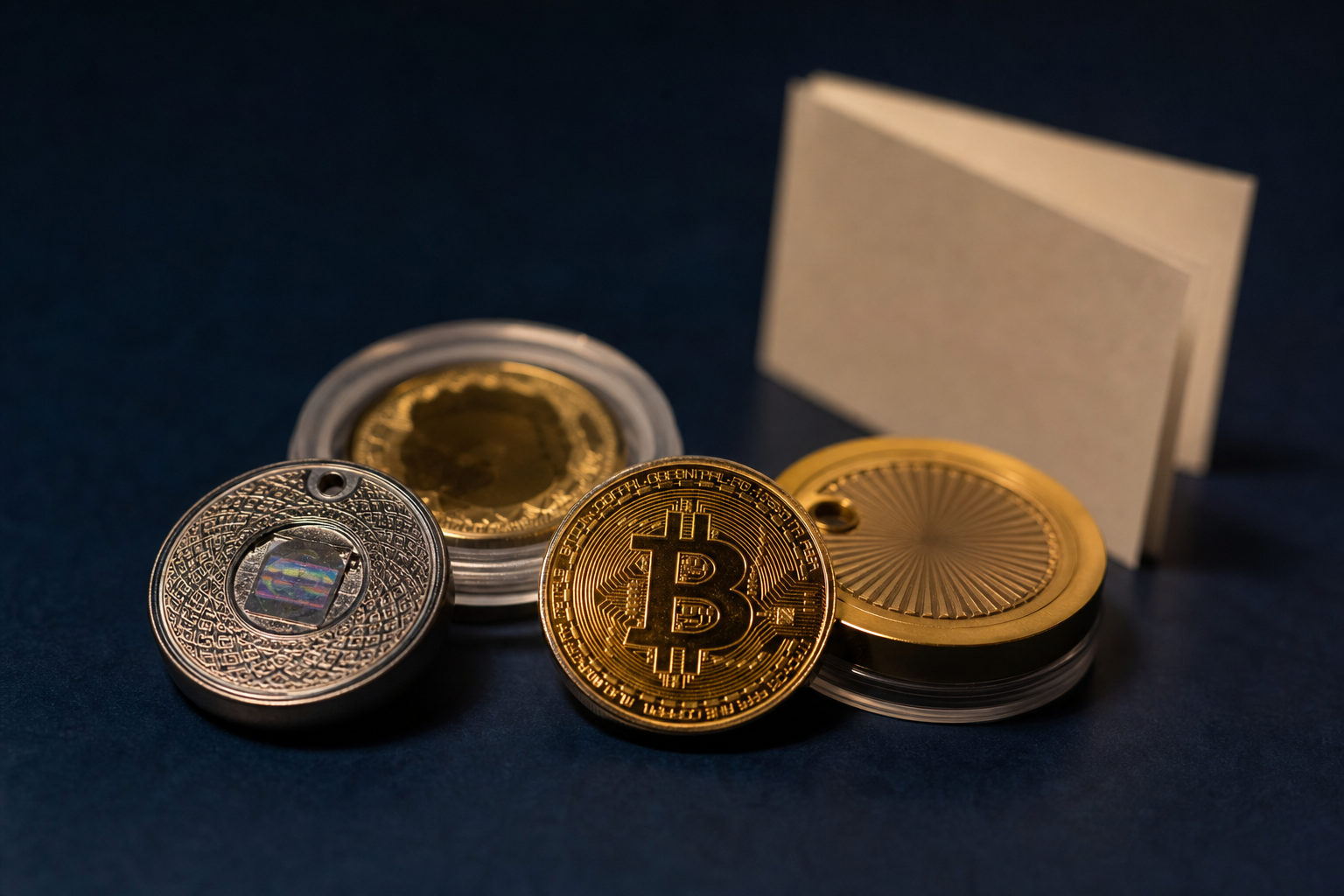
There is no official total for physical bitcoins, because bitcoin itself is not a coin-shaped object. Bitcoin exists on the blockchain, while most so-called physical bitcoins are collectibles, gift items, or objects that store private key information.
Bitcoin itself is digital, even when the packaging is physical
The easiest way to answer the question is to separate the asset from the container. A bitcoin is a unit recorded on the network and controlled by cryptographic keys. A metal token, plastic card, or printed note can represent access to bitcoin, but it is not the bitcoin itself.
This distinction matters because people often picture bitcoin as if it were gold in coin form. That image is useful in advertising and media, yet it can mislead beginners. If you hold an object with the Bitcoin symbol on it, you may be holding a souvenir, a storage tool, or a collector's item. You are not automatically holding spendable BTC.
That is why no one can give a single clean number for “how many physical bitcoins are there.” The term covers several different things, and they should not be counted as if they were the same product.
What people mean by “physical bitcoin”
In everyday use, the phrase usually points to one of a few categories. Some have no on-chain value at all. Others may contain or point to the information needed to control real bitcoin on the blockchain.
| Category | What it really is | Does it mean you own BTC? | Can it be counted reliably? |
|---|---|---|---|
| Souvenir coin | A decorative item with the Bitcoin logo | No | No unified count |
| Private-key carrier | A physical object that hides a private key or recovery data | Possibly, if the key still controls funds | No central record |
| Collector piece | A designed object with sealed information and resale appeal | Sometimes | Only case by case |
| Display prop | A model for photos, videos, gifts, or education | No | Not meaningful to count |
Once you see these categories side by side, the question gets clearer. If you include every decorative token ever made, the count is unknowable and not very useful. If you include only objects that still control real BTC, the count is still unknowable because there is no official registry and no network field that says a UTXO is tied to a metal coin or sealed card.
Why there is no official number
Bitcoin has no central issuer for physical forms. The network records addresses, balances, transactions, and signatures. It does not record whether a private key was written on paper, etched into steel, hidden under a tamper seal, or memorized by a person. From the protocol's point of view, the storage method is outside the chain.
That creates several counting problems. First, many physical items are made privately in small batches or as one-off pieces. Second, an item may once have held spendable BTC but no longer does, because the funds were moved. Third, a physical object can look intact while the key has already been copied. In that case, the object may still look valuable, but it no longer offers exclusive control.
There is also a basic definitional problem. Should a paper wallet count as a physical bitcoin? Should an engraved backup plate count? What about a commemorative coin with no key at all? Different people answer differently, which means the headline question has no single accepted measurement.
How a physical bitcoin actually works when it holds value
A useful mental model is to think of the object as a container for access, not a container for the asset itself. The BTC stays on-chain. The physical item stores the information needed to authorize spending from a specific address.
| Stage | What happens | What matters most |
|---|---|---|
| Key creation | An address and private key are generated | Whether the process was trustworthy and free from copies |
| Physical sealing | The key is hidden inside or behind a physical barrier | Whether tampering would be visible |
| Funding | BTC is sent to the related address | Whether the address can be checked on-chain |
| Transfer of the item | The object is handed to a new owner | Whether prior holders still know the key |
| Redemption | The new owner imports the key into a wallet | Whether the key remains safe after being exposed to a live device |
This is the point most newcomers miss: the object does not “contain bitcoin” in the way a wallet contains cash. It contains access credentials. If those credentials were copied at any earlier step, the physical item may never have provided sole control in the first place.
That makes verification hard. A visible address can show whether funds are present, but it cannot prove that only one person knows the key. So even when a physical bitcoin appears to be funded, its security still depends on how the key was created, stored, sealed, and handed over.
Physical bitcoin versus paper wallets and hardware wallets
These formats overlap, but they are not interchangeable. A paper wallet is usually a printed record of key data. A hardware wallet is a dedicated device meant to protect signing operations. A physical bitcoin often mixes storage with presentation, gift value, and collector appeal.
| Format | Main purpose | Strength | Main weakness |
|---|---|---|---|
| Physical bitcoin | Collecting, gifting, or sealed offline storage | Tangible and easy to grasp | Hard to verify key exclusivity |
| Paper wallet | Offline record of key data | Simple concept | Fragile and easy to mishandle |
| Hardware wallet | Protected key management and signing | Better fit for self-custody | Setup and backup must be done correctly |
For a reader asking how many physical bitcoins exist, this comparison helps cut through the confusion. Many people are really asking whether bitcoin can be made tangible. The answer is that access can be packaged physically, but the asset remains digital. Once you see that, the lack of a universal count makes sense.
How to judge whether a physical bitcoin has real value
If you come across a physical bitcoin for sale or as a gift, the right question is not “Is this made of metal?” The right question is whether the object still maps to spendable on-chain funds and whether control is truly exclusive.
- Check whether a public address is available. Without one, you cannot even verify if funds are present.
- Look at the seal logic. A hidden key only has value if tampering would be obvious.
- Ask who generated the key. If someone else created it, copied it, or kept a record, the item may never have been safe.
- Separate collector value from bitcoin value. A beautiful object can be worth collecting even when it no longer controls BTC.
- Think about redemption. Once the key is imported and the BTC is moved, the item may become an empty shell with only collectible appeal left.
That split between collector value and on-chain value explains a lot of the confusion around physical bitcoin. Some objects are bought for design, rarity, or historical interest. Others are bought because buyers think they are getting spendable BTC. Those are two different markets, even when the item looks the same in a photo.
FAQ
Are physical bitcoins officially issued by Bitcoin?
No. Bitcoin has no official mint and no standard physical edition. Physical items connected to bitcoin come from private makers, collectors, or merchants, not from the network itself.
Does owning a bitcoin-shaped coin mean I own BTC?
Not by itself. You would need a valid private key or recovery method that still controls funded on-chain bitcoin. A logo on metal is just a design unless it is tied to real spendable funds.
Can anyone know the total number of physical bitcoins?
No reliable global total exists. There is no central database, and the blockchain does not label which balances are linked to physical carriers, so any broad count would be incomplete or based on changing definitions.
Why do some people still buy physical bitcoins?
Some buy them as collectibles, gifts, or pieces of early crypto culture. Others like the tactile aspect because it makes an abstract digital asset easier to explain to friends or family.
If a physical bitcoin shows a funded address, is it safe to trust?
It is a useful sign, but not enough on its own. A funded address can show that BTC is there, yet it cannot show whether the key was copied, photographed, or retained by someone else earlier.
If your goal is to own bitcoin, focus on verifiable control of wallet credentials rather than the comfort of a coin-like object. If your goal is collecting, judge the piece as a collectible first and treat any linked BTC as a separate question.