
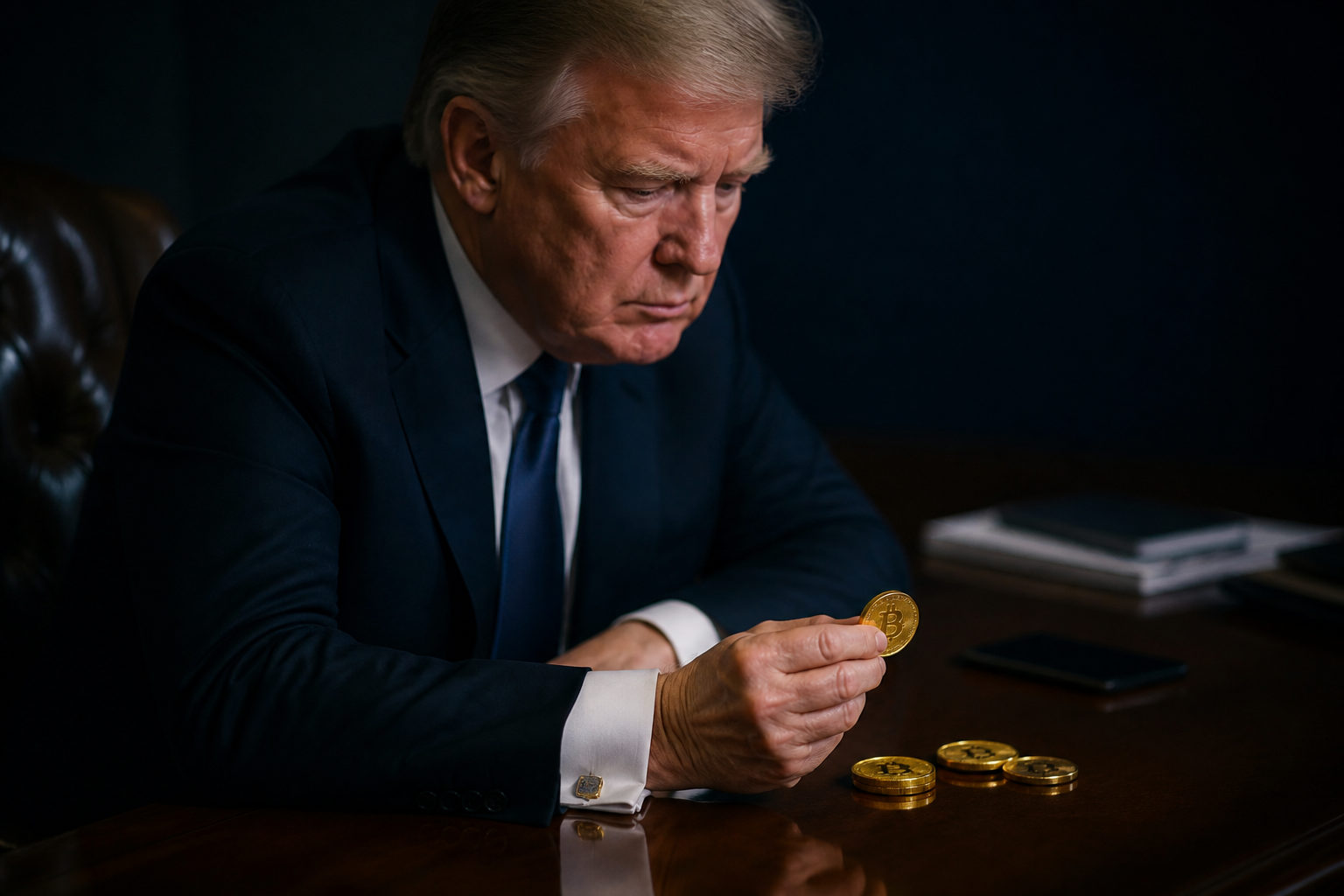
There is no publicly verified number showing exactly how much Bitcoin Donald Trump owns. What people usually find online is a mix of disclosures, wallet speculation, and media shorthand, and those are not the same as confirmed BTC holdings.
Why a precise answer is hard to verify
Bitcoin addresses do not come with built-in legal identity. Unless a person publishes a wallet address, or a formal disclosure clearly names Bitcoin and the amount held, outside observers cannot reliably tie a specific balance to a specific individual.
Assets may sit under a personal name, a family member, a company entity, or a custodial platform. Even when reports mention a wallet linked to someone’s wider business activity, that still does not prove direct personal ownership of Bitcoin.
| Source type | What it can show | Main limit |
|---|---|---|
| Direct public statements | General attitude or broad exposure | Often lacks asset-level detail |
| Formal financial or legal disclosures | More solid than rumor | May group assets into broad categories |
| On-chain wallet tracking | Visible balances and transfers | Address ownership may remain uncertain |
| Media reports | Useful for context and chronology | Can rely on secondhand interpretation |
“Crypto assets” and “Bitcoin” are not interchangeable
Headlines often compress “owns crypto assets” into “owns Bitcoin,” even when the underlying source never makes that jump.
Crypto assets can refer to Bitcoin, other tokens, platform balances, project-related receipts, or digital assets tied to licensing and commercial activity. If the original source does not clearly say BTC or Bitcoin, then a claim about exact Bitcoin ownership goes beyond what the evidence supports.
| Common phrasing | What it really means | Can it prove a BTC amount? |
|---|---|---|
| Owns crypto assets | A broad category only | No |
| Linked wallet | Possible on-chain connection | No |
| Digital collectible or project income | Not the same as spot Bitcoin ownership | No |
| Public support for crypto | A statement of stance | No |
How to judge these claims without getting misled
Start with the original source, not the social post or the rewritten article. A formal disclosure, a legal filing, or a direct public statement gives you something concrete to inspect. If every article traces back to one vague report, the apparent weight of evidence is thinner than it looks.
Watch for category drift: when “linked address” becomes “his wallet,” when “may hold crypto assets” becomes “owns Bitcoin,” or when a business-related connection is rewritten as personal spot holdings.
Ask whether the claim can be checked from more than one angle. Good reporting lets readers compare wording across filings, statements, and independent coverage. Weak reporting leans on screenshots, unnamed sourcing, or a loose phrase like “on-chain data shows” without enough detail to evaluate the method.
| Check step | What to look for | Red flag |
|---|---|---|
| Read the base document | Does it explicitly mention Bitcoin or BTC? | Only broad asset labels appear |
| Confirm the holder | Personal, family, company, or custodian? | Related-party assets treated as personal holdings |
| Inspect the wording | Are there qualifiers like “linked” or “may”? | The headline is firmer than the evidence |
| Cross-check the story | Do separate sources support the same point? | All coverage relies on one recycled claim |
What people usually want to know behind this search
Most readers are trying to figure out whether Trump personally has Bitcoin exposure, whether he has a financial tie to the broader crypto industry, or whether his public stance lines up with any direct holdings.
Those are related questions, but they are not identical. Someone can have crypto exposure without holding much Bitcoin. Someone can speak favorably about the sector while the economic link comes through another asset type, a business arrangement, or branding activity rather than direct BTC ownership.
“Does he own Bitcoin?” should be separated into three checks: actual verifiable holdings, publicly stated views, and business or political ties to the crypto sector.
| What the reader wants to know | Best evidence to review | Why BTC ownership alone is not enough |
|---|---|---|
| Whether he is positive on Bitcoin | Public remarks and policy language | Holding an asset does not fully define a view |
| Whether he has industry ties | Business activity and formal disclosures | Those ties may not appear as spot BTC |
| Whether the story is true | Original records and independent verification | Famous names attract exaggerated coverage |
FAQ
Is there a confirmed public figure for Trump’s Bitcoin holdings?
No public figure appears to be independently verifiable in a way that settles the question. Without a clear filing or a directly identified wallet acknowledged by him, outside observers cannot state an exact BTC amount with confidence.
If a report says he owns crypto assets, does that mean he owns Bitcoin?
Not automatically. “Crypto assets” is a broad label, and it only supports a Bitcoin claim if the underlying source specifically names Bitcoin or BTC.
Can blockchain analysis prove a wallet belongs to Trump?
It can offer clues, but clues are not the same as proof of personal ownership. Without a direct admission, a formal record, or another strong form of confirmation, wallet attribution stays uncertain.
Why do celebrity Bitcoin ownership stories get distorted so easily?
Because the topic combines public curiosity, technical complexity, and fast-moving headlines. Once a vague connection gets reduced to a catchy claim, later coverage often repeats the simplified version instead of the original nuance.
What should I check first when a new claim appears?
Look for the primary document or direct statement before reading commentary around it. If the report cannot point you to a verifiable source, treat the claim as unconfirmed rather than established fact.
The most practical takeaway
If a story claims to know how much Bitcoin Donald Trump owns but cannot show a clear primary record, a directly attributable wallet, or an explicit disclosure naming Bitcoin, it should be treated as unverified. Focus on what is actually documented and ignore headlines that blur “crypto exposure” into a precise BTC number.