
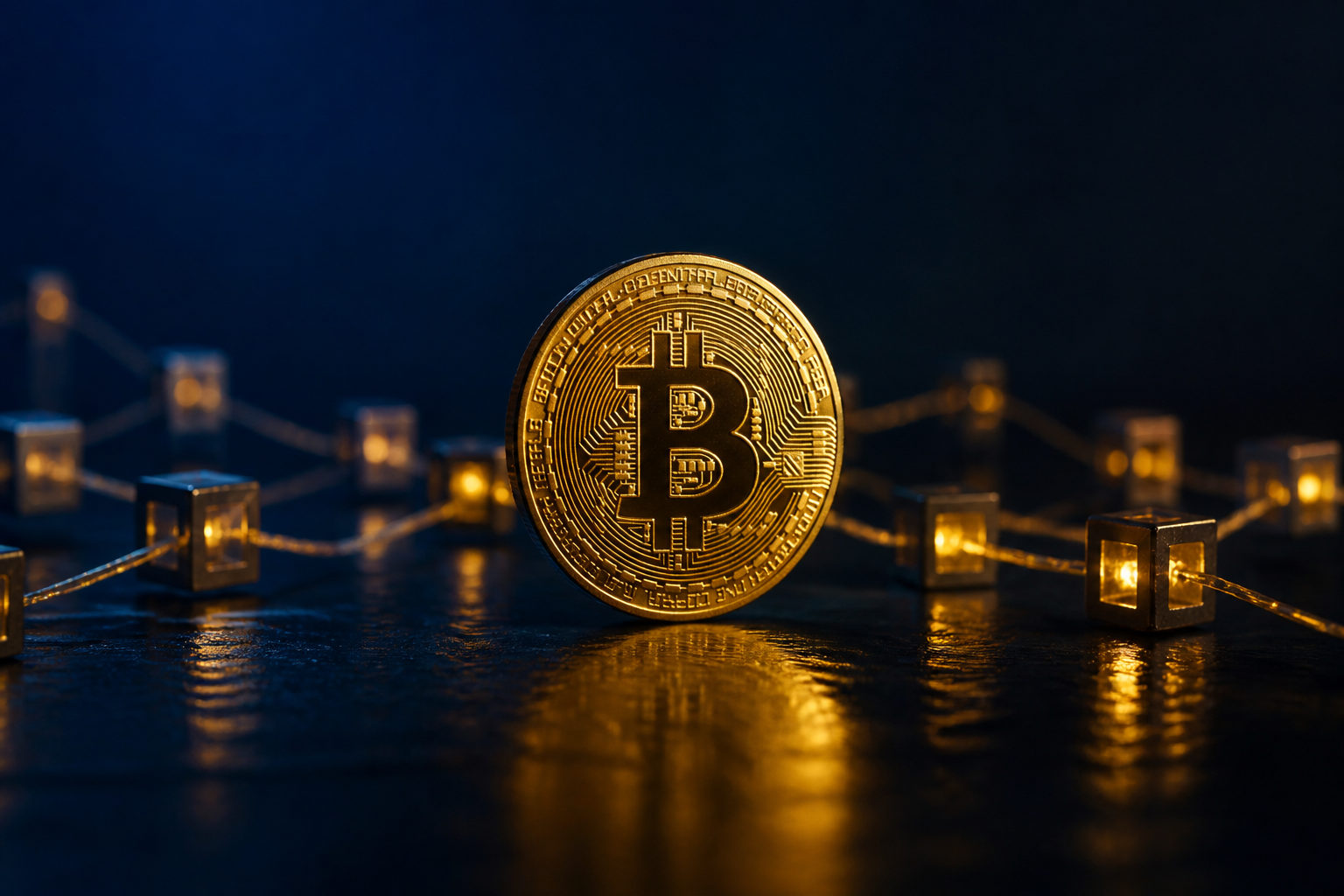
Bitcoin is a decentralized cryptocurrency that runs on a blockchain network, letting people transfer value without relying on one bank, company, or payment operator to keep the master ledger.
What Bitcoin actually is
When people search for a criptomoeda bitcoin, they are often trying to answer a basic question first: is Bitcoin money, an investment, or a piece of internet infrastructure? The honest answer is that it carries all three traits at once. It can be used for payments, it can be held as a scarce digital asset, and it exists as an open protocol that anyone can inspect and use.
Its starting point is well known. A white paper published in 2008, Bitcoin: A Peer-to-Peer Electronic Cash System, described the system, and the name attached to it was Satoshi Nakamoto. The real identity behind that name remains unknown. In January 2009, the genesis block launched the network, and from there Bitcoin grew from a niche technical idea into a global system with users, miners, developers, trading venues, and long-term holders.
One design choice matters more than most: Bitcoin has a supply cap of 21 million coins. That cap is part of the protocol rules, not a policy promise from a central issuer. Ownership is also divisible far below one full coin, because the smallest unit is 1 satoshi, equal to one hundred millionth of a BTC. So even though people talk about “one bitcoin” all the time, actual use does not require buying or sending a whole coin.
| Aspect | What it means in Bitcoin |
|---|---|
| Nature | A decentralized digital asset that exists on a blockchain |
| Record keeping | A shared ledger maintained by distributed nodes |
| Supply rule | Capped at 21 million coins under protocol rules |
| Smallest unit | 1 satoshi, equal to one hundred millionth of a BTC |
| Origin | Proposed under the name Satoshi Nakamoto, whose identity is unknown |
How Bitcoin works in practice
Bitcoin is easier to understand once you stop thinking of it as just another payment app. It is a system for getting strangers to agree on who owns what, without handing that job to a single gatekeeper. Transactions are broadcast to the network, checked by nodes, grouped into blocks, and then added to the chain in sequence. That chain is the public ledger.
New blocks are produced about every 10 minutes. Miners compete to add them, and in doing so they help validate transactions and secure the network. New issuance slows over time because Bitcoin goes through a halving about every 4 years, or every 210,000 blocks. The halving years so far are 2012, 2016, 2020, and 2024. That mechanism is a big reason Bitcoin is often discussed in terms of digital scarcity.
People new to crypto tend to blur several ideas together. Blockchain is the ledger structure. Bitcoin is the native asset of the network. A wallet is the tool that manages private keys and lets you receive or send coins. That distinction matters. What you truly control is not a balance shown on a screen; it is the private key that gives you authority over a given address. Lose that control, and recovery is often difficult or impossible.
| Term | Main role | Common confusion |
|---|---|---|
| Blockchain | The underlying ledger that records and orders transactions | |
| Bitcoin | The native unit of value on the network | |
| Wallet | The tool used to manage private keys and send or receive funds | |
| Mining | The process that helps validate transactions and add new blocks |
What Bitcoin is used for
Bitcoin gets reduced to price talk far too quickly. That misses the point. It has several practical uses, and they are not all the same. For some people, Bitcoin is a way to move value across borders on-chain. For others, it is a long-term holding because the supply rules are transparent and not tied to one institution. It also serves as a base reference asset across much of the broader crypto market.
Still, usefulness depends on the situation. Bitcoin can make sense when someone wants asset control, open verification, and direct settlement on a public network. It may be less convenient for people who want stable day-to-day spending value or a familiar account-recovery experience. Whether it feels efficient comes down to network conditions, the tools being used, and whether the receiving side is set up to accept BTC directly.
If your real question is about value, the right way to frame it without live market data is to ask what moves the price. Bitcoin’s market price reacts to supply and demand, liquidity conditions, regulation expectations, investor risk appetite, miner selling pressure, holder behavior, and broad market sentiment. To check the live price, use a major market data platform or a trading venue showing current quotes that day. Social posts and recycled screenshots are a poor substitute.
| Use case | Who it suits | What to think about first |
|---|---|---|
| On-chain transfer | People moving value across regions | Fees, confirmation time, and whether the other side accepts BTC |
| Long-term holding | Investors who believe in scarcity and the long view | Volatility tolerance, position sizing, and storage method |
| Diversification | People who do not want all risk in one asset | Portfolio purpose, liquidity needs, and changing correlations |
| Learning tool | Beginners trying to understand decentralized systems | Wallet basics, private keys, and transaction confirmation |
The risks people usually notice too late
The biggest surprise for beginners is not the concept. It is the responsibility. In traditional finance, bad actions can sometimes be reversed through support teams, identity checks, or account procedures. On Bitcoin, once a transaction is confirmed on-chain, there is usually no simple undo button. Send to the wrong address, choose the wrong network in a service flow, or expose your recovery phrase, and the damage may be permanent.
Then there is price volatility. Bitcoin attracts attention precisely because it can move hard in both directions. Fast rallies pull in excitement. Sharp drops can trigger panic just as quickly. A lot of people do not get hurt because they failed to understand the theory; they get hurt because they entered without a clear plan for custody, position size, and their own tolerance for stress.
Outside risks matter too. Trading platforms can change rules. Regional regulation can shift. Tax treatment may differ by jurisdiction. Scams keep adapting as well: fake support agents, fake wallet apps, fake investment groups, urgent messages telling you to move coins right now. The Bitcoin protocol is public and relatively plain to inspect. The messy part is often the human layer built around it.
| Risk type | Typical problem | Practical response |
|---|---|---|
| Custody risk | Private key exposure, lost recovery phrase, compromised device | Store sensitive backup information carefully and avoid casual online storage |
| Operational risk | Wrong address, wrong network, mistaken transfer | Test with a small amount before sending the full amount |
| Volatility risk | Large short-term price swings and emotional trading | Define your limits and purpose before entering |
| Platform risk | Withdrawal restrictions, service interruptions, changing controls | Avoid concentrating everything on one platform |
| Scam risk | Fake support, fake wallets, fake communities | Verify information through official channels only |
FAQ
How is Bitcoin different from regular digital payment systems?
Most digital payment systems rely on a company or bank to manage accounts and approve transfers. Bitcoin uses a public ledger and distributed verification, which gives users more direct control but also puts more responsibility on them.
Can you own less than one bitcoin?
Yes. Bitcoin is divisible down to 1 satoshi, which is one hundred millionth of a BTC. In real life, many people buy, hold, or send only a fraction of a coin.
Should a beginner learn wallets first or watch the price first?
Wallet basics usually come first. If you do not understand addresses, private keys, and confirmation flow, even a correct market view can still end in an avoidable mistake.
Is Bitcoin suitable for long-term holding?
That depends on your risk tolerance, funding plan, and reason for owning it. Some people treat it as part of a long-term allocation, while others use it mainly to learn how decentralized assets work.
Where should I check the live Bitcoin price?
Use a major market data platform or a reputable trading venue that shows current quotes that day. Random screenshots, chat messages, and clipped videos can be outdated or misleading.
If you plan to use Bitcoin rather than just read about it, start with two simple steps: learn what private-key control really means, then do one small transfer test with an amount you can afford to treat as a lesson.
Disclaimer: This article is for informational and educational purposes only and is not investment, financial, or legal advice. Crypto assets are highly volatile and you could lose your entire investment. Do your own research and decide carefully.