
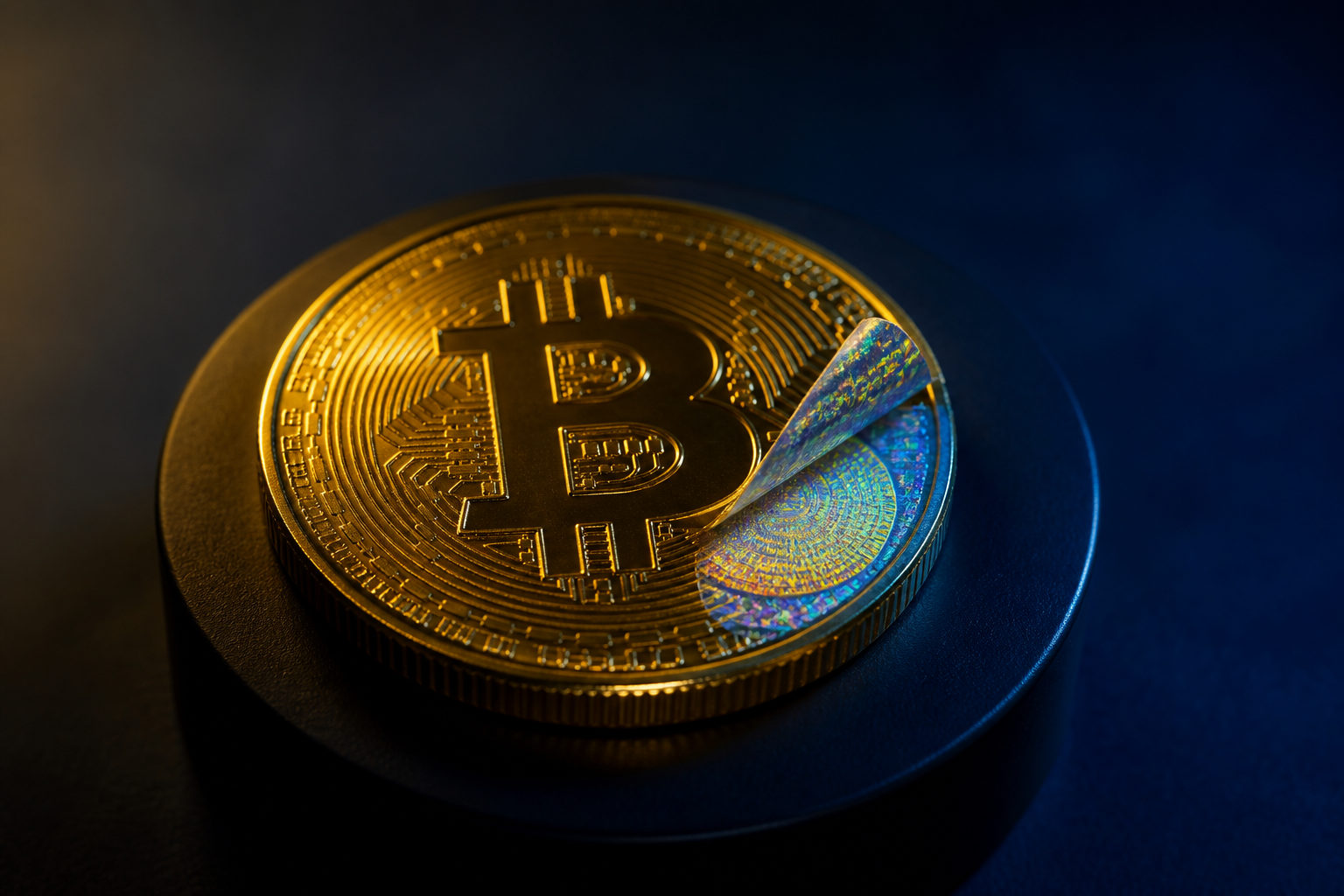
Yes, physical bitcoins do exist. But they are not Bitcoin in physical form; they are objects tied to private keys or redemption details that may give access to BTC on-chain.
What people mean by a physical bitcoin
Beginners often picture a coin minted by some official Bitcoin authority. That idea sounds intuitive. It is also wrong.
Bitcoin itself is digital. Ownership comes from control of a private key, and the record of that ownership lives on the blockchain. So when someone says “physical bitcoin,” they are usually talking about a real-world item connected in some way to that digital ownership, not a separate offline version of the asset.
In practice, the term usually covers two different things. One is a souvenir or commemorative coin with a Bitcoin logo and no BTC attached to it. The other is a physical item that contains, hides, or points to private key material or redemption information. If the related funds are still sitting at the matching address, that item has a live connection to actual bitcoin.
| Type | Linked to on-chain BTC | Main feature | Typical use |
|---|---|---|---|
| Commemorative coin | No | Bitcoin theme only | Collecting, display, gifts |
| Physical bearer item with key data | Possibly | Stores or conceals control information | Collecting, gifting, transferring access |
Why they exist but are not Bitcoin itself
This is the line that matters most. A metal coin can exist in your hand, sit in a drawer, or be sold to another person. None of that proves ownership of BTC by itself.
The real question is whether the private key is still valid, whether it has stayed secret, and whether the funds at the related address are still there. If someone already viewed or copied that key, the object may still be interesting as a collectible, yet its security value is badly weakened. If the coins have already been moved, the physical item can survive long after the bitcoin connection is gone.
That is why the object should be treated as packaging, a shell, or a carrier for access details. The bitcoin is still on-chain. Always.
Common misunderstandings
Most confusion comes from mixing up appearance, ownership, and security. Those are three separate issues, and physical bitcoins blur them in a way that catches new users off guard.
| Claim | What is actually true |
|---|---|
| A physical bitcoin is an official Bitcoin coin | Bitcoin has no central issuer and no official coin or paper note system |
| Holding the item means you own the BTC | Ownership depends on exclusive control of the private key |
| An intact seal proves the key is safe | A seal may help, but it cannot prove the key was never copied |
| Physical form means better protection from hackers | It may reduce online exposure while adding loss, damage, and tampering risk |
| Heavier or fancier pieces must be worth more | Material value, collectible value, and BTC value are separate things |
Another mix-up happens with hardware wallets. They are not the same thing. A hardware wallet is a security device built to generate, isolate, and use private keys in a controlled way. A physical bitcoin is more like an object that carries access information, often with some collectible appeal attached to it.
If you are thinking about buying one
Start with a basic question: are you buying a collectible, or are you buying an object that supposedly gives access to real BTC? People skip this step all the time, then end up judging the wrong thing.
| Checkpoint | What to verify | Why it matters |
|---|---|---|
| Product type | Is it a souvenir or is it claimed to represent actual BTC | Keeps you from mistaking memorabilia for an asset |
| Control method | How are the private key or redemption details stored | Determines whether you can truly take control |
| Seal status | Has the package been opened or altered | Helps assess whether the key may have been exposed |
| Verification | Can you independently check the related address | Lets you test the claim instead of trusting the seller |
| Next step after receipt | Should you move the funds to your own wallet right away | Reduces ongoing exposure to old key material |
If the seller talks only about rarity, finish, and presentation but gets vague when key control or address verification comes up, that tells you a lot. For most people who simply want to own bitcoin, using a wallet they control is cleaner, easier to verify, and much less confusing.
Who physical bitcoins may suit
They can make sense for collectors, gift buyers, or people interested in Bitcoin history and culture. In that setting, the object matters in its own right. Design, condition, and presentation may be a big part of the appeal.
They are less suitable for someone whose main goal is straightforward, long-term BTC storage with clear control. Once a digital asset is wrapped inside a physical object, new questions show up fast: has it been opened, was the key copied before sale, should the funds be moved immediately, and is the collectible premium distracting from the actual security picture?
FAQ
Can a physical bitcoin be spent like cash?
Usually no. The object itself does not settle a blockchain payment. To use the BTC, you normally need to claim or import the private key information and then move the funds through a wallet.
Should I keep it sealed if I buy one?
If you care mainly about collectible condition, keeping it sealed may matter. If your focus is asset safety, confirming control and moving the bitcoin to a wallet you manage is often the stronger move.
Is a physical bitcoin the same as cold storage?
No. Cold storage is about keeping private keys offline through a security process. A physical bitcoin is an object-based form factor that may include offline elements, but the risk model is different.
Does bitcoin still “exist” if there is no physical version?
Yes. Bitcoin is natively digital, so it does not need a coin, card, or printed certificate to be real. Its existence comes from the blockchain record and private key control.
How can I tell whether a physical bitcoin still has BTC attached to it?
You need a way to check the related blockchain address and see whether funds remain there. Even then, a remaining balance does not prove the key is still secret, so “funded” and “safe to trust” are not the same thing.
If your goal is simply to own bitcoin, learn how wallets, addresses, and private keys fit together. If you want a physical bitcoin, treat it first as an object that may carry access information, and only then decide whether it deserves your money.
Disclaimer: This article is for informational and educational purposes only and is not investment, financial, or legal advice. Crypto assets are highly volatile and you could lose your entire investment. Do your own research and decide carefully.