
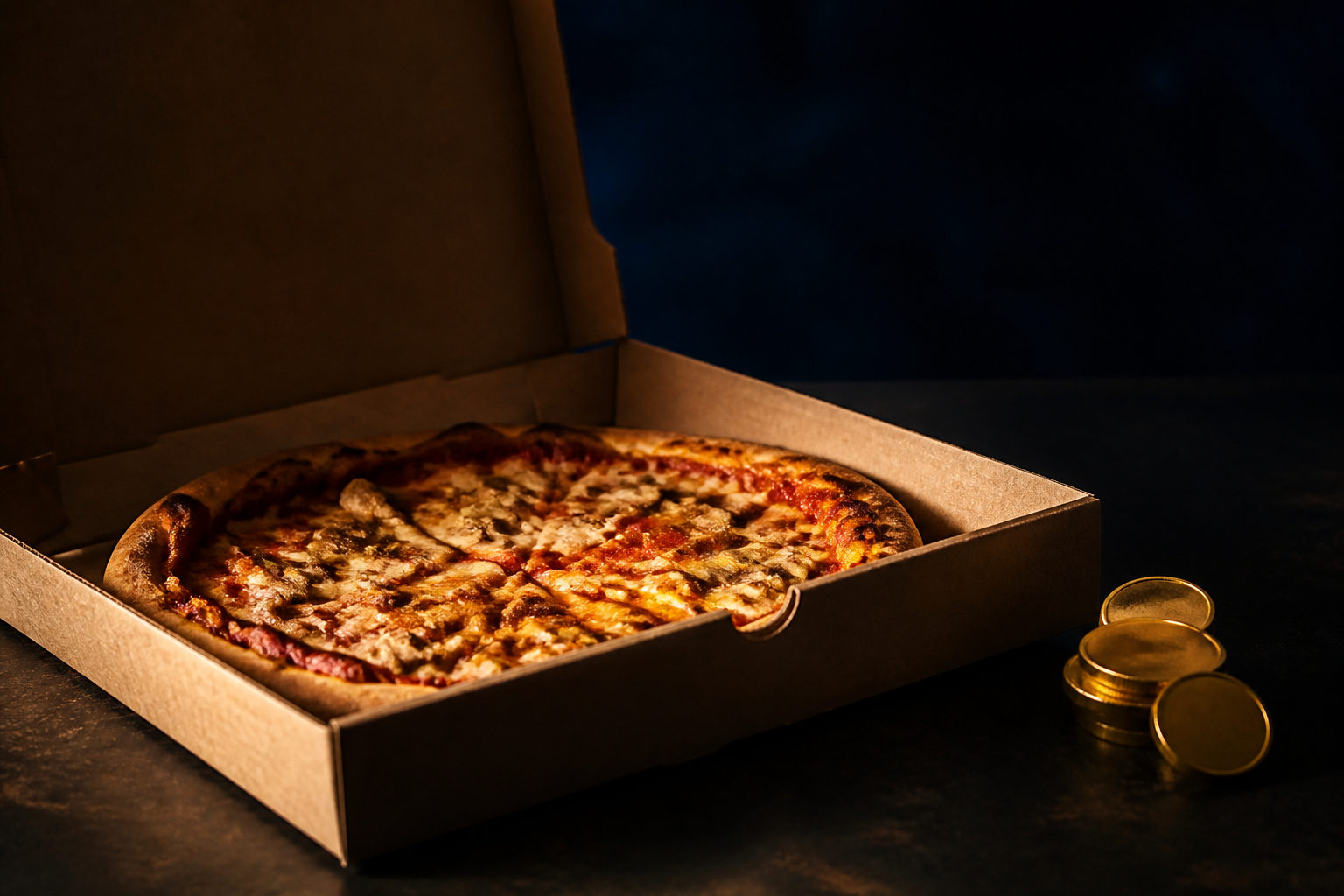
For the famous early pizza purchase, the answer is simple: 10000 bitcoins. That number stuck because it marked one of the clearest moments when Bitcoin moved from a digital idea into a real-world purchase.
Why this pizza question still matters
People often hear the story and jump straight to price hindsight. Fair enough. But that misses the part that actually changed Bitcoin’s place in the world: someone used it to get a physical item, and someone else accepted it as payment. That is a different thing from merely sending coins across a network.
Bitcoin began with the genesis block in January 2009, under the name Satoshi Nakamoto, whose identity remains unknown. The system could already record ownership and transfer value. Still, a working protocol is not the same as everyday economic use. The pizza purchase helped close that gap.
That is why the story keeps coming back. Not because pizza is special. Because ordinary goods make abstract technology easier to understand. A meal is concrete. A transaction on a ledger is not, at least not to most readers on first contact.
“How many bitcoins for a pizza” has two different answers
If the question is historical, the answer is 10000 bitcoins. If the question is about buying a pizza today, there is no fixed number you can memorize. It depends on the pizza price, the live BTC price at checkout, any transaction or service fees, and whether the merchant accepts Bitcoin directly or uses a payment processor.
Those two versions of the question get mixed together all the time. One belongs to Bitcoin history. The other belongs to present-day spending. If you do not separate them, the answer sounds clearer than it really is.
| Version of the question | What it means | Useful answer |
|---|---|---|
| How many bitcoins bought that famous pizza | A historical reference | 10000 bitcoins |
| How many BTC do I need for a pizza now | A live payment question | It changes with price and fees |
| Why does the story matter | A question about Bitcoin adoption | It showed real goods could be bought with BTC |
So yes, the number is real. It is also easy to misuse. Early markets were thin, price discovery was immature, and individual deals carried far more weight than they would in a deeper market. That famous trade tells you what two parties accepted at that moment. It does not give you a timeless exchange rate for pizza.
What the pizza purchase actually proved
The deal mattered because it gave Bitcoin a real-world reference point. The white paper, Bitcoin: A Peer-to-Peer Electronic Cash System, appeared in 2008. A protocol can outline rules. Blocks can arrive about every 10 minutes. Coins can move from one holder to another. None of that automatically answers the public’s most practical question: what can this thing buy?
The pizza purchase answered that in the plainest possible way. Lunch. Real food. Delivered value on one side, digital payment on the other. Suddenly Bitcoin was easier to explain without a long detour through code, mining, or network design.
It also showed how monetary meaning forms in the early stage of a new asset. People do not wake up with perfect agreement on value. They test it. They trade around it. They attach it to goods and services. Over time, repeated exchange builds social understanding. The pizza deal became famous because it captured that process in one very human image.
There is another lesson here, and it is less romantic. Early price signals are fragile. In a young market, one transaction can be memorable without being broadly representative. That is why using this story as a shortcut for what Bitcoin “should” buy today leads people in the wrong direction.
If you want to buy pizza with Bitcoin now, what actually affects the amount
History does not settle the checkout total. Current spending depends on the merchant’s setup and the terms of payment at that moment. Before paying, you need to know whether the seller accepts BTC directly, when the exchange rate is locked, what fees apply, and how payment confirmation is handled.
| Factor | What it changes | What to check |
|---|---|---|
| Merchant acceptance method | Direct BTC payment or third-party conversion | Read the checkout payment instructions |
| Live BTC price | The BTC amount tied to the same pizza can shift | Confirm when the quote is set |
| Fees | Your total outlay may exceed the item value alone | Review wallet and processor notices |
| Confirmation rules | Can affect whether the merchant treats payment as complete | Check the merchant’s payment terms |
This is where many readers get tripped up. The famous pizza story proves Bitcoin can function in commerce. It does not prove that every purchase, on every day, through every payment route, will feel convenient or cost-effective. Real payments are messy. Sometimes they are smooth. Sometimes they are not.
If your real question is how to find the amount for a pizza today, do not start with the old story. Start with the seller’s checkout page and a live market quote, then add whatever fee structure applies. That gives you a usable answer. The history gives you context, which is useful, but only context.
FAQ
Why did that early pizza purchase use so many bitcoins?
Because it happened in a very early stage of Bitcoin’s life, when markets were small and pricing was still being discovered through direct exchange. The amount reflects what the parties accepted then, not a standard for present-day spending.
Would buying a pizza today take that many bitcoins?
No. The historical figure belongs to that specific transaction. A pizza purchase now would depend on the live BTC price, the merchant’s item price, and any payment fees added during checkout.
Why is the pizza story repeated so often in Bitcoin discussions?
It makes Bitcoin’s early adoption easy to picture. Instead of staying at the level of protocol design, the story shows a simple trade: digital coins exchanged for a real product people recognize instantly.
Does this prove Bitcoin is ideal for everyday shopping?
It proves Bitcoin can be used for payment when both sides are willing to transact that way. It does not settle whether it is the best fit for every daily purchase, because cost, confirmation time, and merchant support still matter.
What is the best way to figure out “how many bitcoins for a pizza” today?
Check the merchant’s checkout page first, then compare it with a live BTC market quote. You also need to see whether a payment service is doing the conversion, since that can change the final BTC amount you send.
If you want the standard historical answer, the famous pizza purchase used 10000 bitcoins. If you want a usable answer for a real order today, look at the live quote, the fee terms, and the merchant’s payment method before you hit pay.
Disclaimer: This article is for informational and educational purposes only and is not investment, financial, or legal advice. Crypto assets are highly volatile and you could lose your entire investment. Do your own research and decide carefully.