
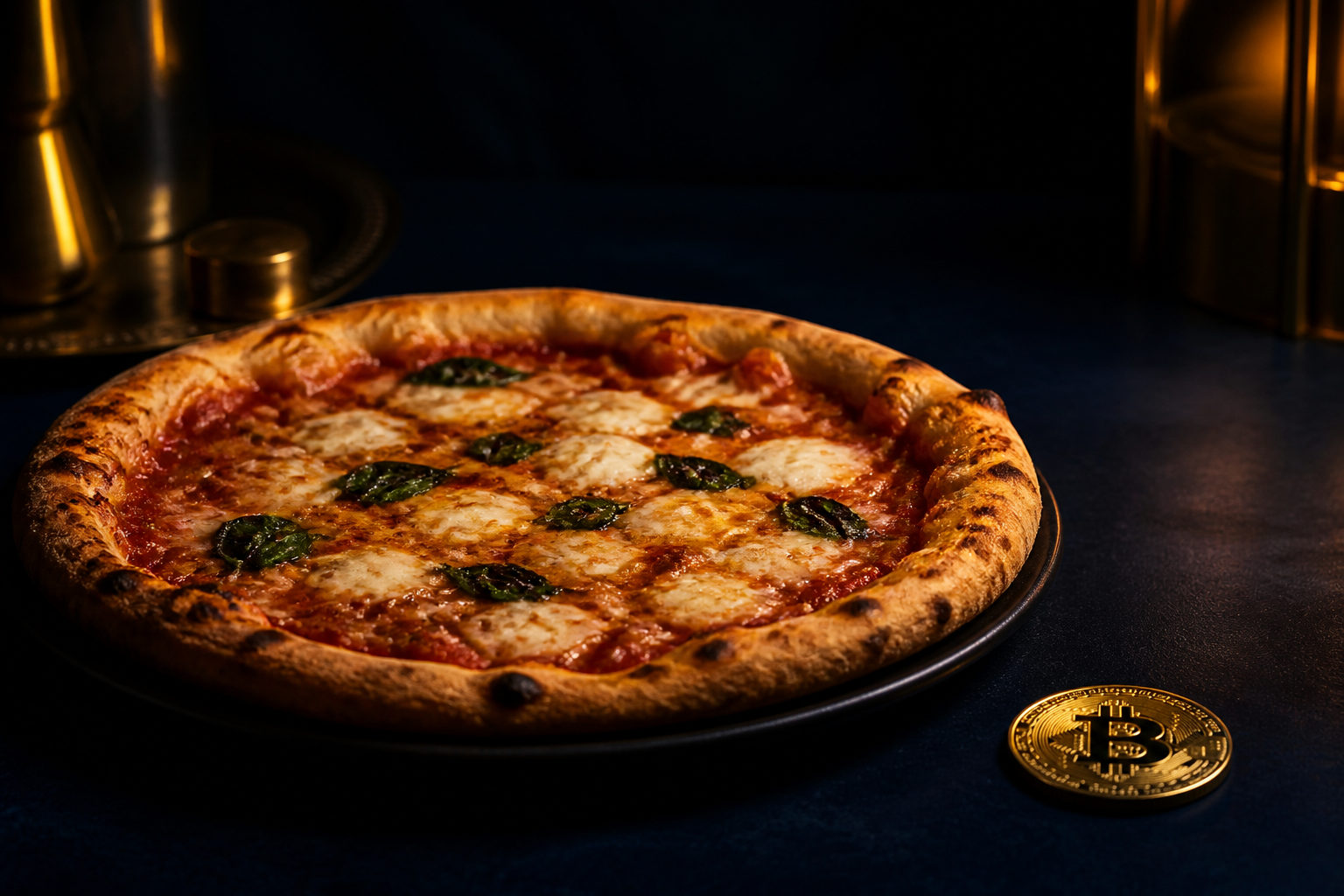
“The world’s most expensive pizza” in Bitcoin refers to an early real-world purchase that later became a symbol of how Bitcoin moved from a technical idea into actual economic use.
Why this phrase became so popular
People who search for this term usually want more than a meme explanation. The phrase lasts because it compresses a big shift into one familiar image: a common food item paid for with a new digital asset that was still trying to prove it could function as money.
That matters because Bitcoin was introduced in the 2008 white paper, Bitcoin: A Peer-to-Peer Electronic Cash System, under the name of electronic cash. A story about buying pizza fits that original purpose far better than a story about passive holding or price watching. It gives readers a concrete example of use instead of an abstract theory about peer-to-peer transfers.
The phrase also spreads easily because almost anyone can understand it at once. You do not need to know how wallets sign transactions or how blocks are produced to grasp why a pizza purchase can become historically important.
The real point is not the pizza price
Many retellings focus on regret. That reading is shallow. What gives the story weight is that a digital token was accepted in exchange for a physical good. For any money system, that step changes everything: value starts to show up through trade, not only through code or discussion.
A network can exist in software and still remain economically irrelevant if nobody is willing to exchange goods or services for its native asset. Once people are prepared to receive it, spend it, and pass it on, the asset begins to gain market meaning. The pizza story is often remembered because it marks that transition in a simple, human way.
It also shows how early Bitcoin depended on community action. Someone had to run the software, someone had to hold coins, and someone had to treat those coins as acceptable payment. Economic adoption did not appear automatically when the protocol launched. It had to be practiced into existence.
What the story says about Bitcoin’s role
This is where the keyword becomes more useful than it looks. A person searching for “a pizza mais cara do mundo bitcoin” may be curious about a famous anecdote, but the story opens a larger question: what exactly is Bitcoin for?
One answer comes from its design. Bitcoin started with the genesis block in January 2009. New blocks are produced about every 10 minutes, and the issuance schedule changes through halving roughly every 4 years, or every 210,000 blocks. Its total supply is capped at 21 million coins. Those features support the idea of a scarce digital monetary asset.
Another answer comes from how users behave. Bitcoin is divisible down to the satoshi, and 1 satoshi equals one hundred millionth of a BTC. That makes it technically suitable for small transfers. Yet technical ability does not guarantee that holders want to spend it in daily life. If users treat it mainly as a scarce asset to keep, payment use can become secondary.
The pizza story sits right at that tension point. It reminds readers that Bitcoin has been used as a medium of exchange, while also showing why later audiences often frame it through the lens of missed appreciation. The same asset can be viewed as spendable money by one group and as long-term reserve value by another.
Common misunderstandings behind the phrase
- Misunderstanding 1: the lesson is only about hindsight. The deeper lesson is how markets begin to assign value through actual exchange.
- Misunderstanding 2: one purchase proves mass adoption. A single transaction shows willingness, not universal acceptance.
- Misunderstanding 3: Bitcoin was always meant to be held, never spent. Early use cases clearly included direct payment for goods.
- Misunderstanding 4: this is just internet folklore. For beginners, it is one of the clearest entry points into monetary adoption and price discovery.
Why the story is still cited today
Communities keep certain events alive because they offer shared reference points. In Bitcoin’s case, the pizza story does that job well. It is easy to tell, easy to remember, and strong enough to carry several themes at once: early experimentation, real-world acceptance, and the gap between use value and later market value.
It also helps correct a common habit of reading history backward. Looking from the present, many readers assume later recognition was obvious from the start. Early participants did not have that certainty. Using Bitcoin in exchange for an ordinary item was part of the process that gave the network practical meaning.
So when people repeat the phrase, they are often preserving a marker of transition. Bitcoin had gone from a system that could send units between users to a system that could mediate a real purchase. Those two facts are related, but economically they are not the same thing.
FAQ
What does the Bitcoin pizza story actually represent?
It represents an early case where Bitcoin was used to obtain a real-world product. The story is remembered because it shows that BTC was not only transferable on a network but acceptable in exchange for something tangible.
Why is this story treated as such a big moment?
Because real trade gives a monetary asset social meaning. A protocol can work perfectly at the technical level, yet it becomes economically interesting only when people start using it in exchange relationships.
Does the story prove Bitcoin works best as everyday money?
No. It proves that Bitcoin can be used in payment, but it does not settle the broader question of how people prefer to use it now. That depends on volatility, user habits, merchant acceptance, and transaction experience.
What should a beginner learn from this phrase?
A beginner should learn how value emerges through participation. Bitcoin did not begin with universal trust; that trust had to be built through holding, exchanging, and repeated use across a growing network.
If I want to check Bitcoin’s current price, what should I verify first?
Check whether you are looking at a spot market quote rather than a derivatives page. It also helps to confirm the quote currency and timestamp, since different platforms can display slightly different readings.
What to read next if this keyword brought you here
If this phrase sparked your interest, the best next step is to study three linked questions: how Bitcoin gained its first market price, why people agreed to accept it, and why spending and holding have remained in tension ever since. Those questions lead to a much clearer understanding than the headline alone.
After that, read the white paper and compare its electronic cash framing with the way Bitcoin is used today. Then look at the roles played by wallets, exchanges, and merchant payment tools. That path turns a famous pizza anecdote into a practical lesson about how a monetary network becomes real.
Disclaimer: This article is for informational and educational purposes only and is not investment, financial, or legal advice. Crypto assets are highly volatile and you could lose your entire investment. Do your own research and decide carefully.