
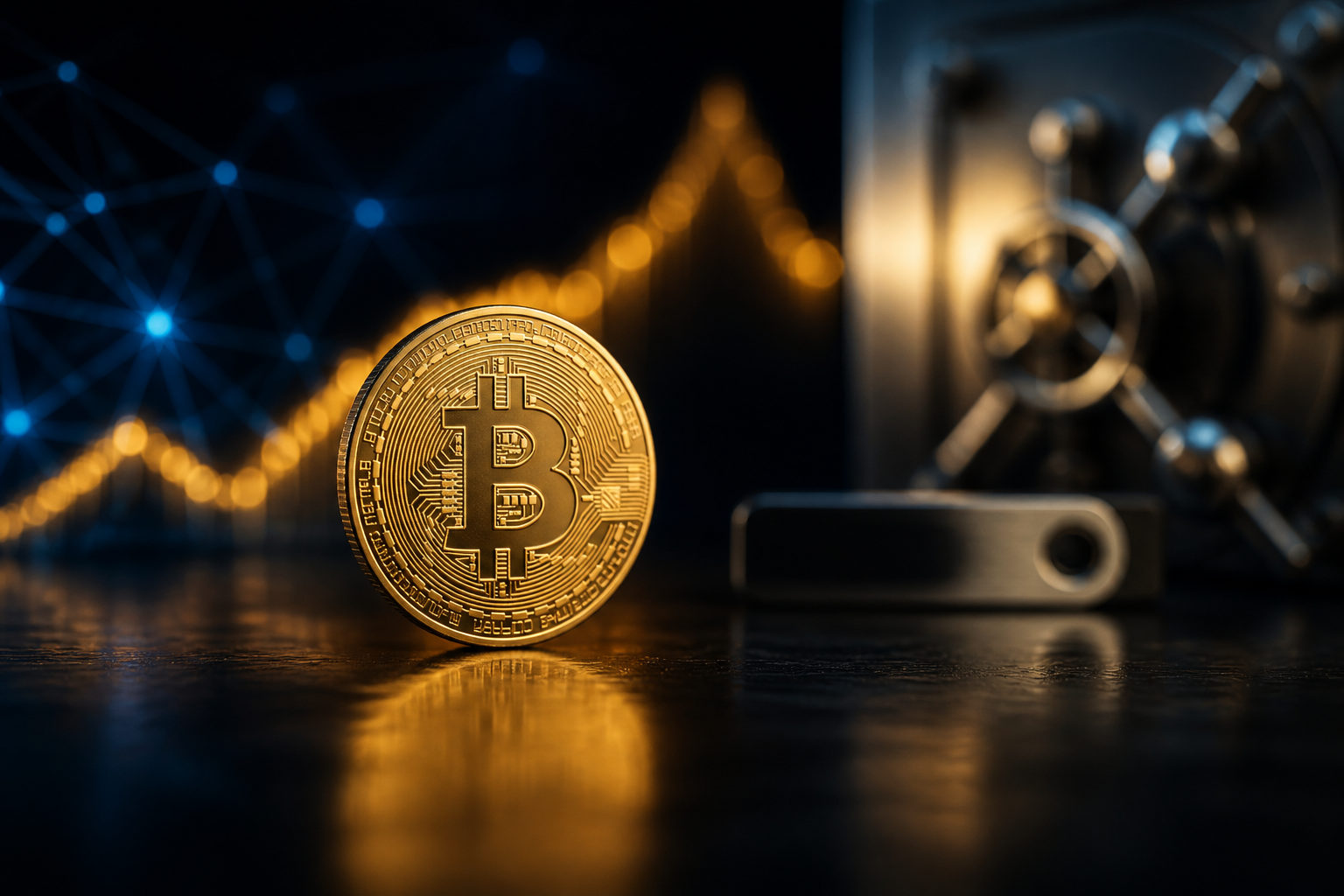
A quick course on bitcoins starts here: Bitcoin is a decentralized digital money system built on a blockchain, with a fixed supply and no single company issuing it.
What Bitcoin is actually for
Beginners often mistake Bitcoin for a token inside a trading app or for a company product. That misses the point. Bitcoin is a public network for recording and transferring value, and BTC is the native unit used on that network.
The idea was introduced in the 2008 white paper titled Bitcoin: A Peer-to-Peer Electronic Cash System, signed by Satoshi Nakamoto, whose identity remains unknown. The network went live with the genesis block in January 2009. Since then, participants around the world have helped maintain the system by running nodes and validating activity on the chain.
One useful way to think about it is to separate the system from the asset. Bitcoin, with a capital B, often refers to the network and protocol. bitcoin, in lower case, often refers to the asset unit itself, though many people use the terms loosely in everyday conversation.
| Term | Plain meaning | Common beginner mistake |
|---|---|---|
| Bitcoin network | A peer-to-peer system for transferring and recording value | Assuming one platform controls it |
| BTC | The native unit used on the network | Thinking it is only a ticker for speculation |
| Blockchain | A public ledger that adds records over time | Believing records can simply be edited away |
| Address | An identifier for sending and receiving bitcoin | Assuming an address automatically reveals identity |
How the system works without a central operator
You do not need advanced cryptography to understand the basic flow. A transaction is created and broadcast to the network. Nodes check whether the digital signature is valid, whether the coins are available to spend, and whether the same coins were already used in another transaction. Valid transactions are grouped into blocks, and later blocks build confirmation on top of them.
Bitcoin also has a transparent issuance rule. The total supply is capped at 21 million coins. New coins enter circulation through mining, where miners compete for the right to add a block and receive the block reward plus fees. A new block is produced about every 10 minutes, and the block reward is cut in half about every 4 years, or every 210,000 blocks. Halving years so far are 2012, 2016, 2020, and 2024.
That structure matters for two reasons. First, the issuance schedule is public and predictable. Second, whether a payment is final is determined by the chain’s confirmation process, not by a customer support message on an app screen.
| Mechanism | What it does | Why it matters to users |
|---|---|---|
| Fixed supply cap | Limits long-term issuance | New supply cannot be expanded on a whim |
| Mining | Competes for block production and helps secure the network | Security comes from distributed participation |
| Block confirmations | Strengthen the permanence of transaction records | Payment status should be checked on-chain |
| Halving | Reduces the pace of new issuance over time | Supply growth changes in stages |
Storage matters more than most beginners expect
Many beginner guides jump straight to buying and selling. A better starting point is custody. Once you understand who controls the keys, you understand who controls the coins.
You can leave bitcoin on an exchange account, or you can move it into a wallet you control yourself. Exchange custody is usually easier for first-time users because the interface is familiar and trading is simple. Self-custody gives you more direct control, but it also means you must protect your keys, your recovery backup, and the device you use to sign transactions.
It helps to define a few terms clearly. A wallet is not a box that holds coins. It is a tool that manages keys and signs transactions. The private key is what gives control. A seed phrase is a human-readable backup used by many wallets. If that relationship is clear, a lot of confusion disappears.
| Storage method | Who it fits | Strength | Main risk |
|---|---|---|---|
| Exchange account | People learning the basic flow | Convenient access and trading | Dependence on platform rules and account security |
| Software wallet | Users ready to manage transfers themselves | More direct control and flexibility | Device compromise or poor backup practice |
| Hardware wallet | Long-term holders focused on key isolation | Private keys stay separated from daily devices | Setup and backup mistakes can be costly |
Good first steps before moving funds
- Decide whether you are learning with a small amount or planning for longer-term holding.
- When sending for the first time, test with a small amount and verify the destination carefully.
- Keep recovery information in an offline place you control, rather than in screenshots or cloud storage.
- Learn the difference between submitted, pending, and confirmed transaction states.
Why the price moves so much
People looking for a quick course on bitcoins often want the price question answered right away. The better answer is to explain how price forms. Bitcoin does not have one universal quote. Real-time prices come from trading activity across different venues, and they can shift with supply and demand, market sentiment, liquidity conditions, macro news, regulatory developments, and leverage positioning.
That is why two venues can show slightly different prices at the same time, and why short-term swings can be sharp. A price jump does not automatically mean the protocol suddenly improved. A decline does not automatically mean the network stopped working. Market price reflects trading behavior, while the protocol follows its own rules.
If you only want a live quote, look for a mainstream market page that clearly shows spot pricing, time range, and trading depth. If you want to judge risk, focus less on a single flashing number and more on what may be driving buying pressure, selling pressure, and liquidation activity.
| Price driver | How it affects the market | How beginners should read it |
|---|---|---|
| Supply and demand | Imbalance can move price quickly | Check whether direction is supported by active trading |
| Liquidity | Thin depth can magnify moves | Do not treat a sudden spike as a stable trend |
| Sentiment and news | Can amplify chasing and panic selling | Separate facts from emotional reaction |
| Leverage | Liquidations can intensify volatility | Understand the risk before touching leveraged products |
A practical learning order for beginners
If you want a clean learning path, start with the relationship between Bitcoin, BTC, and the blockchain. Then move to wallets, private keys, and seed phrases. After that, watch how a transaction travels from broadcast to confirmation. Only then should you spend much time on trading screens and market noise.
This order solves a common problem. New users often rush into price predictions before they know what an address is, what a network fee does, or whether a mistaken transfer can be reversed. A stronger foundation comes from understanding control, finality, and record keeping before taking market risk.
| Learning stage | What to learn first | Why it belongs there |
|---|---|---|
| Stage one | Bitcoin, BTC, and blockchain basics | Build the mental framework |
| Stage two | Wallets, private keys, and seed phrases | Understand control of funds |
| Stage three | Transfers, fees, and confirmations | See how real use works |
| Stage four | Price formation and market risk | Avoid judging everything by short-term moves |
FAQ
Do I need to buy one whole bitcoin to get started
No. Bitcoin is divisible down to 1 satoshi, which is one hundred millionth of a BTC. That means beginners can start small and still learn the full process of storage and transfer.
Why is a bitcoin transaction not final the moment I send it
Because the network still needs to validate and confirm it. A wallet or exchange may show that it was sent, but final settlement depends on its status on the blockchain.
Is keeping bitcoin on an exchange the same as holding it myself
Not in the same way. On an exchange, your access depends on the platform’s custody model and account rules. In self-custody, control rests with whoever holds the private keys.
What should I look at when checking the bitcoin price
Look for whether the page shows spot pricing, the time window, and visible trading activity. A single number without context tells you very little about actual market conditions.
Can I learn Bitcoin without a technical background
Yes. You do not need to start with code or advanced math. For beginners, understanding wallets, transfers, confirmations, and key control is enough to build a solid base.
If you are starting today, pick one custody approach, read its backup rules carefully, and follow one transfer from creation to confirmation. That single exercise teaches more than hours of staring at price charts.
Disclaimer: This article is for informational and educational purposes only and is not investment, financial, or legal advice. Crypto assets are highly volatile and you could lose your entire investment. Do your own research and decide carefully.