
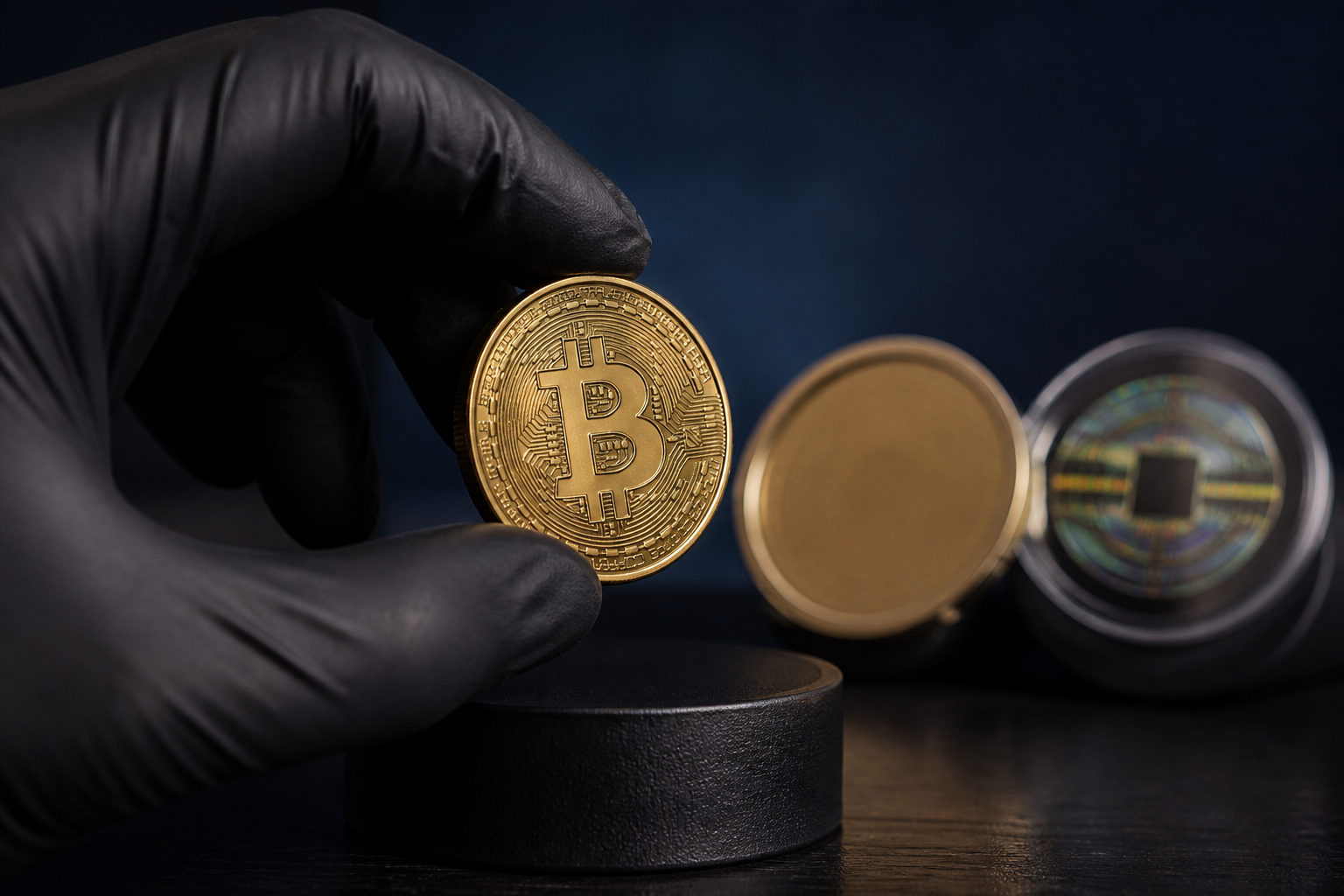
Physical bitcoins are usually made by private mints, gift makers, or collectible brands. Real Bitcoin is not a metal coin at all; it exists as a digital asset recorded on the blockchain.
Who actually makes physical bitcoins
When people ask who makes physical bitcoins, they are often talking about two very different things. One is the common metal token sold as a souvenir, gift, desk piece, or collector item. Those are typically made by private companies, custom coin workshops, promotional product suppliers, and individual sellers.
The other category is the older collectible piece that stores or references a private key. Even then, the maker is still a private party, not an official Bitcoin issuer. Bitcoin has no central mint, no approved coin factory, and no company with the authority to turn BTC into legal metal pieces.
That point matters because Bitcoin started as a digital cash system. Satoshi Nakamoto published the white paper on 2008-10-31, and the genesis block appeared on 2009-01-03. From the beginning, Bitcoin was designed to move through a distributed ledger, not through stamped metal coins.
| What you are looking at | Who makes it | Is it actual BTC? | Main use |
|---|---|---|---|
| Metal souvenir coin | Private makers, gift suppliers, collectible sellers | No | Display, gifts, collecting |
| Loaded collectible coin with private key | Private projects or collectors | The metal piece is not BTC itself; the key controls blockchain BTC | Collecting, unusual transfer method |
| Bitcoin on-chain | Created by the Bitcoin protocol rules | Yes | Payments, settlement, storage of value |
Why real Bitcoin is not “manufactured” as a coin
Bitcoin is issued by protocol rules, not by a mint. New coins enter circulation when miners produce valid blocks and receive the block reward. The target block interval is about 10 minutes. After the 2024-04-19 halving, the current block reward is 3.125 BTC, which means the network adds about 450 BTC per day in total.
That process is very different from making a physical coin. A metal token can be stamped, plated, engraved, and shipped. Bitcoin cannot be created that way. Ownership exists on the ledger and is controlled by private keys.
The issuance schedule is fixed as well. The reward halves every 210,000 blocks, roughly every 4 years. The halving dates so far are 2012-11-28, 2016-07-09, 2020-05-11, and 2024-04-19, with the next one expected around 2028. Bitcoin also has a hard supply cap of 21,000,000 BTC, expected to be fully issued around 2140. None of this depends on a company pressing round pieces of metal.
What most physical bitcoin products are really selling
Most physical bitcoin items are selling design, symbolism, and collectibility. They may feature the Bitcoin logo, circuit-style artwork, gold-colored plating, or a serial-number look. That can make them feel like a form of money, especially to beginners, but appearance does not create blockchain value.
Some products go further and claim to contain Bitcoin. That claim needs careful inspection. The object itself has little value unless it securely represents control over a blockchain address. If the private key was seen, copied, photographed, or backed up by the maker, the buyer has no way to trust the piece just because it looks sealed.
For a new user, the safest mental model is simple: many physical bitcoins are souvenirs, and some are collectible key containers with extra trust risk attached.
| Product type | Common sales pitch | Where the value comes from | Main risk |
|---|---|---|---|
| Regular souvenir coin | Premium look, collectible finish | Craftsmanship and collector interest | Confused with real Bitcoin |
| Custom gift coin | Branding, events, novelty | Design and presentation | No on-chain asset behind it |
| Private-key collectible | “Contains Bitcoin” | Control of BTC linked to the key | Key exposure, copying, prior withdrawal |
Common misunderstandings about physical bitcoins
The biggest mistake is assuming that a coin-shaped object with a Bitcoin symbol is a Bitcoin. It is not. Bitcoin ownership comes from control of a private key, and transfers are recognized on the blockchain. Handing over a metal piece does not, by itself, move BTC from one owner to another.
A second misunderstanding comes from real-world purchases made with Bitcoin. On 2010-05-22, Laszlo Hanyecz used 10,000 BTC to buy two pizzas, a famous early example of Bitcoin being exchanged for a physical good. That event shows that Bitcoin can be used to purchase real items. It does not mean Bitcoin itself became a physical coin.
A third source of confusion is the storage tool. A hardware wallet, a steel seed backup, or a paper backup is a way to protect access. None of those objects are Bitcoin itself. The same goes for the smallest unit: 1 satoshi equals 0.00000001 BTC, but a satoshi is still a ledger unit, not a tiny metal fragment.
What to check before buying one
Start with your purpose. If you want a display piece, a gift, or a collectible, then your focus should be the material, finish, maker reputation, and whether the listing clearly describes it as a souvenir. Clear labeling reduces the chance of paying for a trinket as if it were stored Bitcoin.
If the seller says the item includes actual BTC, the questions change. You need to know how the private key was generated, whether the maker ever had access to it, whether the seal can be tampered with, whether the linked address still holds funds, and whether you can move the BTC to your own wallet immediately after receiving it.
At that stage, the metal coin is almost the least important part of the deal. The real issue is whether the blockchain control was ever exclusive and whether it is still exclusive when you receive the item.
| Buying goal | What to check first | Best fit for | How to judge it |
|---|---|---|---|
| Collecting or display | Material, finish, clear description | General buyers | Look for clear souvenir labeling |
| Gift purchase | Presentation and lack of misleading claims | Gift buyers | Avoid anything that implies official issuance |
| BTC-linked collectible | Private key security and address control | Experienced users | Verify and move funds to self-custody quickly |
FAQ
Are physical bitcoins officially issued by Bitcoin?
No. Bitcoin has no official mint or approved physical coin program. Most items sold as physical bitcoins are privately made collectibles or novelty products.
Can a physical bitcoin really hold Bitcoin?
It can represent access to Bitcoin if it includes a valid private key or another secure control method. The problem is trust: if anyone else has seen that key, the linked BTC may no longer be safe.
Is a loaded physical bitcoin good for beginners?
Usually no. A beginner may find it hard to verify whether the key generation and storage process was secure, and that makes it easy to overpay for something that carries hidden custody risk.
Does handing someone a physical bitcoin count as payment?
Not in the normal Bitcoin sense. Payment is complete when control of the on-chain funds moves, and that is not guaranteed by passing a metal object from one person to another.
Is a hardware wallet the same as a physical bitcoin?
No. A hardware wallet is a device for protecting private keys. It is a storage tool, not Bitcoin itself.
If your goal is to own actual Bitcoin, focus on who controls the private keys and whether the BTC can be moved on-chain. If your goal is to buy a collectible, judge it like a collectible and do not assume the Bitcoin logo gives it blockchain value.