
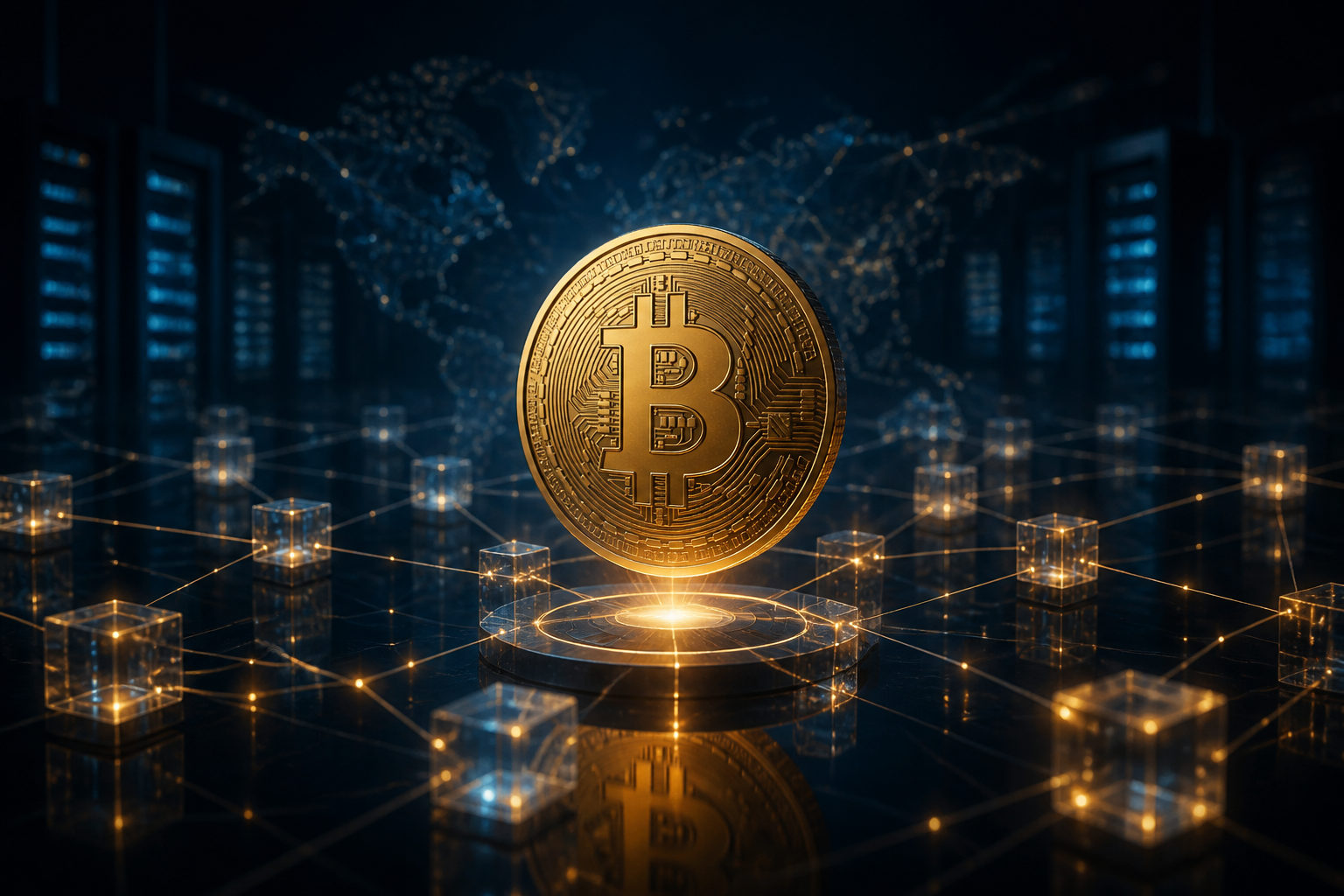
Bitcoin is a decentralized digital currency that runs on a blockchain, letting people send and hold value without a bank or a single issuing company in the middle.
What Bitcoin actually is
People often describe Bitcoin as internet money. That gets the basic idea across, but it leaves out the structure that makes the system work. Bitcoin is a payment and asset network built with cryptography, shared record-keeping, and a set of rules that every participant can verify for themselves.
The network went live in January 2009 with the genesis block. Its design was published under the name Satoshi Nakamoto, whose real identity remains unknown. Another defining feature sits in the code itself: the maximum supply is capped at 21 million coins, which is why scarcity comes up so often in any serious discussion of Bitcoin.
How the network keeps its records
Bitcoin does not rely on one master database. Nodes across the network maintain copies of the ledger, and new transactions are broadcast for verification before miners gather them into blocks.
Those blocks are linked in order, forming the blockchain. Roughly every 10 minutes, a new block is added. Simple idea. Hard to tamper with in practice, because changing an older record would mean rewriting a chain of confirmed history rather than editing a single entry.
Mining does two jobs at once. It issues new bitcoin according to the protocol, and it protects the system by making block production costly and competitive. The issuance rate drops about every 4 years, or every 210,000 blocks, in events known as halvings. The halving years so far are 2012, 2016, 2020, and 2024.
Wallets, private keys, and what you really own
New users often say they “store bitcoin in a wallet.” Close enough for conversation, but the technical picture is different. A wallet mainly manages private keys, and those keys are what let a person control bitcoin recorded on the chain.
That distinction matters. If a service shows you a balance but you do not control the relevant keys, your setup is very different from holding bitcoin directly. On the other hand, self-custody gives you direct control and direct responsibility. No customer service desk can restore access if your credentials are lost.
Bitcoin is divisible, so ownership does not require buying a whole coin. Its smallest unit is the satoshi, and 1 satoshi equals one hundred millionth of a BTC. Wallet software usually displays addresses, transaction history, and fee choices, though the exact layout changes from one app to another.
- Wallet: a tool for managing keys and signing transactions
- Address: a receiving identifier used for incoming BTC
- Private key: the core secret that controls spending authority
- Fee: the payment attached to help a transaction get confirmed
Why Bitcoin has value and how people use it
Bitcoin first appeared in the 2008 white paper titled Bitcoin: A Peer-to-Peer Electronic Cash System. The original goal was peer-to-peer electronic cash, yet its role today is broader than simple payments. People use Bitcoin for transfers, long-term holding, portfolio exposure, and moving value across borders without leaning on the banking rails every time.
Its price is not declared by a central issuer. Markets set it through buying and selling, and that price can shift fast when sentiment changes. Supply expectations, liquidity, regulation, macro conditions, and adoption all play a part. If someone wants the live BTC price, the right move is to check a major market data platform rather than trust an old article with stale numbers.
That point trips up beginners a lot. Bitcoin is tradable because markets give it a price; it is volatile because those markets constantly revise what they are willing to pay.
Main risks before you buy or use Bitcoin
Price swings get most of the attention, and for good reason. Bitcoin can rise or fall sharply over short periods. Still, market volatility is only one layer of risk. Storage choices, transaction mistakes, platform reliability, and local compliance rules can matter just as much.
Blockchain transfers usually do not behave like card payments or ordinary bank reversals. Once a transaction is sent and confirmed, undoing it is not straightforward. Then there is custody: whoever controls the private key controls the asset. That is empowering, but it also removes the safety net many users are used to in traditional finance.
| Area | What to watch |
|---|---|
| Price movement | Short-term moves can be sharp in either direction |
| Custody | Lost or exposed keys can lead to permanent loss of control |
| Transactions | Confirmed transfers are generally not easy to reverse |
| Rules | Tax and trading treatment differ by country and region |
FAQ
Is Bitcoin the same as digital cash?
It can be used that way, but Bitcoin is more than a payment token. It is also the network, the rules, and the public ledger that allow strangers to transfer value without trusting a central operator.
Do I need to buy one full bitcoin?
No. Bitcoin can be divided into much smaller units, down to the satoshi. That lets people buy, hold, or transfer small amounts instead of a full BTC.
Is a Bitcoin wallet the same as a bank account?
Not really. A bank account is managed by a financial institution, while a Bitcoin wallet manages keys that authorize spending. The control model is different, and so is the responsibility.
Why do people see Bitcoin as scarce?
The protocol sets a hard limit of 21 million coins. New issuance also slows over time through halving events, which is one reason scarcity is central to the Bitcoin thesis.
Where should a beginner start?
Start with three things: blockchain basics, wallet types, and private keys. After that, learn how addresses, fees, and confirmations work before sending any BTC.
If you are just getting started, choose a wallet you can actually understand, learn how backups work, check addresses carefully, and test the process with a small amount before doing anything more complex.
Disclaimer: This article is for informational and educational purposes only and is not investment, financial, or legal advice. Crypto assets are highly volatile and you could lose your entire investment. Do your own research and decide carefully.