
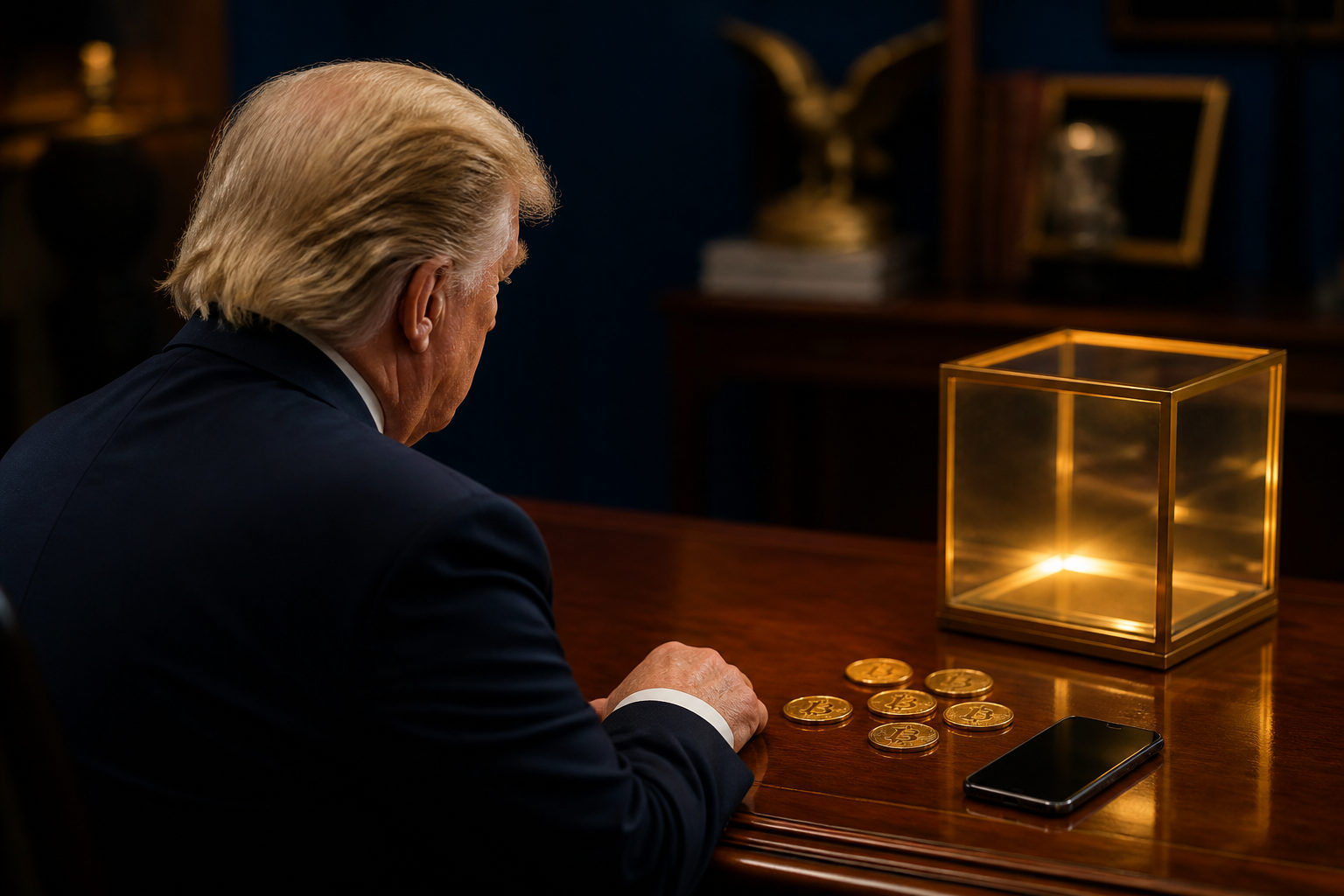
How much bitcoin does Trump own? The short answer is that there is no publicly verifiable exact figure. Public discussion often mixes up personal BTC holdings, related crypto assets, and third-party wallet labels.
Why there is no clean public number
Bitcoin addresses do not come with built-in identity. Unless a person publicly ties an address to their name through a statement, a filing, or a signed on-chain message, outside observers can see activity but cannot prove ownership from the address alone.
That problem gets bigger with high-profile figures. Reports, social posts, asset disclosures, and blockchain screenshots may all point to something different. One source may describe a broad category of digital assets, another may mention revenue connected to a branded project, and a third may show a wallet that someone on the internet says belongs to the same person. Those are not the same thing.
| Source type | What it can tell you | What it cannot prove by itself |
|---|---|---|
| Public statement | The person's own claim or stance | Exact BTC holdings without verifiable evidence |
| Asset disclosure | That some digital assets may have been reported | The precise share that is bitcoin |
| Blockchain address data | Whether an address holds BTC | That the address is controlled by Trump |
| Media summary | Useful context and leads | Independent proof if the original source is missing |
Three things readers often mix together
Most people searching this topic want a direct answer about Trump's personal bitcoin holdings. To get close to that answer, you need to separate three buckets: personal holdings, related income, and public labels. Personal holdings mean bitcoin he directly controls. Related income may come from activity tied to his name, brand, or a project associated with him. Public labels are tags used by platforms, analysts, or social users to connect an address to a public figure.
Once those buckets are blended together, the number stops meaning much. A disclosure that mentions digital assets does not mean every reported asset is BTC. A wallet connected to a project bearing his name does not automatically equal a private wallet. A payment received on another blockchain cannot be rewritten as a bitcoin holding figure.
| Common claim | Better interpretation | Question to ask next |
|---|---|---|
| “He owns crypto” | The category may be broad | Does the source clearly say bitcoin? |
| “There is a wallet tied to him” | Start with ownership proof | Who verified the address link? |
| “A tracker shows related assets” | A label may come from data curation | What is the original basis for the tag? |
| “News reports say he owns a lot” | This is second-hand information | Is there a filing, statement, or only a retelling? |
What kind of evidence actually matters
If you want to judge this topic with care, a few forms of evidence carry the most weight. The strongest cases come from direct public disclosure, a filing that clearly distinguishes bitcoin from other assets, or technical proof showing control of a wallet. Without one of those, any exact figure should be treated as unconfirmed.
People often hear that blockchain data is transparent and assume that identity is transparent too. Those are different claims. The chain can show that an address holds BTC or sent BTC. It does not tell you who controls the keys unless that link is proven elsewhere.
- Start with the original source. Read the filing, full interview, or official statement rather than a cropped image or social post.
- Check the asset category. Make sure the source is talking about bitcoin, not a broad basket of crypto assets or income from a digital collectible project.
- Look for ownership proof. A signed message, an official confirmation, or a document with clear attribution carries more weight than a public label.
- Watch the time frame. Even if a source is sound for one moment, holdings can change later because bitcoin can be moved at any time.
What this search term is really useful for
For most readers, the value of this question is not a trading signal. Even if a public figure does hold BTC, outside observers usually do not know the cost basis, holding period, custody setup, or whether the coins were later transferred. Quantity alone gives a thin picture.
A better use of the topic is to sharpen your filter for crypto claims. Ask who is being described, what asset is being discussed, whether the evidence is first-hand, and whether ownership is proven or merely suggested. That process is more useful than repeating a headline figure that may collapse under basic scrutiny.
| Your goal | A better question | Why it helps more |
|---|---|---|
| Understand his view on bitcoin | What has he publicly said or done? | Public stance is easier to verify than an exact holding number |
| Use the story for market decisions | How strong is the source? | Poor sourcing can lead to weak conclusions |
| Track blockchain evidence | Is there a formally confirmed wallet? | Without attribution, on-chain data is limited |
| Check whether a report is real | Does it include original documentation? | This removes a lot of recycled claims |
FAQ
Has Trump publicly disclosed an exact amount of bitcoin?
Public discussion does not offer a single exact number that is broadly accepted and independently verifiable. If clearer filings or wallet proof appear later, the answer could become more precise.
Does a “Trump-related wallet” mean it is his personal BTC wallet?
No. A related wallet may belong to a project, a partner, a custodian, or simply reflect a third-party tag. A label is not the same as proven personal control.
If a disclosure mentions digital assets, can that be read as bitcoin holdings?
Not automatically. Digital assets is a wider category, and the source may not break the holding down by coin. You need a source that clearly separates BTC from other assets.
Why do reports on this topic often conflict with each other?
The reporting often uses different definitions. One piece may refer to personal assets, another may refer to related revenue, and another may rely on wallet attribution that has not been firmly proven.
Is this question useful for ordinary investors?
Yes, mainly as a test of source quality. If you learn to separate first-hand evidence from broad claims and speculative attribution here, you can apply the same habit to many other crypto stories.
What to do if you want to verify future claims
Look first for original disclosures, direct statements, and any proof of wallet control. Then separate bitcoin from other crypto assets before repeating a number. If those steps are missing, any exact answer to how much bitcoin Trump owns should be treated as a claim, not as a settled fact.
Disclaimer: This article is for informational and educational purposes only and is not investment, financial, or legal advice. Crypto assets are highly volatile and you could lose your entire investment. Do your own research and decide carefully.