
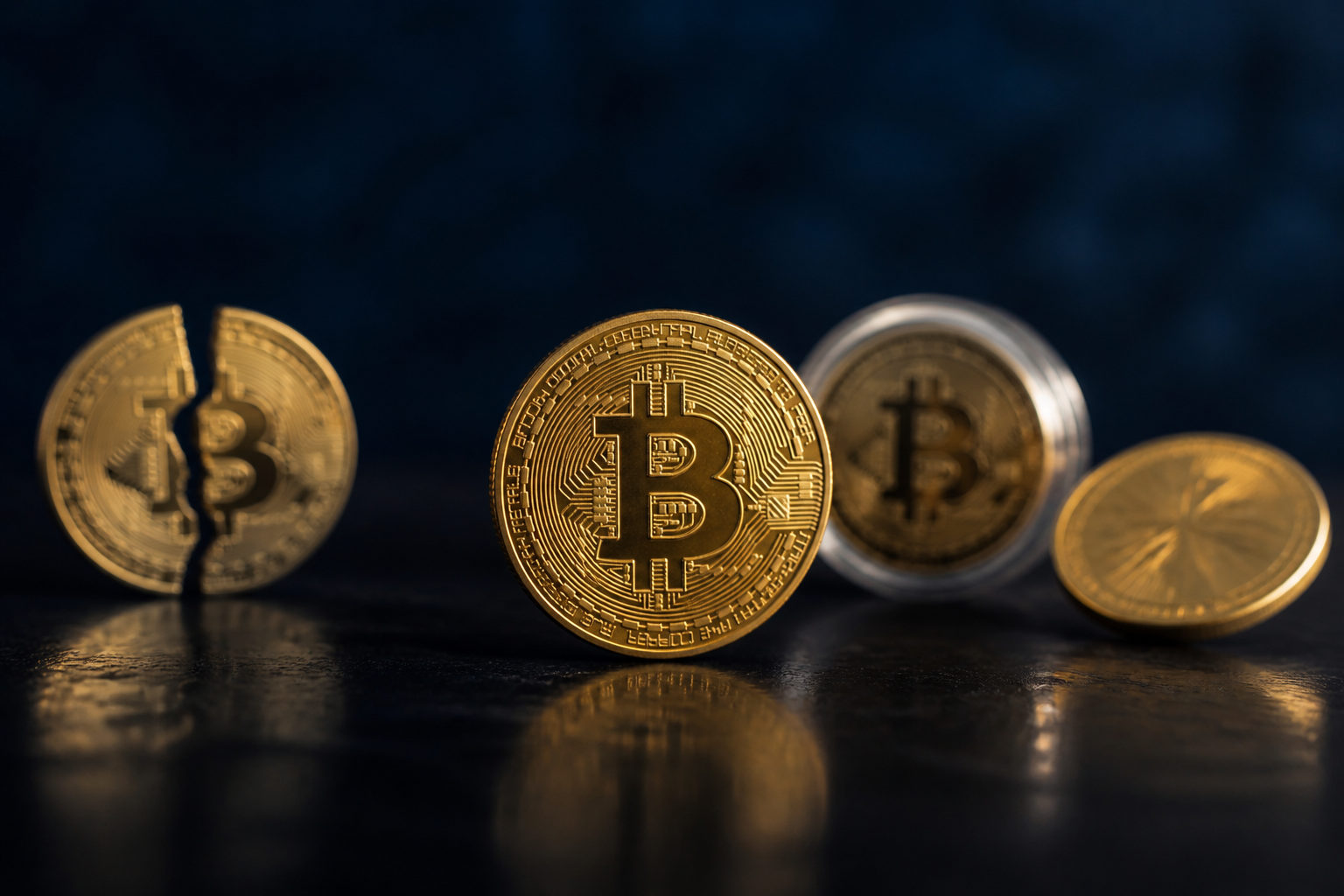
Are there different bitcoins? In everyday use, Bitcoin usually means BTC on the Bitcoin network, but the market also has several Bitcoin-related assets that share the name without being the same thing.
Start with the narrow definition
For a beginner, the cleanest starting point is this: Bitcoin, with a capital B in the general sense, usually refers to the network and asset people know as BTC. That asset exists natively on the Bitcoin blockchain. If an exchange, wallet, or app shows something with “Bitcoin” in the name, that alone does not prove it is native BTC.
BTC is the asset tied to the Bitcoin system introduced by Satoshi Nakamoto. The white paper, Bitcoin: A Peer-to-Peer Electronic Cash System, appeared in 2008, and the genesis block was created in January 2009. Bitcoin has a supply cap of 21 million coins, and its smallest unit is the satoshi, where 1 satoshi equals one hundred millionth of a BTC. Those facts apply to native Bitcoin itself, not to every asset that borrows the Bitcoin label.
What people mean when they think there are “different bitcoins”
| Category | Native BTC? | What it is | What beginners often miss |
|---|---|---|---|
| BTC | Yes | The native asset on the Bitcoin blockchain | This is what most people mean by Bitcoin |
| Fork coins | No | Separate assets created from a split in code or chain history | A similar name does not make them equal to BTC |
| Wrapped Bitcoin-style assets | No | Tokens on other blockchains that track or represent BTC | They may follow BTC in value, but they are not BTC on the base chain |
| Exchange balances | Not always | A BTC balance shown inside a trading platform account | A screen balance is not the same as direct on-chain control |
| Lookalike tokens | No | Tokens with Bitcoin in the name for branding or attention | The name can create false trust |
That table explains why the answer can sound confusing. There is one native Bitcoin asset, BTC, yet there are multiple other instruments and tokens that people casually group under the same label. The problem is not a lack of categories. The problem is sloppy naming.
Why these related versions exist
One source is a fork. A blockchain can split when developers, miners, businesses, or users disagree on rules or direction. When that happens, the new chain may keep part of the Bitcoin identity in its name. It still becomes a separate asset with its own network, community, and market behavior.
Another source is cross-chain demand. Native BTC lives on the Bitcoin network, but some users want Bitcoin-linked exposure on other chains for trading, lending, or app use. That leads to wrapped or tokenized versions. These are built to represent BTC value elsewhere, often through custody or mint-and-redeem structures. If that structure fails, the token can behave differently from native BTC.
A third source is branding. Some projects use the word Bitcoin because it is familiar and attracts clicks. For a new user, this is often the hardest case to spot. The name feels trustworthy even when the asset has no special status in the Bitcoin system.
How to tell what you are actually looking at
| Check | What to look for | Why it matters |
|---|---|---|
| Ticker | Whether the asset is clearly listed as BTC | Helps separate native Bitcoin from similarly named assets |
| Network | Whether it runs on the Bitcoin main network | Shows if it is native BTC or a token on another chain |
| Deposit and withdrawal page | Whether the platform shows Bitcoin network support | Reduces the chance of using the wrong chain |
| Control | Whether you hold the private keys or recovery phrase | Distinguishes self-custody from platform IOUs |
| Asset description | Whether it mentions wrapping, backing, mapping, or a fork origin | Explains what kind of Bitcoin-related product it is |
If you buy “BTC” on a platform, one practical test is whether you can withdraw it to a Bitcoin address on the Bitcoin network. If you can, you are usually dealing with something much closer to native BTC use. If the asset only moves on another chain, you may be holding a tokenized representation instead.
Another common misunderstanding is the idea that a cheaper-looking “Bitcoin” must be the easier entry point. Bitcoin itself is divisible. You do not need to buy a whole coin to own Bitcoin. Since 1 satoshi equals one hundred millionth of a BTC, a small amount of BTC is still Bitcoin. A low unit price on a different asset does not make it a bargain version of BTC.
Common mistakes that create confusion
| Claim | What is wrong with it | Better way to read it |
|---|---|---|
| Anything named Bitcoin is a type of Bitcoin | It treats branding as proof of identity | Check the chain, ticker, and issuance method first |
| Wrapped Bitcoin is the same as BTC | It skips custody and contract structure | It is a representation of BTC in another environment |
| A fork coin is the new version of Bitcoin | It assumes continuity without checking the chain split | Forks create separate assets after the split |
| An exchange BTC balance is the same as holding coins yourself | It confuses account records with direct control | You still need to know who controls the asset and how it can be withdrawn |
So the precise answer is this: there are not multiple native Bitcoins on the Bitcoin blockchain, but there are several Bitcoin-related assets that many people lump together under one name. If you want actual Bitcoin, focus on the asset code, the network, and whether it behaves like native BTC in withdrawal and storage.
FAQ
Is every coin with Bitcoin in the name part of Bitcoin?
No. Some are forked assets, some are wrapped versions on other chains, and some are simply branded to sound familiar. The name is only a starting clue, not proof.
Is wrapped Bitcoin the same thing as BTC?
It is meant to represent BTC value in another blockchain environment, but it is still a different asset form. Its design can add custody or smart contract dependencies that native BTC does not have in the same way.
If I own only a fraction of a BTC, do I still own Bitcoin?
Yes. Bitcoin is divisible into satoshis, so you do not need a whole coin. Holding part of a BTC is still holding Bitcoin.
How can I avoid buying the wrong Bitcoin-type asset?
Check the ticker, confirm the network, and read the withdrawal options before you buy. If those details are unclear, treat the asset as unverified rather than assuming it is BTC.
Do fork coins count as real Bitcoin?
They are real crypto assets with their own chains, but they are not the same asset as BTC. In conversation, it is better to name the exact asset instead of using “Bitcoin” as a catch-all term.
If your goal is simple and specific, keep your checklist simple too: confirm the ticker is BTC, confirm the network is Bitcoin, and confirm withdrawals work on the Bitcoin network. That removes most of the confusion behind the idea of “different bitcoins.”
Disclaimer: This article is for informational and educational purposes only and is not investment, financial, or legal advice. Crypto assets are highly volatile and you could lose your entire investment. Do your own research and decide carefully.