
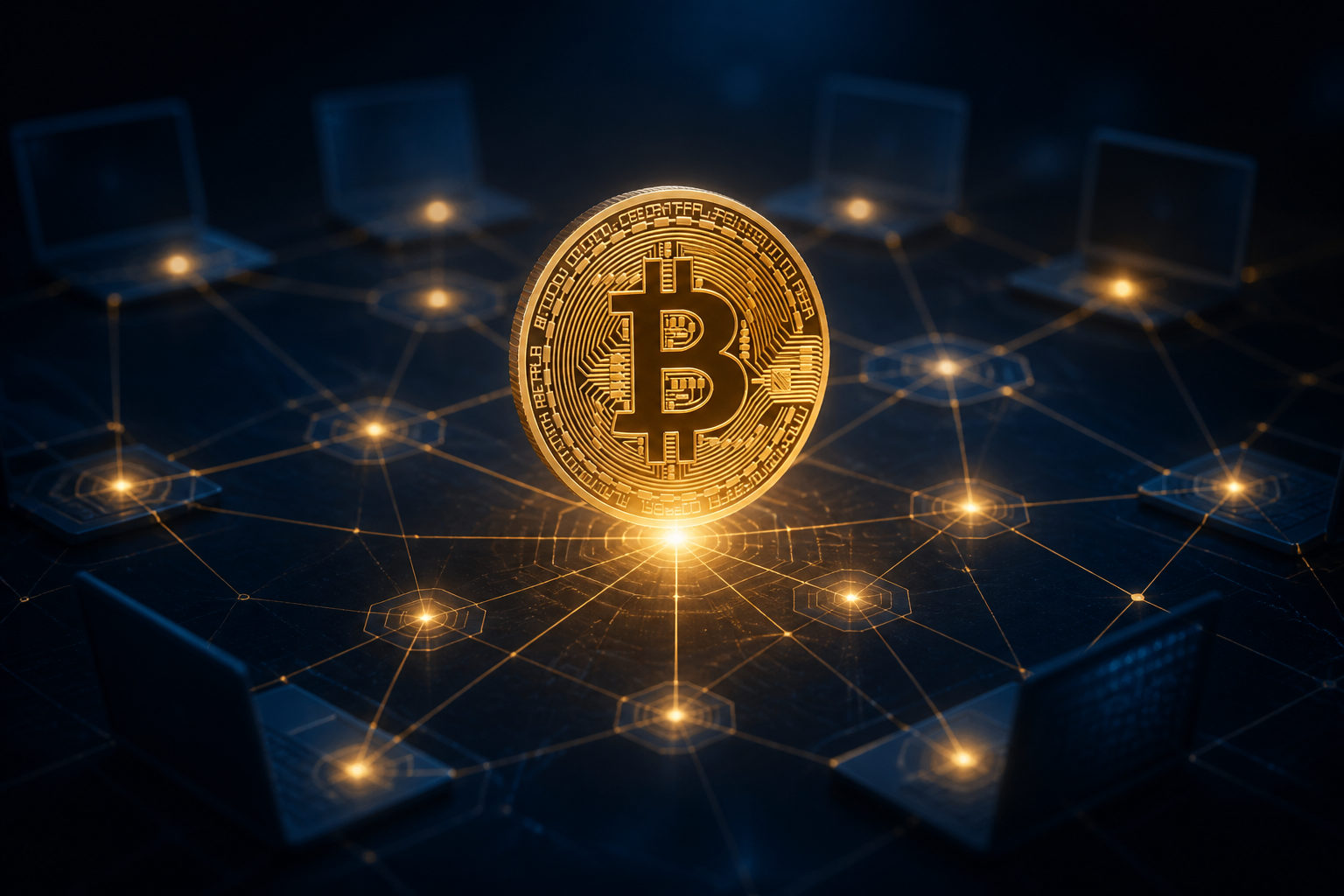
Bitcoin is a decentralized digital currency that runs on a public blockchain, which means no single bank, company, or government directly controls its issuance or transaction record.
What Bitcoin actually is
Beginners often hear the word Bitcoin and assume it means a trading code, an app balance, or a generic internet token. That misses the core idea. Bitcoin is both a digital asset and a payment network designed to let people transfer value without relying on one central operator to keep the ledger.
That distinction matters. Sometimes people say “Bitcoin” when they mean BTC, the asset. Other times they mean the Bitcoin network, the system that checks transactions, groups them into blocks, and keeps a shared history of ownership. If you separate those two meanings early, the subject becomes much easier to follow.
Bitcoin is not a digital version of a bank account, and it is not equity in a company. It exists as entries on a blockchain, a public ledger that anyone can inspect. The records are open, but wallet addresses are not the same thing as real names, so the system is transparent without looking like a standard bank statement.
How Bitcoin works in plain English
You do not need advanced cryptography to understand the basics. For a first pass, focus on three questions: who keeps the ledger, how transactions are confirmed, and what limits the supply.
The ledger is maintained by a distributed network of participants rather than one central database. Nodes keep copies of the blockchain and check whether incoming transactions follow the rules. If a transaction does not meet those rules, it is not accepted in the normal way.
Transactions are grouped into blocks. The Bitcoin network produces a new block about every 10 minutes, and each new block is linked to the previous ones. That chain structure is a big part of why old records are hard to change after the fact.
Supply is also rule-based. Bitcoin has a maximum supply of 21 million coins. New bitcoin enters circulation through mining, and the block reward is cut roughly every 4 years, or every 210,000 blocks. The known halving years are 2012, 2016, 2020, and 2024.
You may also see the word “satoshi.” That is the smallest unit of bitcoin. 1 satoshi equals one hundred millionth of 1 BTC, which is why people can buy or transfer tiny fractions rather than a whole coin.
Where Bitcoin came from and why people care about it
Bitcoin was introduced in the 2008 white paper titled Bitcoin: A Peer-to-Peer Electronic Cash System. It was published under the name Satoshi Nakamoto, whose real identity remains unknown. The network itself started with the genesis block in January 2009.
People do not value Bitcoin because a company promises redemption. They value it because the rules are public, the supply limit is known, the ledger can be verified, and the network has built a broad base of recognition over time. For some users, the appeal comes from scarcity. For others, it comes from portability, resistance to single-point control, or the ability to move value across borders without using the standard banking stack.
Still, acceptance is not universal. Bitcoin is not something every merchant must take, and people approach it for different reasons. Some view it as a long-term store-of-value asset. Some see it mainly as a volatile risk asset. Others care more about its role as the first major blockchain-based monetary network. These views can exist at the same time.
Common misconceptions that confuse new users
Bitcoin is not the same as all crypto
Bitcoin is one digital asset and one network, not a label for every token in the market. Other crypto assets can have very different supply rules, governance models, technical designs, and risks.
Bitcoin is not a stock
Owning BTC does not mean you own part of a business. There are no shareholder rights, no claim on company earnings, and no management vote attached to a bitcoin balance.
Bitcoin is not fully anonymous
A better description is pseudonymous. Transactions are recorded on a public blockchain, and if an address is linked to a real-world identity, activity connected to that address may be analyzed.
A wallet does not “store coins” in the simple physical sense
A Bitcoin wallet is mainly a tool for managing private keys and addresses. The asset record exists on the blockchain. What gives someone control is usually control of the private key, not the app screen that shows a balance.
You do not need to buy a whole bitcoin
This is one of the most common beginner mistakes. Because bitcoin can be divided into satoshis, a person can own a small fraction. Understanding custody and risk matters far more than owning one full unit.
What a beginner should understand before going further
First, learning what Bitcoin is and deciding to buy it are two different things. You can study the system, understand why it exists, and still decide it is not suitable for your goals or risk tolerance.
Second, many people asking what Bitcoin is are also asking, indirectly, why it has a price. The answer is that price comes from market supply and demand, liquidity, risk appetite, regulation expectations, and broader sentiment. If you want the live price, check a major market data service or a regulated trading platform rather than expecting a definition article to act as a quote screen.
Third, risk is not limited to price swings. If you leave bitcoin with a custodial platform, your main concerns include platform risk and account security. If you hold it yourself, your main concerns shift to private keys, seed phrases, device security, and backup discipline.
Fourth, not everything marketed with the word Bitcoin carries the same structure. Spot ownership, derivatives, custody services, yield products, mining offers, and social-media promotions can expose users to very different risks. A beginner should identify the product category before doing anything else.
FAQ
What does one bitcoin mean?
It means one unit of the native asset on the Bitcoin network, commonly written as BTC. A full coin is only a unit of account, since bitcoin can be divided into much smaller parts.
How is Bitcoin different from normal digital payments?
Standard digital payments usually depend on banks or payment companies to manage accounts and settlement. Bitcoin uses a public network and consensus rules to record transfers without one central bookkeeper.
Is Bitcoin just virtual money?
In everyday speech, many people call it virtual currency or cryptocurrency. A more precise description is a decentralized digital currency that operates on a blockchain, though legal classification can vary by jurisdiction.
Why does Bitcoin have value at all?
Its value is not declared by one authority. It emerges in the market from what people are willing to pay and accept, shaped by scarcity, transferability, verifiability, liquidity, and shared belief in the network's usefulness.
Do I need to mine Bitcoin before I can own any?
No. Most people who get started with Bitcoin begin by learning about wallets, custody, and trading basics rather than mining. Mining involves equipment, maintenance, and technical overhead, so it is not the default path for beginners.
If your goal is simply to understand Bitcoin, the most useful order is this: learn the difference between Bitcoin, blockchain, wallets, and exchanges; understand private keys and custody risk; then decide whether buying any makes sense for you.
Disclaimer: This article is for informational and educational purposes only and is not investment, financial, or legal advice. Crypto assets are highly volatile and you could lose your entire investment. Do your own research and decide carefully.