
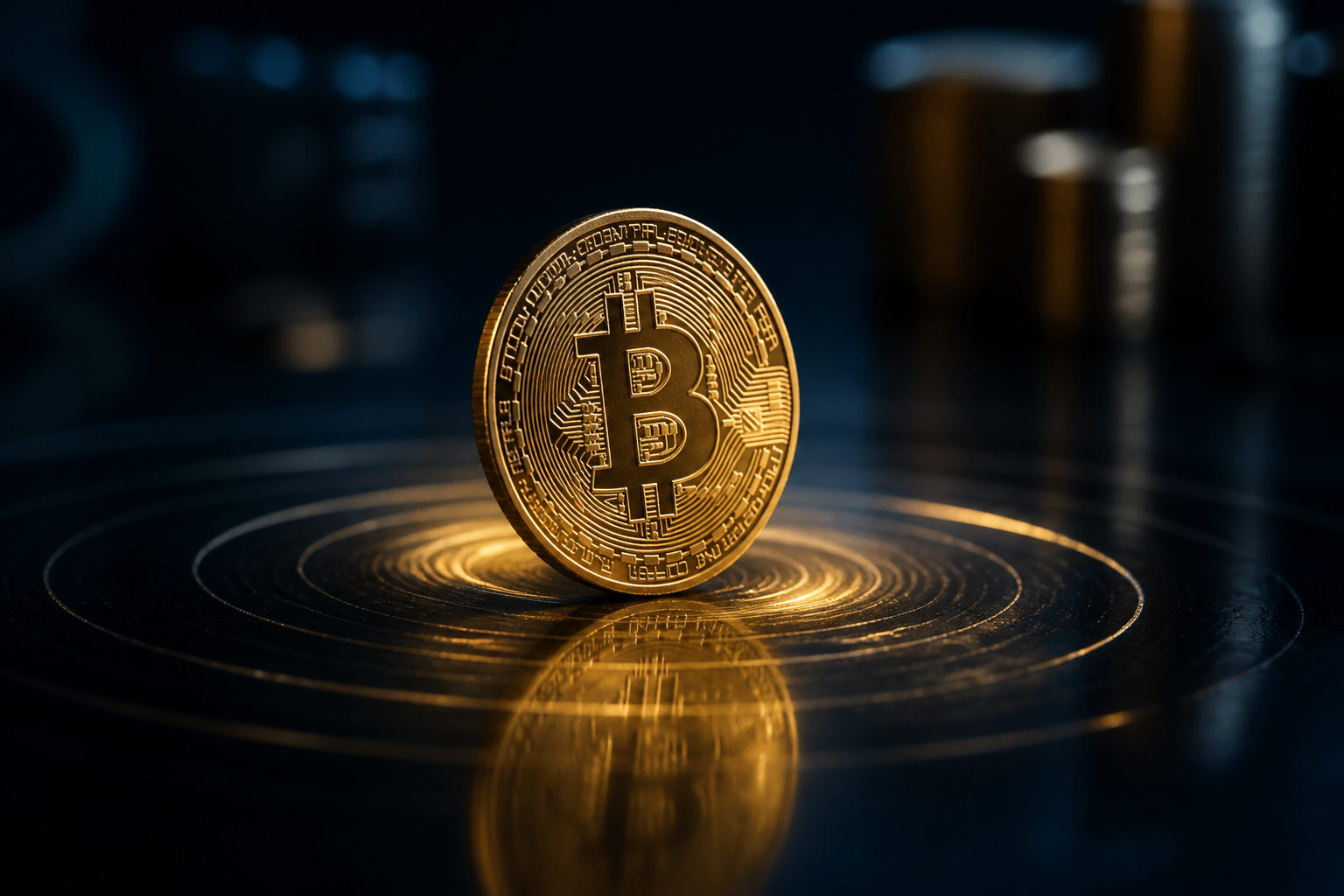
What is bitcoin going to do? For a beginner, the clearest answer is this: Bitcoin is a digital money system that runs on a blockchain and is used to move and store value, while its market price changes based on how people value that system.
What people usually mean by this question
The phrase sounds simple, but it often combines several different questions. Some people want to know where the price may move next. Others want to know whether Bitcoin will matter in the future. A third group is simply asking what Bitcoin actually does in the first place.
Those are separate issues, and mixing them creates confusion fast. Price is a market outcome. Utility comes from design and adoption. Long-term relevance depends on whether users keep finding reasons to hold it, use it, or build services around it.
| Common question | What it really asks | Better way to think about it |
|---|---|---|
| What is bitcoin going to do | How its price or role may change | Separate market action from network function |
| What will Bitcoin be used for | Whether adoption can continue | Look at payments, savings, and value transfer |
| What does Bitcoin actually do | How the system works | Focus on issuance rules, validation, and ownership |
A practical answer is that Bitcoin itself does not wake up and choose a new direction. It follows its rules. What changes is demand, market sentiment, access, regulation, and the story people tell about why it matters.
Start with the one-sentence definition
Bitcoin is a peer-to-peer electronic cash system introduced under the name Satoshi Nakamoto in the white paper titled Bitcoin: A Peer-to-Peer Electronic Cash System. It started running from the genesis block in 2009, has a supply cap of 21 million coins, and issues new coins according to code rather than the decision of a single company or state.
Blocks are added roughly every 10 minutes. The issuance schedule is reduced about every 4 years, or every 210,000 blocks, in events known as halvings. The halving years so far are 2012, 2016, 2020, and 2024.
For a newcomer, the key boundary is this: Bitcoin is both an asset and a network-based monetary system. The price chart is only the outer layer. Under that chart sits a public ledger, a fixed issuance structure, and a model where control depends on access to private keys.
What Bitcoin is actually doing
If we set aside short-term price talk, Bitcoin is doing several concrete things. It lets users transfer BTC over the internet without depending on bank hours. It makes its issuance rules visible in advance. It gives users the option to hold value in a system with a known supply cap. It also allows self-custody, which means the owner can control assets directly instead of leaving that control entirely with an intermediary.
Each of those points matters for a different reason. Public verification makes transactions auditable. A fixed issuance path gives markets a clear framework for discussing scarcity. Self-custody changes the responsibility model because the user can hold the keys, but that also means the user carries more operational risk.
| Function | What Bitcoin does | Beginner misunderstanding |
|---|---|---|
| Value transfer | Sends BTC across the network | Assuming it works exactly like a standard payment app |
| Value storage | Can be held as a long-term asset | Assuming volatility means it cannot serve any savings role |
| Self-custody | Lets users control their own keys | Thinking lost access is always easy to recover |
| Public settlement | Records transactions on a verifiable chain | Believing it is automatically invisible to everyone |
Many first-time readers reduce Bitcoin to a line on a chart. That misses the larger point. If you want to think about what Bitcoin is going to do next, you need to understand the relationship between the network's rules, the reasons people use it, and the way markets react to both.
The main forces that shape Bitcoin's next move
Without live market data, the useful approach is not to make a pretend forecast. It is to build a framework. Bitcoin's next move in price or adoption usually comes from several forces acting at once, and they do not always point in the same direction.
Supply rules
Bitcoin's issuance path is one of its defining features. A capped supply and scheduled halvings give market participants a fixed reference point. That does not guarantee rising prices, though, because scarcity only matters if people continue to want exposure to the asset or the network.
Demand quality
Demand can come from different places. Some users treat Bitcoin as a long-term holding. Some use it for trading. Some care about moving value across borders or holding an asset outside traditional financial rails. A market driven by several motives tends to look different from one driven only by short-term speculation.
Access and usability
The easier it is for ordinary users to buy, hold, learn, and transfer Bitcoin, the wider the potential user base becomes. If the tools feel confusing, many people stop before they understand what a wallet does, how custody works, or why private keys matter.
Market mood
Bitcoin is often discussed as a volatile asset, so broader risk appetite affects how money flows into or out of it. In periods when traders are comfortable taking risk, participation can expand. In more defensive periods, behavior often turns cautious.
| Factor | Why it matters | What beginners should watch |
|---|---|---|
| Supply design | Shapes expectations for new BTC entering the market | Learn the cap and halving schedule first |
| Demand mix | Shows why people want to hold or use Bitcoin | Separate saving, trading, and payment demand |
| Ease of access | Affects whether new users can participate | Pay attention to custody, tools, and learning curve |
| Risk appetite | Influences capital flows and volatility | Avoid making a call from one headline alone |
So when someone asks what Bitcoin is going to do, the first follow-up should be: do you mean price, role, or adoption? That one distinction clears up a lot of noise.
Common beginner mistakes that distort the answer
One mistake is treating Bitcoin like a company stock. It does not have a standard corporate income statement or a management team guiding quarterly performance, so equity analysis does not map neatly onto it.
Another mistake is assuming Bitcoin means complete anonymity. The ledger is public and transactions can be examined. An address is not the same thing as a real-world name, but that is very different from total invisibility.
A third mistake is believing that buying BTC automatically solves the security side. Exchange accounts, wallets, and private keys are different layers. If a user confuses them, problems usually appear during storage, transfer, or recovery.
A fourth mistake is reading every halving as a direct promise of higher prices. A halving changes the flow of new supply. It does not create demand on its own, and it does not remove volatility.
FAQ
Is Bitcoin mainly supposed to be money or an investment?
In practice, people use it in both ways. Some focus on its role as a network for transferring value, while others treat it as an asset they want to hold over time.
If I want to judge where Bitcoin may go next, what should I learn first?
Start with the supply cap, the halving cycle, and the difference between network utility and market price. That gives you a base for reading news without turning every headline into a price call.
Is Bitcoin the same thing as blockchain?
No. Bitcoin is a monetary system that runs on a blockchain, while blockchain is the broader record-keeping structure that supports verification and settlement.
Do I need to buy a whole bitcoin to use it?
No. Bitcoin can be divided into smaller units. The smallest unit is one satoshi, which is one hundred millionth of a BTC.
What concept should a complete beginner learn before anything else?
Learn the difference between an exchange account, a wallet, and a private key. If those three ideas are blurred together, almost every later step becomes harder than it needs to be.
If you want to study Bitcoin seriously, do one practical thing before asking whether it will go up or down next: make a short checklist for yourself that covers use case, custody, risk tolerance, and where you will check live price data. That will help more than any single prediction.
Disclaimer: This article is for informational and educational purposes only and is not investment, financial, or legal advice. Crypto assets are highly volatile and you could lose your entire investment. Do your own research and decide carefully.