
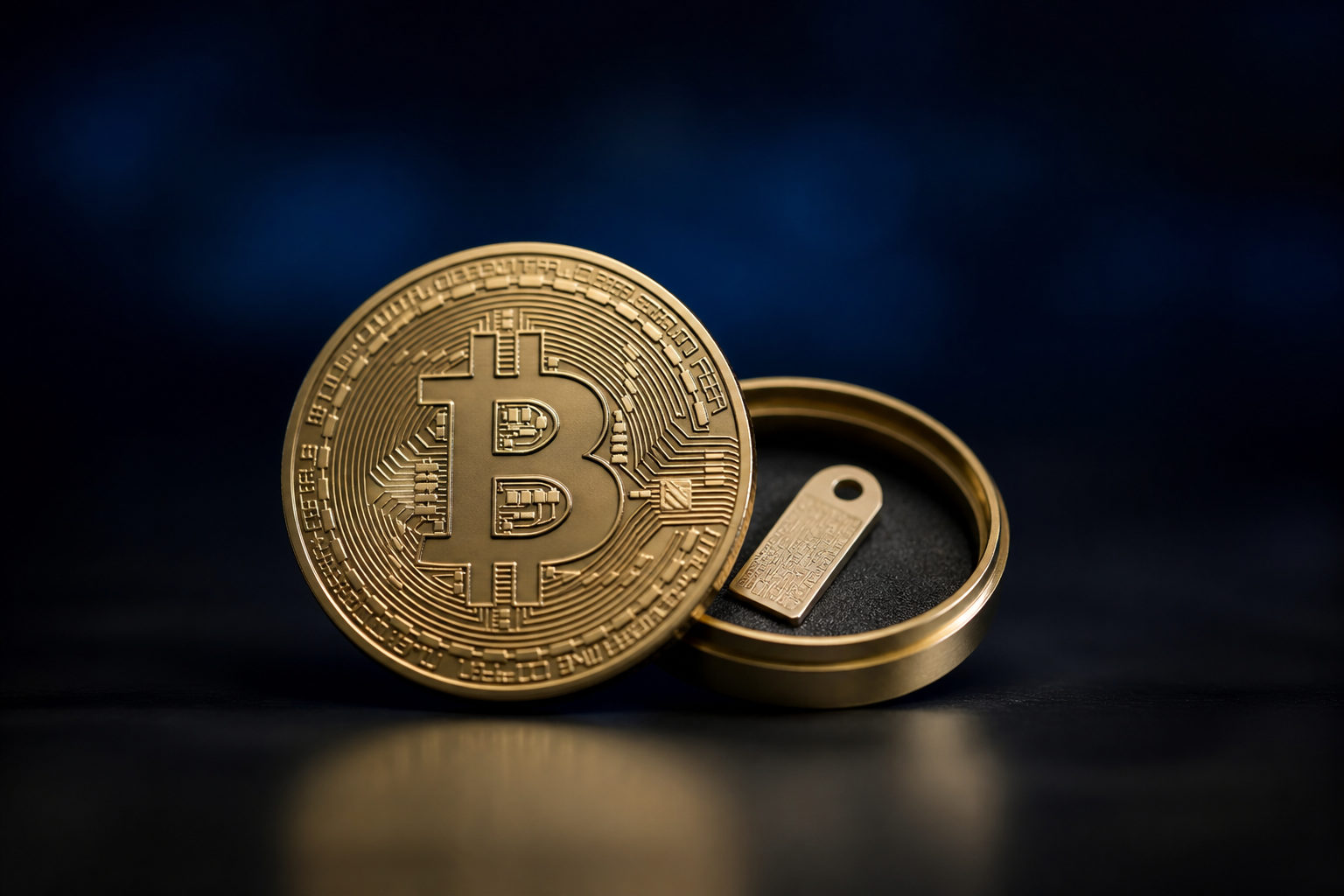
Physical bitcoins are real-world objects tied to bitcoin branding, wallet data, or private keys, but the bitcoin itself still exists only on the blockchain.
What people mean by “physical bitcoins”
Beginners often hear the phrase and picture a coin you can hold, spend, and pass from one person to another like cash. That image is understandable, yet it skips the main point: Bitcoin is a digital asset controlled by private keys, not a metal token with value inside it by default.
In practice, “physical bitcoins” can refer to several different things. Some are simple novelty coins or collectibles with the Bitcoin symbol on them. Some are physical carriers that include a public address, a QR code, or a concealed private key. Some early collector pieces were funded with real BTC and sold as loaded items. Those three categories look similar, but they should not be treated as the same product.
| Type | Does it automatically contain BTC? | Main source of value | Main risk |
|---|---|---|---|
| Novelty coin or souvenir | No, usually not | Design, material, collectibility | Buyer assumes it represents real bitcoin |
| Physical key carrier | Possibly | Control of funds tied to a private key | Key may already be exposed |
| Older funded collector piece | Possibly | Collector premium plus on-chain balance | Funds may have been moved long ago |
Why bitcoin itself is not a physical coin
Bitcoin was introduced in the white paper published by Satoshi Nakamoto on 2008-10-31, and the genesis block followed on 2009-01-03. From the start, the system was built as peer-to-peer electronic cash. Ownership comes from the ability to authorize transactions with a valid key, not from possession of a physical object.
You can write a private key on paper, engrave it on metal, or store it in another offline form. That changes the storage medium, not the nature of bitcoin. The BTC remains a balance recognized by the network. The object in your hand is only a container for access data, or in many cases, just a decorative item.
This distinction matters because a physical object can create a false sense of certainty. A sealed coin or card may look secure, yet the private key could have been copied during manufacturing, packaging, or sale. A blockchain balance only tells you coins are sitting at an address. It does not tell you whether someone else can spend them.
Common forms of physical bitcoins
Collectible coins and display pieces
These are the easiest to find. They may be made of plated metal, sold in display boxes, or marketed as gifts for bitcoin fans. In most cases, they do not hold any BTC at all. Their value comes from appearance and collector interest.
If a seller talks about finish, weight, packaging, or edition style but says nothing about a verifiable address or key-handling method, treat the item as memorabilia. That is not a criticism. It is simply the right category.
Physical carriers for wallet data
Another format stores bitcoin-related data in a tangible object. A card or metal piece may show a public address on the outside and hide a private key under a scratch-off layer or seal. The appeal is obvious: it gives digital money a form you can present, gift, or store in a drawer.
The weak point is trust. If the key was generated by someone else, you cannot confirm with certainty that no copy exists. Even if the item appears untouched, the security model depends on the honesty and process of the creator.
Funded collector pieces from earlier periods
Some well-known physical bitcoin items from earlier years were sold with real BTC attached to them. These pieces may attract collectors for historical reasons even when the original balance has already been redeemed. That creates a split between collectible value and spendable value, and new buyers need to understand both.
| Use case | How suitable a physical bitcoin is | Better approach |
|---|---|---|
| Gift with visual impact | Good fit | Move the BTC into a fresh wallet after receiving it |
| Long-term storage of meaningful funds | Weak fit | Use a wallet you initialize yourself |
| Collecting bitcoin-themed objects | Good fit | Judge it as a collectible first |
What to check before buying or accepting one
Start with the basic question: are you buying a collectible, or are you buying access to on-chain bitcoin? Sellers sometimes use the same wording for both. The object may be beautifully made and still have no BTC connected to it. On the other hand, an ugly card with a valid key could control real funds.
Next, separate visible balance from secure ownership. If a public address is provided, you can inspect the address with a block explorer and see whether funds are still there. That helps, but it is only half the story. A copied private key remains dangerous even if the balance is untouched on the day you check.
Also remember that a collectible premium is not the same as bitcoin value. A physical item can be desirable because of rarity, age, or design even when its linked balance is zero. The reverse is also true: if an item really does hold BTC, the shell around it may matter far less than the funds it can unlock.
Understanding the smallest unit can help clarify the idea. One satoshi equals 0.00000001 BTC, so bitcoin can be divided finely, yet every unit still exists on-chain. A physical bitcoin does not contain satoshis as material substance. It only points to or protects the credentials that control them.
How physical bitcoins differ from paper wallets and hardware wallets
People often group all three together because each involves private key storage. The better comparison is based on who generated the key and who had a chance to see it. That question matters more than the object’s shape.
| Form | What it is | Who may have generated the key | Best suited for |
|---|---|---|---|
| Physical bitcoin carrier | Tangible object with wallet data | Often a third party | Gifts, display, collecting |
| Paper wallet | Private key and address stored on paper | User or tool chosen by user | Those who understand offline key handling |
| Hardware wallet | Dedicated signing device | Usually initialized by the user | Long-term self-custody |
If your goal is education, a physical bitcoin can be a useful teaching object because it makes an abstract system easier to picture. If your goal is secure ownership, the key issue is still key creation and custody. A nice coin does not solve that problem.
None of this changes Bitcoin’s monetary rules. The supply cap remains 21,000,000 BTC, issuance halves every 210,000 blocks, the current block reward is 3.125 BTC after the 2024-04-19 halving, and with a target of roughly one block every 10 minutes, the network adds about 450 BTC per day. Those protocol facts apply whether someone stores access in a phone app, a hardware wallet, or a decorative metal piece.
FAQ
Does buying a physical bitcoin mean I own bitcoin?
Not automatically. If it is just a souvenir coin, you own a collectible item. If it includes a private key, ownership of spendable BTC depends on whether that key still controls funds and whether nobody else has a copy.
How can I tell whether a physical bitcoin still has BTC attached?
If the item shows a public address, you can check that address on a block explorer. That confirms the visible balance, but it does not prove the private key is still secret.
Should I keep a gifted physical bitcoin sealed?
If real BTC is involved, many users prefer to move the funds into a new wallet they created themselves. The original item can still be kept as a memento after the transfer.
Are physical bitcoins officially issued by Bitcoin?
No. Bitcoin has no central issuer and no official standard physical coin. Physical versions on the market are products made by businesses, collectors, or individuals.
What does Bitcoin Pizza Day have to do with physical bitcoin?
On 2010-05-22, Laszlo Hanyecz spent 10,000 BTC on two pizzas. That event is famous because it showed bitcoin being exchanged for a real-world good, though it did not turn bitcoin into a physical coin.
If you want a bitcoin-themed object, judge it like any other collectible. If you want actual BTC, focus on private key control and move any loaded balance into a wallet you set up yourself.