
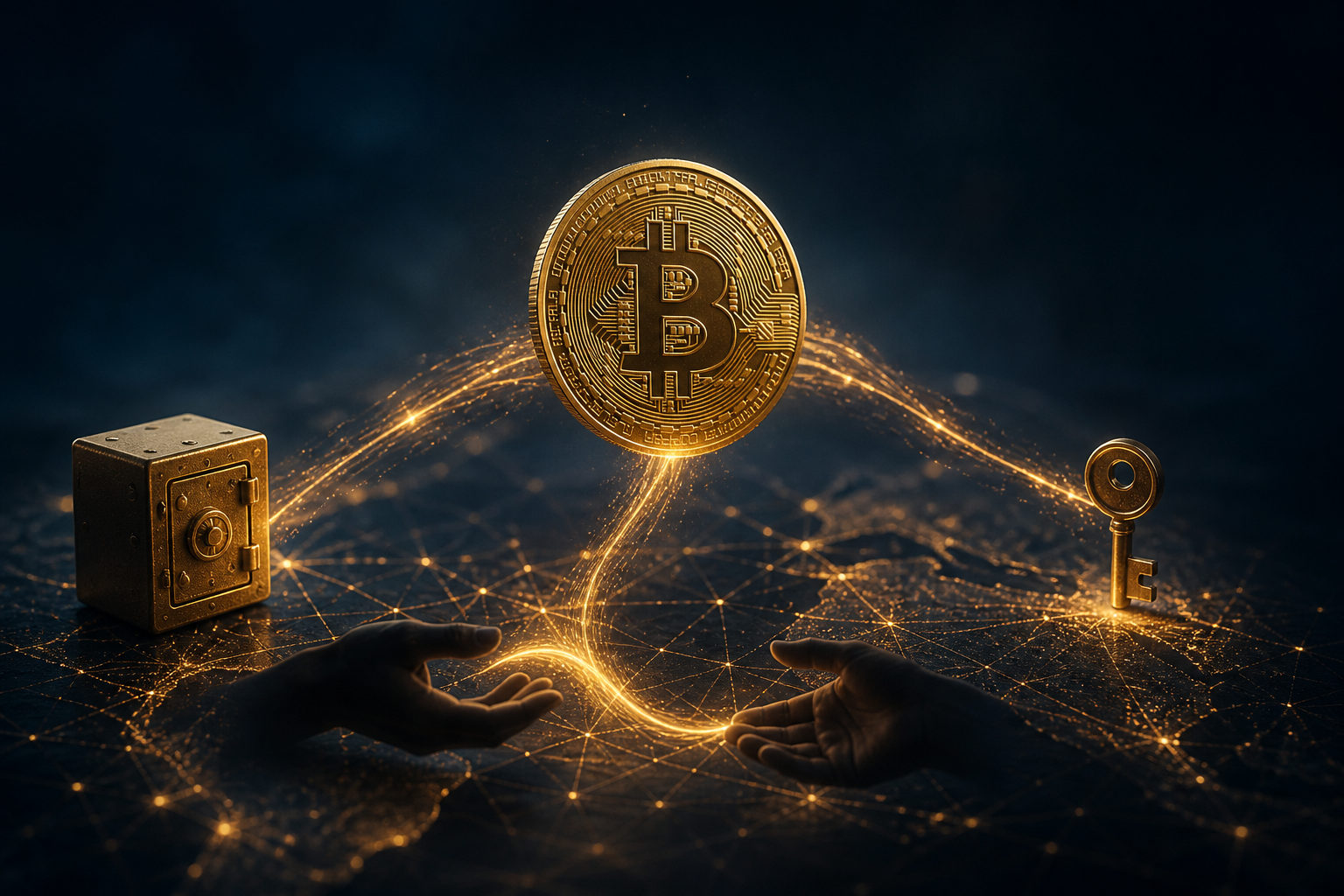
The point of bitcoin is simple: it lets people hold and move scarce digital value on an open network without fully depending on one company, bank, or state to keep the ledger.
Start with the basic definition
Beginners often hear bitcoin described as money, a speculative asset, or a payment system. Each label captures part of the idea, but none covers the full picture. Bitcoin is better understood as a network with fixed issuance and verification rules, while BTC is the native asset used within that network.
That matters because the question is not only why people buy bitcoin. The deeper question is why anyone wanted a digital asset that could be transferred online, checked by strangers, and kept scarce without a central operator deciding the official record.
What problem bitcoin tries to solve
It creates verifiable digital scarcity
Most digital files can be copied at almost no cost. A photo, document, or video can be duplicated endlessly. Bitcoin was designed to handle a harder problem: how to stop the same digital unit from being spent twice.
Its answer is a public blockchain that records transaction order and lets the network verify which transfers are valid. That is why many people compare bitcoin to digital gold rather than loyalty points. Points exist at the mercy of the issuer; bitcoin has a fixed maximum supply of 21 million written into the protocol.
It offers an alternative to single-institution control
In normal online finance, balances are updated inside the database of a bank, payment company, or platform. Bitcoin spreads verification across a network of participants following the same rules. You do not have to think this model is better for every use case to see why it matters.
For people who want direct control over an asset, this is a real distinction. If you control the private keys, you are closer to holding the asset yourself rather than relying only on a platform promise shown on a screen.
It makes monetary rules more visible
Bitcoin does not promise stable prices, and it does not guarantee gains. What it does offer is a rule set that is public from the start: a new block is produced about every 10 minutes, and the issuance rate is cut about every 4 years, or every 210,000 blocks. The halving years include 2012, 2016, 2020, and 2024.
Those rules do not tell you where the price will go. They do tell you that supply is not adjusted on short notice by a single management team. For many users, that predictability is part of the point.
What bitcoin is not
- It is not perfect anonymity. Addresses are not the same as real names, but blockchain activity is public and can be analyzed.
- It is not a replacement for every form of money. Salaries, taxes, rent, and daily commerce still run mostly through existing financial systems.
- It is not valuable only because people trade it. Trading gets attention, but the larger discussion is about ownership, settlement, and monetary rules.
- It is not risk-free self-custody. If private keys or recovery phrases are lost or exposed, the asset can be lost as well.
That is where many misunderstandings begin. People reduce bitcoin to price action and miss the design choice underneath it. The network matters for reasons that are separate from short-term market excitement.
Concept boundaries new readers should understand
First, separate the bitcoin network from the bitcoin price. Market sentiment changes quickly. The protocol rules for supply, transaction validation, and block production do not change because of a rough week or a euphoric one.
Second, separate owning BTC from leaving BTC on an exchange. When coins stay on a platform, what you often hold is a claim recorded by that platform. Direct control usually means controlling the private keys yourself, along with the responsibility that comes with that choice.
Third, separate decentralization from the absence of rules. Bitcoin is not chaos. It is a system where rules are shared in advance and verification is distributed, instead of being concentrated in one gatekeeper.
For a beginner, these boundaries matter more than memorizing jargon. Once you understand them, you can judge whether bitcoin is most interesting to you as a payment rail, a scarce digital asset, or a monetary experiment.
FAQ
Why does bitcoin matter at all?
Bitcoin matters because it combines scarcity, transferability, and public verification in one digital system. That combination was hard to achieve online without a central record keeper.
Is the point of bitcoin just to make money?
No. Many people first notice bitcoin because of price moves, but its broader purpose is about ownership and open settlement. Profit seeking is one use case, not the full explanation.
Why do people call bitcoin digital gold?
They use that comparison because bitcoin is scarce by design and is often discussed as a store-of-value asset. The phrase is a shorthand, not a perfect match, since gold and bitcoin behave differently in many settings.
Does bitcoin have a purpose if I never use it for payments?
Yes. Even if you never spend it directly, bitcoin still raises important questions about who controls money, how digital ownership works, and whether online value transfer always needs a trusted middleman.
If you want to decide whether bitcoin has a real point, start with three things: learn how the supply rule works, learn what private keys control, and learn how transactions are confirmed on-chain. Those basics will tell you far more than headlines about fast gains or sharp drops.
Disclaimer: This article is for informational and educational purposes only and is not investment, financial, or legal advice. Crypto assets are highly volatile and you could lose your entire investment. Do your own research and decide carefully.