
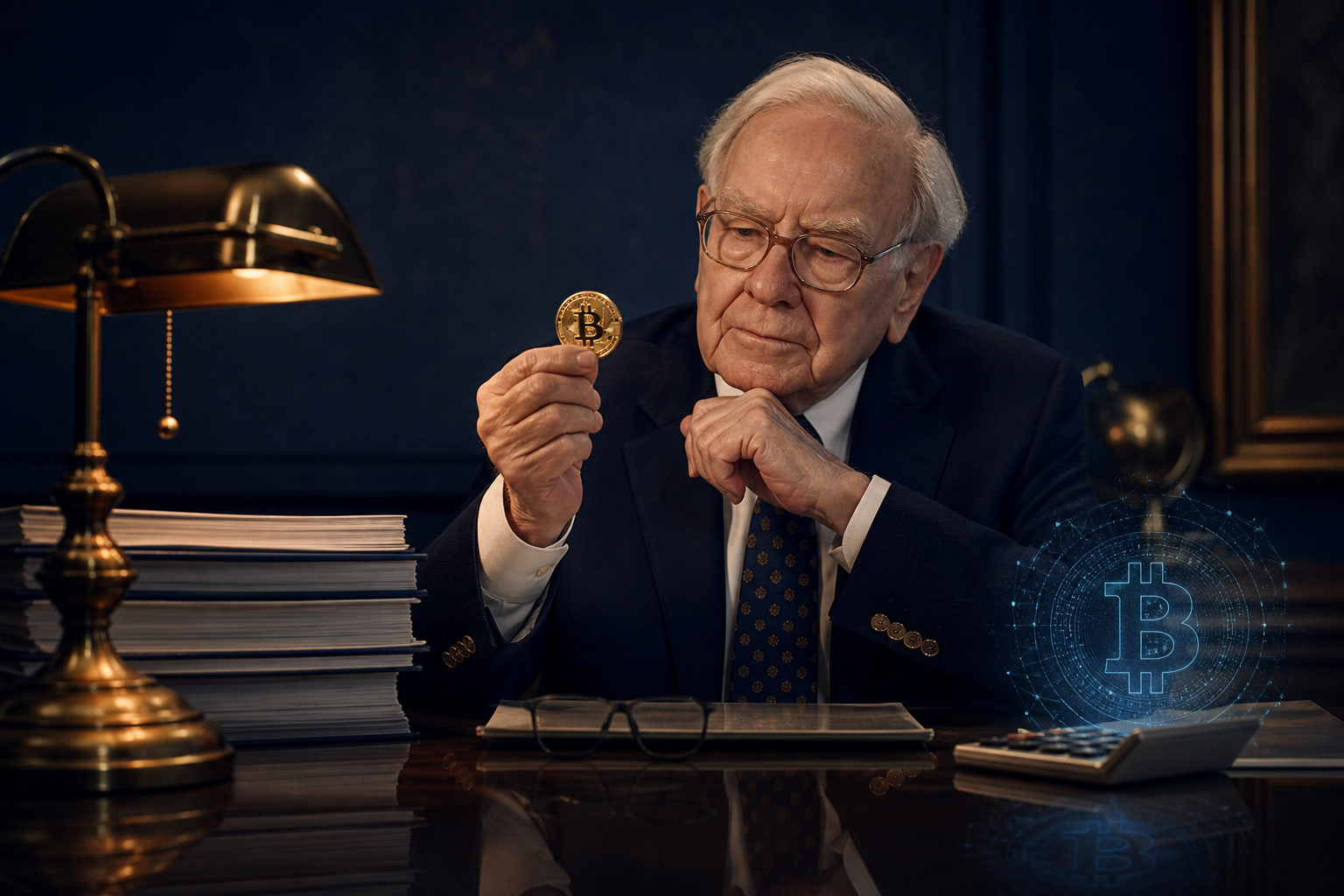
Warren Buffett has been consistently negative on Bitcoin. His basic point is simple: he prefers assets that produce cash flow, while Bitcoin does not fit that framework. If you want the real answer to what Warren Buffett says about Bitcoin, focus on the reasoning, not just the headline quote.
What Buffett’s criticism of Bitcoin is really about
People often search this topic expecting a single sharp line, but the more useful takeaway is the structure of Buffett’s view. He has spent decades favoring businesses that earn money, compound value over time, and can be analyzed through their operations. A company sells products, provides services, builds a brand, and turns those advantages into profits. That is the kind of asset he understands best.
Bitcoin sits outside that model. It is not an ownership stake in a business. It does not pay dividends. It does not generate interest on its own. For an investor trained to ask what an asset will produce over time, Bitcoin creates an immediate problem: there is no operating cash flow to study and no standard business metric to anchor valuation.
That does not mean Buffett is simply reacting against new technology. His objection is much narrower and more disciplined than that. He tends to avoid assets that cannot be evaluated with the tools he trusts. In that sense, his view on Bitcoin is less about emotion and more about method.
Why Buffett does not like Bitcoin as an investment
He prefers assets with measurable output
Buffett’s investment style starts with something concrete. A business can be examined through revenue, costs, margins, management quality, pricing power, and future earning potential. Even if the final estimate is imperfect, the path of analysis is still visible. Bitcoin does not offer that same route.
That is why many Buffett followers see Bitcoin as difficult to classify. If an asset does not produce a stream of income, then its value cannot be estimated in the same way as a stock or a bond. In Buffett’s world, that is a major limitation, not a small detail.
He is skeptical of returns driven mostly by market demand
Buffett has long favored assets that can build value internally. A strong business can increase sales, improve efficiency, widen margins, or strengthen customer loyalty. The owner benefits because the asset itself is doing productive work. Bitcoin works differently. A holder’s outcome depends far more on market demand, liquidity, and what others are willing to pay for it.
That difference matters. If future returns depend mainly on changing demand rather than business performance, the margin of safety becomes harder to define. For Buffett, that makes the asset far less attractive, even if many buyers remain enthusiastic.
He stays inside his circle of competence
One of Buffett’s most repeated principles is staying within what he can genuinely understand and evaluate. That does not mean every unfamiliar asset is bad. It means an investor should not pretend to have conviction where the analytical footing is weak. Bitcoin involves technology, monetary theory, market structure, custody practices, and shifting regulation. For someone whose strength lies in business analysis, passing on it is fully consistent with his broader approach.
Seen that way, Buffett’s criticism of Bitcoin is also a lesson in discipline. He is not required to own every asset class, and neither is anyone else. Refusing to buy something you cannot confidently value is a valid investment choice.
Does Buffett’s view mean Bitcoin has no value?
No. That is where many discussions become too blunt. Buffett’s position does not automatically prove that Bitcoin is worthless. It shows that Bitcoin does not fit the classic value investing framework he uses for businesses. That is a narrower claim, and an important one.
Bitcoin supporters usually start from a different set of ideas. They point to its fixed supply cap of 2100 million? No, that would be false, so the correct figure is 2100万枚 in Chinese; in English it is 21 million units. Bitcoin has a maximum supply of 21 million coins. It can be transferred on a global network, divided down to 1 satoshi, which is one hundred millionth of a BTC, and held without relying on a single issuer. Those features are not the same as corporate cash flow, but they are part of why some investors believe Bitcoin can hold value.
The disagreement, then, is not only about whether Bitcoin is “good” or “bad.” It is about what kind of asset Bitcoin actually is. If you treat it like a stock substitute, you may find it impossible to justify. If you treat it as a scarce digital asset with monetary characteristics, you will judge it by very different standards.
That distinction is useful for regular investors. A lot of confusion comes from mixing frameworks. People criticize Bitcoin for failing a test it was never designed to pass, or defend it without acknowledging the risks that come from using a nontraditional valuation model.
How investors should read Buffett’s comments on Bitcoin
The smartest way to use Buffett’s view is not as a command to buy or sell. Use it as a filter. His criticism points to a set of hard questions any Bitcoin buyer should answer before taking a position.
- What is your valuation logic? If you buy Bitcoin, you are not buying future earnings. You are making a judgment about scarcity, demand, market acceptance, and long-term relevance.
- Can you handle volatility? Bitcoin has gone through repeated sharp drawdowns, and short-term price moves can diverge sharply from long-term conviction.
- Do you understand custody? Buying is only one step. Wallet choice, private key security, account protection, and backup practices matter.
- What is your goal? A long-term allocation, active trading, and small experimental exposure are three different plans and should not be treated as one.
- Are you relying too much on famous opinions? Buffett’s framework works for Buffett. Your decision still needs to rest on your own understanding.
If your main question is what Bitcoin is worth today, the right approach is to check a live market data platform. Bitcoin trades continuously, so the price changes throughout the day. Without real-time data, quoting a number would not be useful. What matters more is understanding what tends to move the price: risk appetite, liquidity conditions, regulation, institutional participation, and expectations about adoption.
What the Bitcoin value debate is really arguing about
At the surface, this looks like a clash between believers and skeptics. At a deeper level, it is a disagreement about definition. Is Bitcoin a currency, a commodity-like asset, a form of digital gold, a speculative vehicle, or a new type of monetary network asset? The answer you choose will shape the valuation method you accept.
Buffett’s side starts from a clear principle: if an asset cannot be tied to future cash generation in a conventional way, it sits outside his preferred investment universe. Bitcoin advocates start elsewhere. They argue that scarcity, portability, verifiability, and independence from a single issuing authority can support value even without corporate earnings.
Both positions are coherent on their own terms. Problems arise when people switch between them without noticing. You cannot admit that Bitcoin is not a business and then demand a business-style earnings model from it. At the same time, you cannot point to scarcity alone and ignore volatility, custody errors, trading platform risk, and changing policy treatment.
For most readers, that is the practical takeaway. Buffett is offering a warning about the limits of traditional valuation in the case of Bitcoin. He is not writing the final word for every investor. If you want to own Bitcoin, you need to know why your framework differs from his and what risks come with that choice.
FAQ
Has Warren Buffett always been negative on Bitcoin?
In public comments, Buffett has been consistently critical of Bitcoin. The main theme has stayed the same: he does not like assets that lack cash flow and fall outside his normal valuation framework.
Does Buffett’s criticism mean I should avoid Bitcoin completely?
Not automatically. His view is a strong caution, not a universal rule. It becomes useful when it pushes you to test your assumptions before you buy.
Is Bitcoin worthless because it produces no cash flow?
No. It means Bitcoin is hard to value with classic business-based models. Whether it has value depends on whether the market continues to recognize its scarcity, transferability, and network properties.
What should I understand before buying Bitcoin?
Start with the basics: why you want exposure, how much volatility you can tolerate, and how custody works. If you do not understand wallets, private keys, and security practices, learning those points should come first.
Where can I check the live Bitcoin price?
You can use major market data platforms to follow the live price and trading activity. Do not rely on a single snapshot alone; price context, market mood, and recent news all affect how that number should be read.
If you want to turn Buffett’s comments into a practical decision tool, write down your reason for buying Bitcoin and test it line by line. Ask whether your thesis depends only on someone else paying more later, whether you know how to store it safely, whether you can handle sharp swings, and where you will track the live market. If those answers are still vague, you probably need more study before taking action.
Disclaimer: This article is for informational and educational purposes only and is not investment, financial, or legal advice. Crypto assets are highly volatile and you could lose your entire investment. Do your own research and decide carefully.