
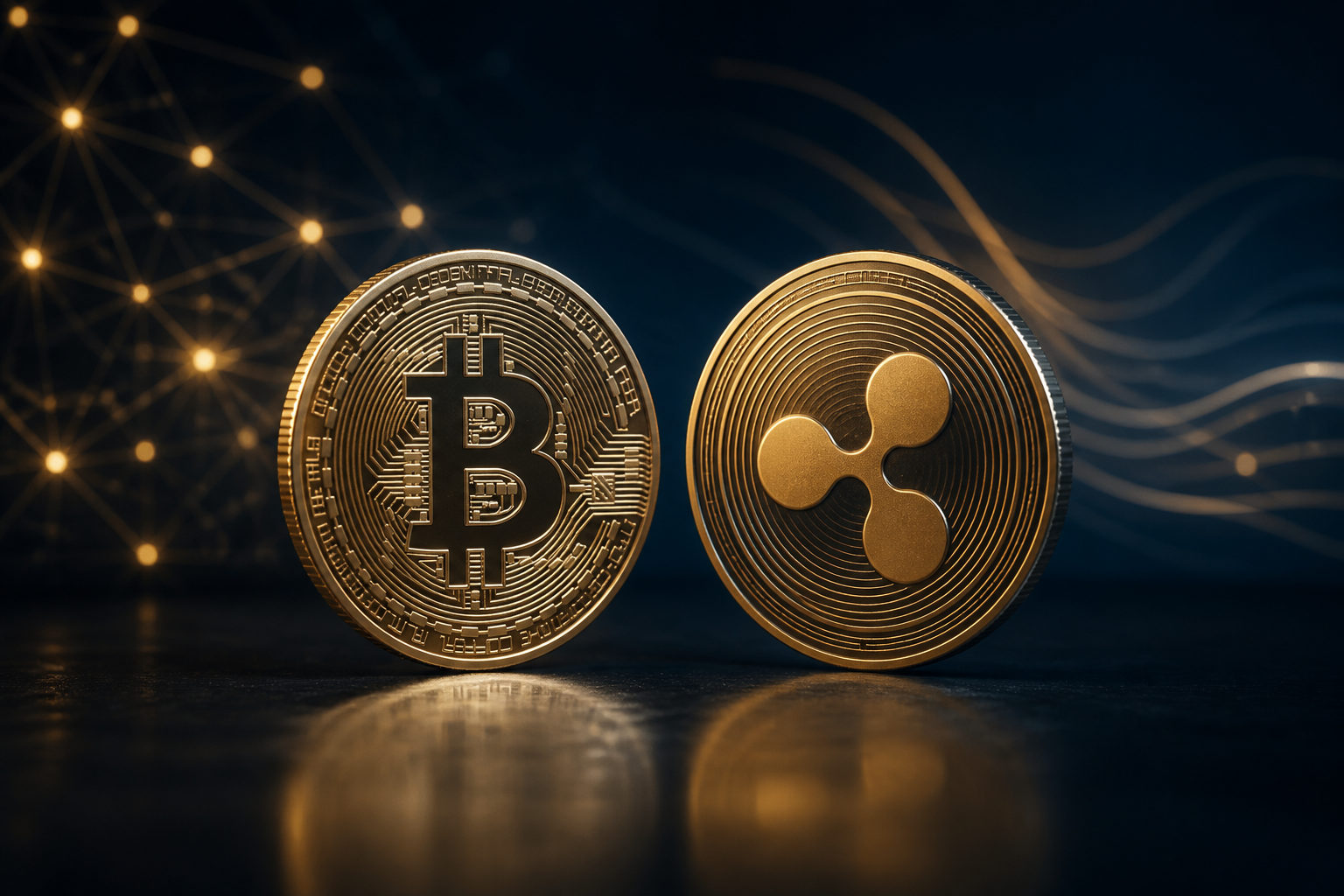
XRP and Bitcoin are not the same kind of asset with different branding. Bitcoin is usually understood as a scarce digital money, while XRP is often discussed as a token used in payment and settlement flows.
Start with the basic definitions
For beginners, the first problem is usually a language problem. People hear XRP, Ripple, and Bitcoin in the same conversation and assume they sit in the same box. They do not.
Bitcoin is the best-known early cryptocurrency. Satoshi Nakamoto published the Bitcoin white paper on 2008-10-31, and the genesis block arrived on 2009-01-03. Its core idea is simple to state and harder to build: move value over a network without needing one central party to run the whole system.
XRP is the native token associated with the XRP Ledger. It often comes up in discussions about payments, transfers, and settlement. Ripple, by contrast, is usually a company or brand reference. That distinction matters. Owning XRP does not mean you own shares in a company, and it does not give you control over a payment business.
That single misunderstanding causes a lot of confusion. Fix it early.
What makes XRP and Bitcoin different
| Category | Bitcoin | XRP |
|---|---|---|
| Main role | Decentralized digital money and store-of-value asset | Token often linked to payment and settlement use |
| How people frame it | Scarcity, monetary independence, long-term holding | Transfer utility, settlement, payment flow |
| How new units enter the system | Mining | Not through Bitcoin-style ongoing mining |
| Supply model | Hard cap of 21,000,000 BTC | Does not run on Bitcoin’s halving-mining structure |
| Typical beginner mistake | Thinking it is only for payments | Thinking it is the same as company stock |
Bitcoin’s supply rules are unusually clear. The total supply is capped at 21,000,000 BTC, with issuance stretching roughly until 2140. The block subsidy is cut in half every 210,000 blocks, or about every four years. The halving dates already passed are 2012-11-28, 2016-07-09, 2020-05-11, and 2024-04-19. After the 2024 halving, the current block reward is 3.125 BTC.
Bitcoin also targets about one block every 10 minutes. Put that together and the network currently adds about 450 BTC per day in total. That is a network-wide figure, not the output of any one miner or company.
Those details are not trivia. They are the reason Bitcoin is so often described through the language of scarcity. People can inspect the monetary schedule. They can argue about demand, sure. The supply side is much less fuzzy.
XRP is usually approached from a different angle. A newcomer should not drag Bitcoin terms straight into it. If you start asking about halving, mining rigs, or mining pools, you are already using the wrong frame for XRP.
The trust model is different too
This is where many comparisons go off track. The real question is not just which token moves faster or sounds more useful. It is what kind of system each one asks you to trust.
Bitcoin is widely viewed as a network built around open verification, fixed issuance rules, and resistance to control by any single company. Anyone can study the monetary policy: 21,000,000 BTC total, halving every 210,000 blocks, current reward 3.125 BTC, roughly 450 BTC added per day across the network. That predictability is a big part of the appeal.
XRP is more often evaluated through payment use cases. People looking at it may care less about a mining-based scarcity story and more about whether the token fits transfer and settlement functions. So when someone asks, “what is xrp vs bitcoin,” the clean answer is that they are built to be understood in different economic and practical contexts.
Same broad asset class. Different center of gravity.
Common mistakes beginners make
| Mistake | Better way to read it |
|---|---|
| XRP is Ripple stock | XRP is a token, not company equity |
| XRP and Bitcoin are basically interchangeable | They differ in purpose, supply design, and market narrative |
| Faster transfer automatically means better asset | Value also depends on supply rules, demand, and user conviction |
| XRP has Bitcoin-style halving | XRP does not use Bitcoin’s mining-halving model |
| Bitcoin is only a payment coin | Many holders focus on scarcity, self-custody, and monetary rules |
A very common beginner shortcut is to judge both assets by one feature only, usually transfer speed. That misses the point. An asset can be attractive for reasons that have little to do with how quickly a payment is processed.
Bitcoin is a good example. Many people do not start with it because they want a daily spending coin. They start with it because its issuance schedule is public, its total supply is capped, and the system was designed to reduce dependence on changing human decisions.
XRP draws attention for another reason. People often look at where it might fit in payment flows. That is a separate line of thinking. If you mix the two stories together, the comparison gets sloppy fast.
How a beginner can decide which one to study first
If your interest starts with money itself, Bitcoin is usually the easier foundation. Its key facts are straightforward and useful: white paper on 2008-10-31, genesis block on 2009-01-03, supply cap of 21,000,000 BTC, halving every 210,000 blocks, current reward 3.125 BTC after 2024-04-19. Those rules give you a clean framework for understanding digital scarcity.
If your interest starts with payment rails, transfer use, or settlement logic, then XRP may be the better second step. You will read it more clearly once you stop forcing Bitcoin’s mining vocabulary onto it.
If what you really want is the current price, check a live market data platform. Prices move constantly, so a timeless explainer should not pretend to pin them down. The more useful first question is this: what gives each asset its reason to exist?
FAQ
Is XRP just another name for Bitcoin?
No. Both are cryptocurrencies, but they were designed with different goals, different supply mechanics, and different use cases in mind.
That is why they are discussed so differently in markets, even when they appear on the same exchange screen.
Why do people keep mixing up XRP and Ripple?
Because the terms often appear together in payment-related discussions. Ripple usually points to the company or brand context, while XRP is the token itself.
Keeping that distinction in your head prevents one of the biggest beginner errors: treating a token as if it were equity.
Why does Bitcoin’s 21,000,000 limit matter so much?
It is one of the core rules behind Bitcoin’s scarcity case. The cap, the halving schedule every 210,000 blocks, and the current 3.125 BTC block reward all shape how people value its monetary policy.
When investors talk about Bitcoin as a scarce digital asset, this is usually where the argument begins.
Can XRP be mined like Bitcoin?
Not in the way Bitcoin is. Bitcoin issues new coins through mining, while XRP does not use that same ongoing mining structure.
So if your question starts with mining rigs, mining pools, or halving, you are asking a Bitcoin question, not an XRP one.
Which should a complete beginner learn first?
For most people, Bitcoin is the better starting point because its monetary design is easier to explain and easier to compare against everything else in crypto.
After that, looking at XRP makes more sense. You can then see the difference between a scarcity-led asset story and a payment-led token story without mixing them together.
The practical next step is simple: separate the asset, the network, and the company in your notes before you look at any headline or price chart.
Disclaimer: This article is for informational and educational purposes only and is not investment, financial, or legal advice. Crypto assets are highly volatile and you could lose your entire investment. Do your own research and decide carefully.