
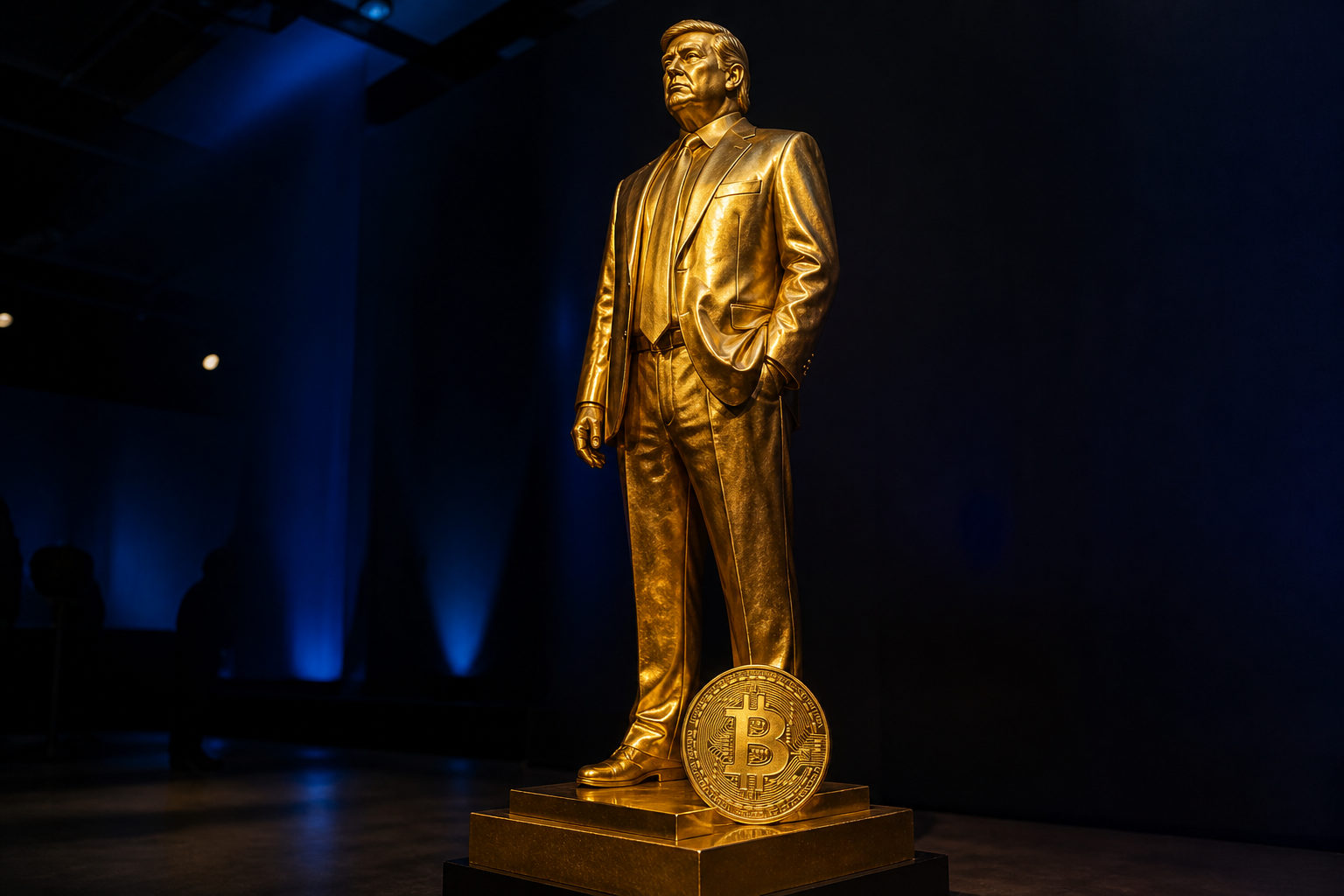
Short answer: there is no widely verified, permanent, single location for a “Trump Bitcoin statue.” In most cases, people are chasing an image, a display at an event, a temporary art piece, or a viral post rather than a fixed public landmark.
Why this search rarely leads to one clear place
The phrase sounds specific. It really isn't. A lot of online posts bundle together three different things: a statue of Donald Trump, a Bitcoin-themed sculpture, and an event prop that mixes both for visual impact. Once that mash-up starts circulating, the caption becomes the “fact,” even if nobody has shown a stable real-world location.
That is why you may see the same image copied across social platforms, blogs, and discussion threads with little else attached. No venue. No organizer. No artist statement. No repeat sightings from different times. Without those pieces, “where is the Trump Bitcoin statue” has no solid answer.
Sometimes the object may have existed physically, just not as a permanent installation. Trade shows do this all the time. Political art does too. A one-off display can generate a lot of attention online and then disappear from public view.
| What you find online | What it may actually be | Can you treat it as a confirmed location? |
|---|---|---|
| A single social post image | Repost, old image, edited artwork | No |
| A short video clip | Event display, booth prop, partial scene | No |
| A news illustration | Stock visual, file image, composite graphic | No |
| A formal venue or organizer page | A traceable physical exhibit | Yes, but verify further |
| Multiple on-site images from different people | A real object seen in person | Yes, then check if it was temporary |
How to verify whether the statue had a real location
Start with the earliest source you can find. Not the loudest repost. Not the account with the biggest following. The earliest source. If the first post came from an event organizer, a venue, an artist, or someone clearly filming on site, you have something to work with.
Then read the surrounding text carefully. A real exhibit usually leaves a trail: venue name, city, event title, artist credit, or a sequence of photos from the same place. If all you have is “look at this” and a cropped frame, that is weak evidence.
Next, check whether the object appears across time. Public statues tend to be photographed more than once, by more than one person, on different dates. Temporary displays don't. They flash, trend, and vanish.
Simple rule: you are not really looking for an address first. You are looking for proof that the thing in question was a stable physical object at all.
| Verification step | What to look for | What it tells you |
|---|---|---|
| Trace the first post | Original account, original caption, posting context | Whether the source was close to the event |
| Read the description | Venue, city, event name, artist name | Whether there are details you can cross-check |
| Find more angles | Additional photos or videos from the same scene | Whether a physical object was really there |
| Check timing | Whether posts appear only in a narrow window | Permanent statue or temporary display |
| Look for independent confirmation | Other attendees, media coverage, venue material | Whether separate sources align |
Why “Trump statue” and “Bitcoin statue” get mixed up so easily
Because the internet rewards compression. A gold coin symbol, a bust-like face, a political reference, and suddenly the whole thing gets labeled as one object with one identity. Search engines and social tags do not always separate a Trump sculpture from a Bitcoin prop that merely borrows his image.
That matters. If one result refers to political satire, another to conference decor, and another to digital artwork, the keyword still looks the same to the reader. The search feels precise while the underlying object stays blurry.
So when people ask where the statue is, they may be asking about entirely different items without realizing it. That is the core problem.
| Commonly mixed-up item | Main feature | Best way to identify it |
|---|---|---|
| Trump statue | The person is the main subject | Check artist, exhibition, and city |
| Bitcoin-themed sculpture | The BTC symbol or coin motif leads | See whether a public figure was added for attention |
| Event prop | Built for a booth, stage, or photo area | Search the event name and host |
| Digital render | Polished image with little on-site evidence | Look for raw footage or multiple real photos |
If this search led you to Bitcoin, separate the symbol from the asset
A lot of people first notice Bitcoin through visuals like shiny coins, the B symbol, or dramatic statues. Those images are cultural shorthand. They are not the asset itself. Bitcoin does not exist as a single official physical coin or monument stored in one place.
Bitcoin is a decentralized network asset. The white paper, Bitcoin: A Peer-to-Peer Electronic Cash System, was released on 2008-10-31 under the name Satoshi Nakamoto, and the genesis block followed on 2009-01-03. Its rules live in the protocol, not in a sculpture.
That distinction helps when viral imagery muddies the picture. Bitcoin can be divided into units as small as 1 satoshi, or 0.00000001 BTC. The supply schedule is also rule-based: the block subsidy halves every 210,000 blocks, roughly every 4 years, and after the 2024-04-19 halving the current block reward is 3.125 BTC. Those are facts about the network. They tell you nothing about whether a “Trump Bitcoin statue” has a lasting public address.
FAQ
Is the “Trump Bitcoin statue” online definitely a real object?
No. It could be a real display, a temporary installation, an art piece, or just an image passed around without context. Until you have a venue, organizer, artist, or consistent on-site evidence, treat it as unconfirmed.
How can I tell whether the image was edited or composited?
Check for raw context: lighting consistency, background perspective, edge quality, and additional shots from the same setting. One polished image with no traceable source is weak proof.
If it was only used at an event, can I still find where it was?
Yes, but search by event details, not like you are hunting a monument. The useful terms are the event name, host, venue, and attendee posts from the same day.
Does a Bitcoin statue or prop mean official backing from Bitcoin itself?
No. Bitcoin has no single official marketing body authorizing visual displays of that kind. Most statues, props, and coin models are artistic or promotional objects.
I only wanted to learn about Bitcoin. Is this search still useful?
It can be, if it helps you separate imagery from the actual network. Once you move past the visual symbol, the real reference points are the white paper, the genesis block, and the protocol rules.
If you want the fastest path to an answer, save the image or clip you saw and reverse-track the source. Try to pin down three things: who made it, what event or exhibition it belonged to, and what venue hosted it. If those are missing, the “location” is still guesswork.
Disclaimer: This article is for informational and educational purposes only and is not investment, financial, or legal advice. Crypto assets are highly volatile and you could lose your entire investment. Do your own research and decide carefully.