
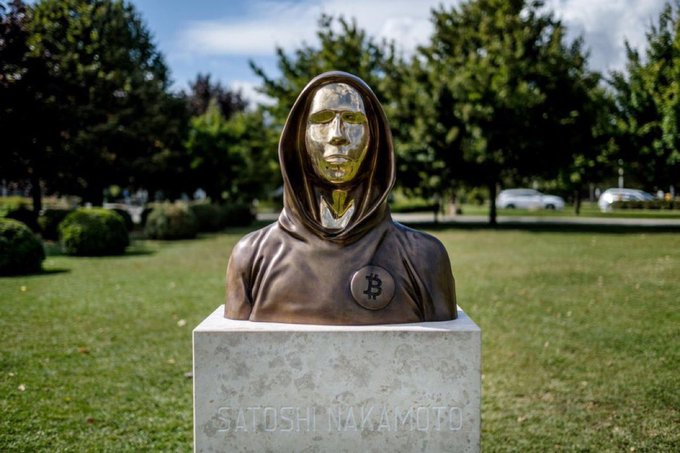
Bitcoin was introduced by the pseudonymous Satoshi Nakamoto, and it was created to make a peer-to-peer electronic cash system work without a central authority.
Who invented Bitcoin
The most accurate answer is this: Bitcoin was proposed and launched by a person or group using the name Satoshi Nakamoto. That name appears on the 2008 white paper and the early software, but Satoshi's real identity remains unknown.
The public timeline is straightforward. In 2008, Satoshi released the white paper titled Bitcoin: A Peer-to-Peer Electronic Cash System. In January 2009, the genesis block was created and the Bitcoin network began operating. So Bitcoin was not just an idea on paper; it started as a live system with rules, software, and a functioning ledger.
Why Bitcoin was created
To understand why Bitcoin exists, start with the problem it was trying to solve. Traditional electronic payments usually depend on banks, card networks, or payment companies to keep records and approve transfers. That model can work well, but it asks users to trust an intermediary to process payments, maintain accounts, and enforce access.
Bitcoin proposed a different structure. Instead of one central bookkeeper, participants on the network could verify transactions and maintain a shared ledger under common rules. The phrase “peer-to-peer electronic cash system” matters because it captures the original goal in plain terms: online value transfer between users without relying on a single institution to stand in the middle.
That is also why Bitcoin places so much weight on public verification, predictable issuance, and open participation. People now discuss Bitcoin in many ways, including as a store of value, but the original design focus was payment and settlement without a central controller.
A simple timeline of how Bitcoin appeared
2008: the rules were published first
The white paper laid out the core idea before the network went live. It described how a distributed system could order transactions, prevent the same coins from being spent twice, and maintain a ledger that anyone could check. The novelty was not a single isolated feature. It was the way several ideas were combined into one working design.
January 2009: the network started running
With the genesis block, Bitcoin moved from proposal to operation. New blocks began to extend the chain, transactions could be recorded, and the network followed a schedule that aimed for a new block roughly every 10 minutes.
The long-term monetary rules were built in
Bitcoin has a maximum supply of 21 million coins. New bitcoin enters circulation through mining, and the issuance rate is cut in half about every 4 years, or every 210,000 blocks. The halving years are 2012, 2016, 2020, and 2024.
Bitcoin is also highly divisible. Its smallest unit is the satoshi, and 1 satoshi equals one hundred millionth of 1 BTC. That makes the system usable both for whole-coin accounting and for very small transfers.
What was actually invented
When people ask who invented Bitcoin, they are often asking what was truly new about it. The answer is not simply “a digital coin.” Bitcoin brought together a public ledger, cryptographic signatures, distributed broadcasting, mining incentives, and fixed issuance rules into a system that could run in the open.
Many individual building blocks had been discussed before. What made Bitcoin stand out was the working combination: strangers on the internet could agree on the state of a shared ledger without handing control to one operator. That is why the invention matters even if Satoshi's identity remains unknown.
It also helps explain why debates about Bitcoin often drift in two directions at once. One path focuses on the mystery of the inventor. The other looks at the architecture itself and asks whether the system can continue to function according to transparent rules. For anyone trying to understand Bitcoin seriously, the second path is usually more useful.
How the “why” still shapes Bitcoin today
The original purpose still shows up in the way Bitcoin is discussed and used. Supporters often focus on the value of an asset that follows transparent issuance rules. Critics often focus on limits in speed, user experience, or practical payment use. Both sides, though, are reacting to the same foundation: Bitcoin was built around the idea that money on the internet did not have to depend on a central gatekeeper.
That does not mean Bitcoin replaced every payment system or solved every economic question. It means it introduced a lasting model for digital money: a network where rules are visible, supply is constrained by code, and transaction history can be checked by anyone running the system.
FAQ
Is Satoshi Nakamoto a real person
Possibly, but the public does not know for sure. Satoshi Nakamoto is the name attached to Bitcoin's white paper and early software, yet no identity claim has achieved universal acceptance.
Was Bitcoin invented mainly as an investment
No source in the original white paper frames it that way. The design goal was a peer-to-peer electronic cash system, while the investment thesis came later as the network matured and the market assigned it different roles.
What makes Bitcoin different from regular online payments
Regular digital payments usually rely on a company or bank to approve and record transactions. Bitcoin tries to handle those functions through a shared network and consensus rules instead of a single trusted intermediary.
Why do people connect Bitcoin with scarcity
Because the supply cap is fixed at 21 million and the issuance schedule is predetermined. That does not settle every debate about value, but it does make Bitcoin's supply rules unusually clear.
If I am new, should I study the inventor or the system first
Start with the system. If you understand the white paper's goal, the 21 million supply cap, the mining process, the roughly 10-minute block rhythm, and the halving schedule, the question of who invented Bitcoin becomes easier to place in context.
A practical way to study this topic is to separate identity from design. The inventor is known publicly only as Satoshi Nakamoto; the reason Bitcoin was created is much clearer: to build a peer-to-peer electronic cash system that does not depend on a central authority.