
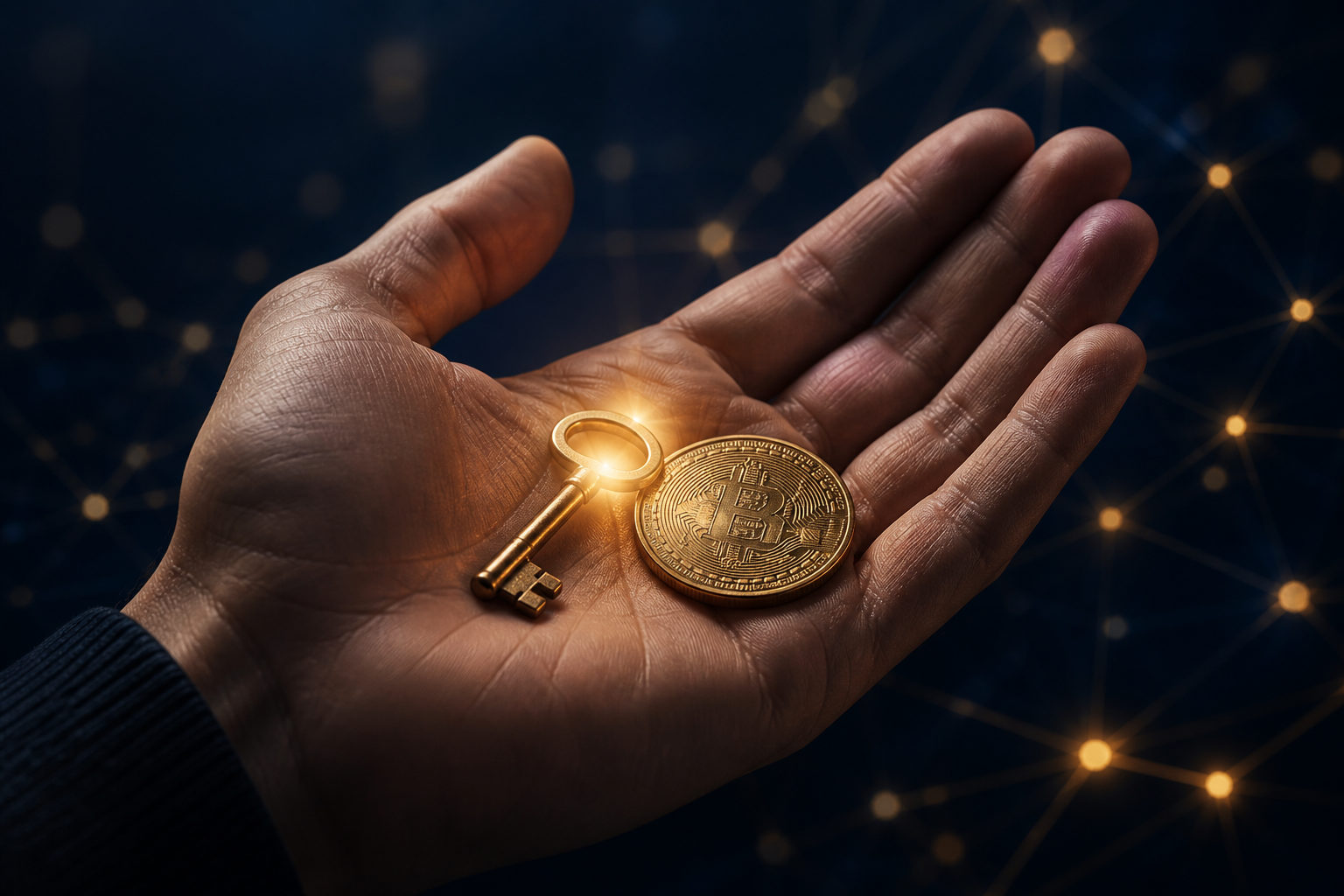
Who is owner of bitcoin? The short answer is no single person or company owns Bitcoin. The network has no central owner, while any specific bitcoin is controlled by whoever holds the private keys for that address.
Founder and owner are not the same thing
People often mix up two separate questions: who created Bitcoin, and who owns Bitcoin. Bitcoin is tied to the name Satoshi Nakamoto, an unknown person or group, but that does not mean Satoshi owns the whole system.
The idea was published in 2008 in the white paper Bitcoin: A Peer-to-Peer Electronic Cash System. The genesis block followed in January 2009. From the start, Bitcoin was designed as a system that could run without a permanent central operator, so asking for “the owner” of Bitcoin can be misleading.
If you mean the Bitcoin network itself, there is no sole owner. If you mean a particular amount of bitcoin, ownership is closer to control: the party with the private key can move it.
A timeline that explains why Bitcoin has no boss
The white paper stage
In 2008, the white paper described a peer-to-peer cash system where transaction verification would rely on network consensus instead of a central bookkeeper. That basic design already points away from the idea of one owner.
The network launch
In January 2009, the genesis block started the network. Early users could mine, run nodes, and receive bitcoin, but participating in the system is not the same as owning the system.
A useful comparison is an open internet protocol. Many people can use it, and many can help maintain software around it, yet no one can honestly claim to own the protocol as a whole. Bitcoin works in a similar way.
After Satoshi stepped back
Satoshi Nakamoto later faded from public involvement, and the identity behind the name remains unknown. That matters because Bitcoin did not stay alive through daily orders from a founder. It kept running through rules, software, miners, node operators, and users.
Developers can suggest code changes. Node operators decide whether to run them. Miners compete to produce blocks, on average about every 10 minutes. Holders control coins through keys. Power is split across roles rather than sitting with one owner.
What “owning Bitcoin” actually means
With Bitcoin, ownership is best understood as control over a specific balance. If you can sign a valid transaction with the private key, the network recognizes your ability to spend those coins.
That is why people say, “not your keys, not your coins.” If your balance sits on a custodial platform, the account may show that the assets are yours in an economic sense, but the platform may still control the on-chain addresses.
It helps to break the issue into layers:
- The Bitcoin network: no single owner.
- The Bitcoin codebase: open source, open to review and contribution, but no developer can force the whole network to accept a change.
- Coins at a given address: controlled by the holder of the private key.
- Exchange balances: often held in custody, so direct control may remain with the platform until withdrawal.
Bitcoin can also be divided into very small units. The smallest unit is 1 satoshi, equal to one hundred millionth of a BTC. So a person does not need to own a full bitcoin to be a Bitcoin holder.
Who gets mistaken for “the owner of Bitcoin”
Satoshi Nakamoto
Satoshi is the named creator, not the owner of the entire network. Writing the rules is different from owning every asset that follows those rules.
Developers
Developers influence software direction, but they cannot impose changes on all users. A proposal matters only if enough participants choose to adopt it.
Miners
Miners help confirm transactions and add blocks. Even so, they do not own Bitcoin itself. They control only the coins that belong to them and for which they hold the keys.
Exchanges and custodians
Large platforms may control many addresses, which can make them look like the owner of vast amounts of bitcoin. A better reading is that they may be holding assets on behalf of users, not claiming full beneficial ownership over every coin in custody.
Large holders
Someone can own a lot of bitcoin without owning Bitcoin as a network. Bitcoin is not a company with shares that grant absolute control over the protocol.
How to tell whether you really hold Bitcoin yourself
The practical test is simple: where does control sit? If you hold your own private keys or seed phrase and can send coins without asking a third party for permission, you are much closer to direct self-custody.
- Check where the bitcoin is stored: in a self-custody wallet or on a platform account.
- Check whether you can withdraw to an address you control.
- Check who holds the backup material, such as the seed phrase or private keys.
Self-custody also brings responsibility. If you lose the keys, expose the backup, or compromise the device, the risk falls on you immediately.
Bitcoin’s fixed supply cap of 2100 million coins and its issuance schedule are part of the rules, not signs of ownership. New blocks continue to be produced, and the block subsidy has halved in 2012, 2016, 2020, and 2024, but none of that creates a central owner.
FAQ
Is Bitcoin owned by a company?
No. Bitcoin is not issued or owned by a parent company. It runs through open rules and decentralized participation.
Does Satoshi Nakamoto own all bitcoin?
No. Satoshi is the creator name associated with Bitcoin, not the owner of the entire network. Holding some coins is completely different from owning Bitcoin as a system.
If I buy bitcoin on an exchange, do I own it?
You may have a claim to the asset, but direct control depends on who holds the private keys. If you withdraw to a wallet you control, the answer becomes much clearer.
Who decides Bitcoin’s rules?
No single group gets the final word on its own. Developers, miners, node operators, and users all play a part, and adoption depends on broad acceptance.
What happens if private keys are lost?
The coins do not disappear from the ledger, but the person who lost the keys can no longer control them. In practical terms, access is gone.
What to focus on after understanding this question
If you came here before buying Bitcoin, the useful next step is not to search for a hidden owner. Focus on the difference between network governance, custody, and key control, then decide whether you want self-custody and how you will protect your backup.