
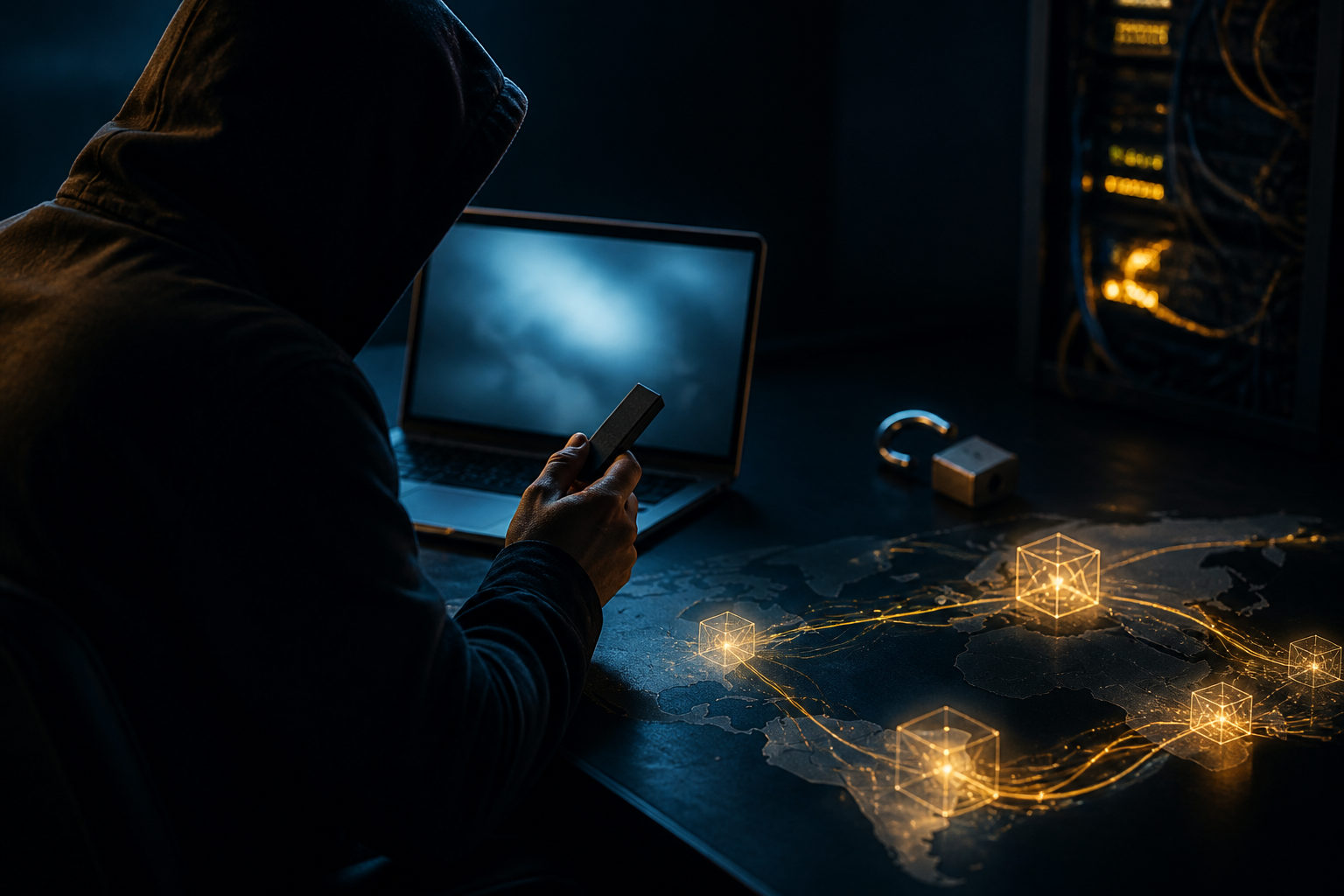
Ransomware groups often ask for bitcoin because it is easy to move across borders, hard to reverse after confirmation, and simple to receive with only a wallet address. That explains the payment choice better than the popular claim that bitcoin is “secret money.”
Why bitcoin fits the mechanics of ransom collection
A ransom scheme has two separate parts: blocking access to data and collecting payment. Traditional bank rails create friction for the second part. Banks can freeze transfers, flag unusual activity, delay international wires, or require identity checks that expose the receiver. Bitcoin works on an open network, so an attacker can publish an address and demand payment from victims in different countries without opening a standard merchant account.
The next attraction is settlement finality. Card payments and some digital payment systems leave room for chargebacks, manual disputes, or payment holds. A bitcoin transaction, once confirmed on chain, usually cannot be pulled back by the sender in the same way. For a criminal trying to get paid under time pressure, that matters a lot.
There is also a practical issue: setup is easy. A receiver does not need a storefront, a payment processor contract, or an approved corporate bank profile just to accept funds. Control of the private key is enough. That lowers the barrier for small crews, affiliates, and temporary operators.
| What ransom operators want | How bitcoin helps | What it means for victims |
|---|---|---|
| Cross-border collection | No dependence on one national banking system | Victims can be targeted almost anywhere |
| Hard-to-reverse payment | Confirmed transfers are usually not chargeback-friendly | Payment may be final even if the attacker lies |
| Low setup friction | A new address can be created quickly | Attackers can rotate receiving addresses |
| Funds can be split | Coins can move through many addresses | Tracing becomes more labor-intensive |
| Global liquidity | Value can circulate through many venues | Ransom proceeds may be layered and moved on |
Bitcoin is not truly anonymous
This is where public discussion often goes off track. Bitcoin does not attach a legal name to every address, but the ledger is public. Every transaction is recorded, and that record does not disappear. A better term is pseudonymous rather than anonymous.
If an address becomes linked to a real person through an exchange account, device history, withdrawal step, or another operational mistake, investigators can follow the trail with far more context. Attackers know this, which is why they often try to break up flows across multiple addresses or pass funds through services designed to blur movement. Even then, “hard to trace” is not the same as “impossible to trace.”
This point matters because people often assume bitcoin was built for crime. It was not. Satoshi Nakamoto published the white paper, Bitcoin: A Peer-to-Peer Electronic Cash System, on 2008-10-31, and the genesis block went live on 2009-01-03. Criminals use bitcoin for the same reason legitimate users do: it is an internet-native way to transfer value without asking a bank to clear the payment first.
Why attackers often choose bitcoin over other cryptoassets
Even victims with no crypto experience have usually heard of bitcoin. That familiarity reduces the attacker’s support burden. If a criminal wants payment fast, it helps to demand the asset most likely to have public guides, exchange availability, and a wallet app the victim can recognize.
Bitcoin is also highly divisible. The smallest unit is 1 satoshi, equal to 0.00000001 BTC. That lets an attacker specify a very exact amount if they want to. More broadly, its long operating history makes it a dependable settlement network from the attacker’s point of view.
Bitcoin blocks are targeted at roughly one every 10 minutes, which gives both sides a visible way to check whether payment has been broadcast and later confirmed. After the 2024-04-19 halving, the block subsidy is 3.125 BTC. The subsidy halves every 210,000 blocks, about once every 4 years. Those facts are not the reason ransom exists, but they do show why criminals see bitcoin as a predictable network rather than an experimental tool.
| Reason for choosing bitcoin | Attacker benefit | Hidden downside for the attacker |
|---|---|---|
| Strong name recognition | Less time spent explaining the payment process | Public attention is higher |
| Deep infrastructure | Wallets and trading routes are widely available | More compliance touchpoints can create evidence |
| Clear on-chain settlement | Payment status is visible | The transfer record is visible too |
| Divisibility | Exact ransom amounts can be requested | Small fragments still leave a transaction trail |
Why paying in bitcoin does not solve the underlying problem
From a victim’s side, the most important fact is simple: payment does not guarantee recovery. The attacker may send a broken decryptor, disappear after payment, or restore files while keeping stolen data for later extortion. Modern ransom events can include encryption, data theft, service disruption, and threats of publication. A bitcoin transfer addresses only the demand for money.
That is why incident response starts elsewhere. Affected devices should be isolated, logs preserved, and internal security and legal teams alerted. Law enforcement and specialist responders may also need to be involved early. The payment question can touch sanctions screening, reporting duties, contractual obligations, and cyber insurance terms. Treating it as only a wallet transfer is a serious mistake.
It is also useful to separate bitcoin’s design from criminal behavior. Any tool that can move value can be abused. Cash can be used in crime; bank wires can be used in fraud; that does not tell you the whole story about the tool itself. In ransom cases, bitcoin is selected because it sits at a useful intersection of recognizability, portability, and payment finality.
FAQ
Why do ransom notes so often ask for BTC instead of another coin?
Bitcoin is the cryptoasset most victims have at least heard about, so attackers spend less time explaining what to buy and how to send it. It is a practical choice for collection speed.
Can bitcoin ransom payments be traced?
They can be traced to a degree because the blockchain is public. The hard part is linking addresses to real people and following funds after they are split or moved through additional services.
If a company pays the bitcoin demand, will it get its files back?
There is no guarantee. Some attackers do provide a decryptor, but others fail to restore data fully or keep stolen data as leverage for another demand.
Why not demand a bank wire instead?
Bank transfers create more exposure to freezes, reviews, and identity checks, especially across borders. Bitcoin is easier for a criminal to receive quickly and move again.
Does bitcoin’s use in ransom prove it has no legitimate purpose?
No. It shows that criminals prefer payment systems that are borderless and difficult to reverse. That says something about the payment problem they are trying to solve, not the full set of legitimate uses for the network.
If a real ransom screen appears on your device, disconnect the affected system from the network and avoid making payments or signing in to sensitive accounts on that machine. Preserve what you can see, then bring in qualified responders before taking the next step.
Disclaimer: This article is for informational and educational purposes only and is not investment, financial, or legal advice. Crypto assets are highly volatile and you could lose your entire investment. Do your own research and decide carefully.