
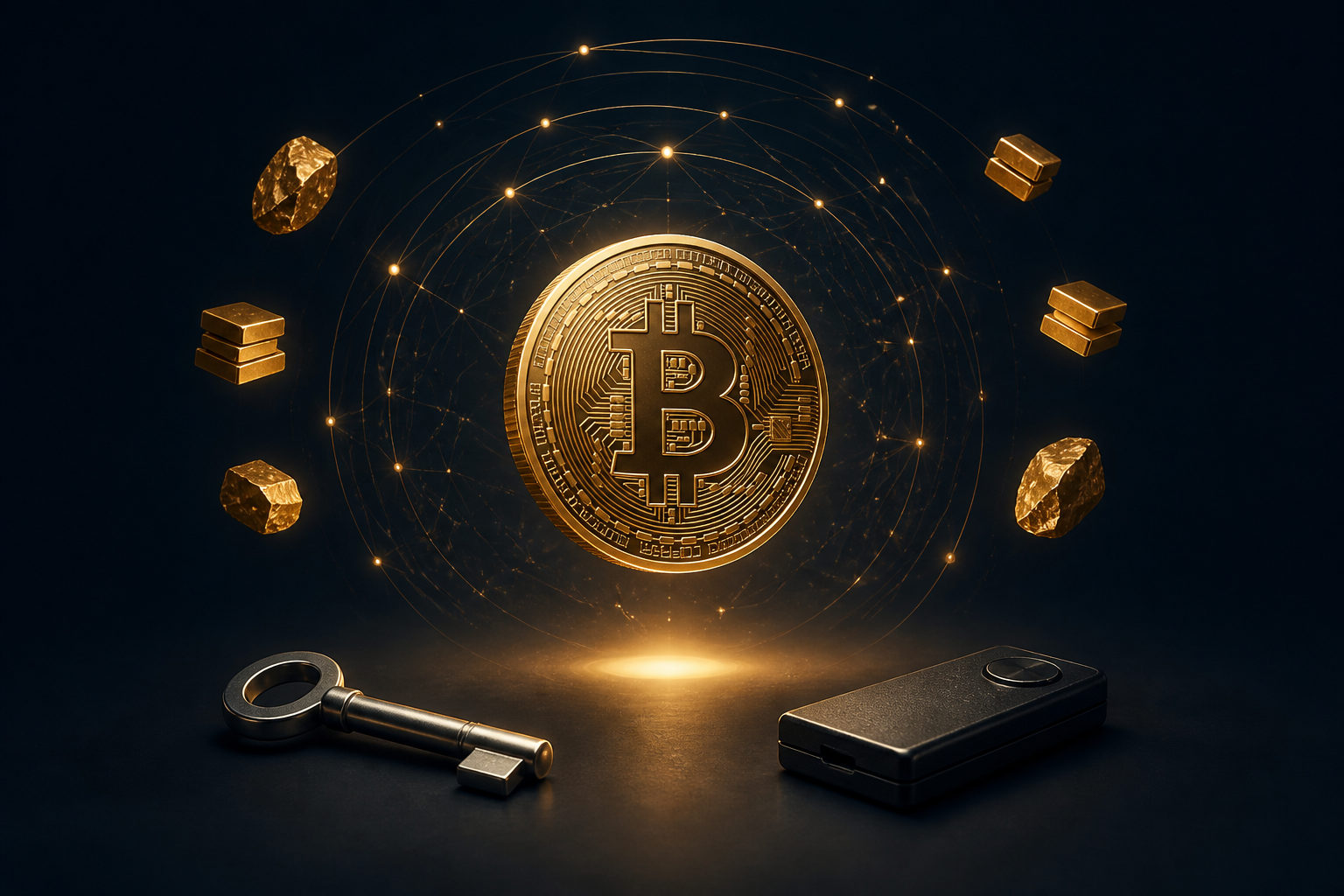
Bitcoin is worth anything because people can verify its scarcity, use it to transfer value, hold it without relying on a single gatekeeper, and trust that no one can freely create more of it beyond the stated limit.
Value starts with what Bitcoin can reliably do
When people ask why bitcoin is worth anything, they are usually asking a deeper question: why would anyone pay real money for something that exists only as digital records. That question makes sense. Most people are used to linking value to something they can physically hold, consume, or point to in the offline world.
But markets do not price things only by physical form. Many assets are valuable because they represent rights, scarcity, transferability, or broad acceptance. Bitcoin fits into that category. It is not valuable because it looks like gold or because it has a building behind it. It is valuable because it offers a set of properties that some people want and because those properties can be checked rather than merely promised.
A simple way to think about it is this: imagine a public ledger that anyone can inspect, where ownership can change according to known rules, where no central actor can just decide to print more units, and where participants around the world can agree on the same record of who owns what. If enough people want access to that system, the asset native to that system can carry value.
So the answer is not just “because people believe in it.” Belief matters, but it is built on structure. Bitcoin combines scarce supply, open verification, transferability, divisibility, and user control in a way that many people find useful.
Scarcity matters, but verifiable scarcity matters more
Scarcity alone does not guarantee value. Plenty of rare things are ignored by the market. Still, without scarcity, it is hard for an asset to hold long-term appeal as a store of value. Bitcoin begins with a hard supply cap of 21 million coins. That cap is one of the clearest reasons people pay attention to it.
The more important point is that bitcoin’s scarcity is not based on a speech, a press release, or a promise from an issuer. It is embedded in the system’s rules. People who interact with the network can check whether those rules are being followed. That difference matters. Markets tend to trust scarcity more when it can be independently verified.
Bitcoin is also divisible. One bitcoin can be split into smaller units, with 1 satoshi equal to one hundred millionth of a BTC. That means a person does not need to buy a whole coin to participate. Divisibility helps an asset remain usable even when demand changes.
The issuance path is also known in advance. Bitcoin started with the genesis block in January 2009. New blocks are produced about every 10 minutes, and the issuance schedule changes through halvings roughly every 4 years, or every 210,000 blocks. Halving years include 2012, 2016, 2020, and 2024. People may disagree about the price implications, but the basic supply rules are clear, and that clarity shapes how the market thinks about value.
Bitcoin is not just a token; it is a settlement system
A common mistake is to think of bitcoin only as a coin with a ticker. That misses the larger point. Bitcoin is also a network for recording and settling ownership. If an asset is supposed to carry value, it helps if ownership can be defined clearly and transfers can be checked in a shared system.
In the Bitcoin network, transactions are validated according to public rules. You can think of it as a ledger that many participants can inspect and verify. The system checks whether coins being spent actually belong to the sender and whether they have already been spent before. That makes the record harder to rewrite on a whim.
Why does this support value? Because control and transfer are basic parts of ownership. An asset is less useful if access depends entirely on one intermediary that can change the rules without meaningful outside verification. Bitcoin offers an alternative model. Users can hold bitcoin through a platform, or they can use wallets and self-custody their holdings. That choice is a major part of the appeal for many holders.
This does not mean self-custody is easy for everyone, and it does not mean there are no risks. It means the system gives users an option that many traditional setups do not offer in the same way. A market may assign value to that option even if not every user exercises it.
Consensus is part of the answer, but not the whole answer
Some critics hear the word consensus and assume it means empty social hype. That is too simple. Consensus does shape value in many markets. Brands, collectibles, domain names, and even fiat money all depend on shared recognition. Bitcoin is no different in that respect.
Still, the phrase “people agree it has value” is incomplete unless we ask what they are agreeing about. In bitcoin’s case, the agreement is built around a rule set. Participants agree on what counts as a valid transaction, what counts as a valid block, and what the supply rules are supposed to be. That makes bitcoin’s social layer stronger than a pure fad with no structure under it.
The white paper published in 2008, titled Bitcoin: A Peer-to-Peer Electronic Cash System, described the basic idea. The creator used the name Satoshi Nakamoto, whose real identity remains unknown. Those facts matter historically, but they are not the source of value by themselves. Bitcoin’s value comes from people continuing to use, verify, hold, and trade an open system with predictable rules.
In other words, bitcoin is not priced only because people feel excited. It is priced because a global group of participants keeps accepting the same ledger rules and using the asset tied to that ledger. Sentiment moves markets in the short run. Structure gives sentiment somewhere to attach.
Utility does not need to be one thing
Another useful way to answer why are bitcoins worth anything is to ask who finds them useful and for what reason. The answer is not identical for every holder. Different users care about different traits, and bitcoin can be valued for more than one reason at the same time.
- Store-of-value demand: Some holders want exposure to an asset with a fixed supply schedule and no easy path to discretionary expansion.
- Transfer demand: Some users care that value can be moved through the network according to transparent rules rather than by a single bookkeeper.
- Self-custody demand: Some people place a premium on being able to control their own holdings through wallets and private keys.
- Global recognizability: BTC is a widely recognized unit across exchanges, wallets, and market participants, which supports marketability.
- Portfolio diversification thinking: Some buyers see bitcoin as one component in a broader mix of assets rather than a replacement for everything else.
These sources of demand are not always equally strong, and they can shift over time. That is normal. The key point is that bitcoin’s value is not resting on one story alone. It is supported by a combination of monetary rules, technical properties, and user preferences.
If bitcoin had no use beyond speculation, the case would be much weaker. But speculation is not the full story. The system’s design gives people reasons to hold it even when they are not trying to trade every move.
Value and price are related, but they are not the same thing
People often use value and price as if they mean the same thing. They do not. Value explains why an asset can attract lasting demand. Price is the market’s current expression of competing views about that asset.
Bitcoin’s price can be highly volatile. That does not prove it has no value. It shows that market participants disagree, sometimes sharply, about how much those properties are worth and how they should be priced at a given moment. Many established assets have volatile periods. Volatility is a market condition, not an automatic verdict of worthlessness.
It is more useful to ask whether there are durable reasons people keep returning to bitcoin. The strongest reasons are still the same: a fixed cap of 21 million, public verification, transferability, divisibility, and the option of self-custody. Those features do not settle every debate, but they explain why the asset is not simply dismissed and forgotten.
If you want the live BTC price, the right move is to check a major market data platform or exchange quote screen. Without live market data, any exact price statement would be stale or misleading. For this topic, the more useful question is why buyers and holders continue to care at all.
Bitcoin is not perfect, and it does not need to be perfect to have value
A lot of arguments collapse into two extremes. One side says bitcoin has no intrinsic value at all. The other side talks as if it is a flawless answer to every monetary problem. Both views flatten a more complicated reality.
Bitcoin does have meaningful limits. It can be hard for newcomers to understand. Self-custody comes with responsibility. Price swings can be severe. Platform risk, user error, and policy shifts can all affect how people use it. Those are real issues, not minor footnotes.
At the same time, saying it has no value ignores what the market is actually evaluating. People are not paying for physical substance. They are paying for access to a scarce digital asset tied to an open, verifiable monetary network. In that sense, bitcoin’s “inside” value is found in its rules and functions rather than in industrial use.
That is enough for some people and not enough for others. Markets do not require universal agreement. They require enough demand from participants who think the asset’s properties are worth paying for.
FAQ
Why would anyone pay for bitcoin if it is just digital code?
Because the code is only part of the story. Bitcoin represents a scarce digital asset on a public network with known rules, and those rules let people verify ownership and transfer value without relying on a single issuer.
If enough market participants want those properties, the asset attached to that system can hold value. Digital form does not cancel usefulness.
Is bitcoin valuable only because people agree it is?
Shared agreement matters, but it is not the whole explanation. The agreement is anchored to specific traits such as a capped supply, public verification, divisibility, and the option to self-custody.
Without those traits, the social agreement would be much weaker. Bitcoin is not sustained by a slogan alone.
Can bitcoin still be worth something if its price is volatile?
Yes. Price volatility means the market is constantly repricing future expectations, risks, and demand. It does not automatically mean the asset has no underlying reason to be held.
Many people separate the long-term case for bitcoin from short-term price swings. Whether that case is convincing is up to each investor.
If other coins can be created, why does bitcoin keep value?
Creating another coin is much easier than recreating bitcoin’s level of recognition, market acceptance, and trust in its rule set. Code can be copied, but network acceptance is harder to duplicate.
That is why “a similar system exists” is not the same as “the same value can be reproduced.” Market history and user conviction matter.
What should a beginner learn first before judging bitcoin’s value?
Start with the basics: the 21 million supply cap, what private keys control, how wallets work, and why transaction verification matters. Those ideas explain far more than watching price alone.
After that, compare custody options and learn where to check live BTC quotes. Understanding the mechanism usually leads to a better judgment than reacting to headlines.
If you want to evaluate bitcoin seriously, begin with wallets, private keys, seed phrase safety, and how network verification works. Once those basics are clear, it becomes easier to decide whether bitcoin’s properties are useful to you or not.
Disclaimer: This article is for informational and educational purposes only and is not investment, financial, or legal advice. Crypto assets are highly volatile and you could lose your entire investment. Do your own research and decide carefully.