
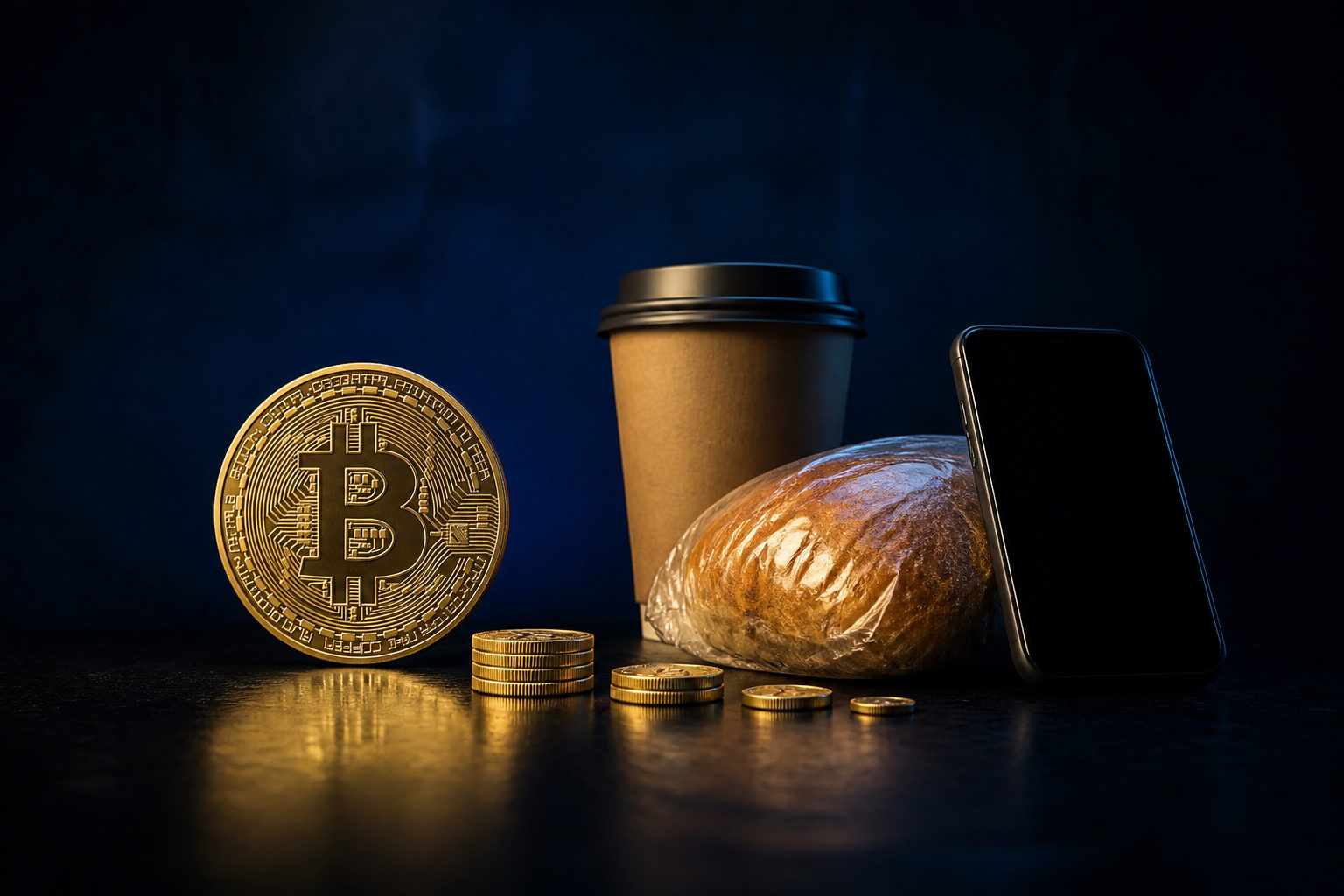
What 1 bitcoin equals has no fixed answer on its own. You first need to decide whether you mean its current price in dollars, the fraction you can buy, or the real-world buying power that amount represents.
What people usually mean by “what one bitcoin equals”
This query sounds simple, but the intent behind it often changes from person to person. Some people want a direct conversion and are really asking how many dollars 1 BTC is worth at a given moment. Others want to know whether buying less than a full coin is normal, or whether one bitcoin is the minimum unit they need to think about.
There is also a third meaning: people may be trying to understand what holding one bitcoin represents as an asset. That is a different question from a live quote. A market price gives you a number; it does not tell you, by itself, whether the asset fits your goals, time frame, or risk tolerance.
| Interpretation | What the user is really asking | What to check |
|---|---|---|
| Dollar value | How much 1 BTC is worth right now | Live market price on a trading venue or price tracker |
| Fractional ownership | Whether you can buy less than one full bitcoin | Minimum order size and fraction support |
| Buying power | What that amount can represent in practice | Current price and where bitcoin can actually be used |
| Portfolio meaning | What one bitcoin means in a personal allocation | Volatility, custody, liquidity, and time horizon |
If your only goal is to know its dollar value today, the answer comes from a live quote. If you want to act on that number, you need a bit more context before it becomes useful.
Why there is no single permanent answer
Bitcoin trades in open markets, so its price moves with supply and demand. There is no single printed value that stays in place across all venues. Different platforms have their own order books, different fee structures, and different levels of liquidity, which is why prices can vary slightly from one place to another.
That matters because the number you see on a screen is often just a reference point. Your actual outcome depends on whether you are buying or selling, which order type you use, and what fees apply before settlement. In fast markets, the displayed quote can shift between the moment you look and the moment you confirm.
So when someone asks what one bitcoin equals, the useful reply is not a static figure. The better reply is that it equals the current market price at the venue you use, adjusted by the trading conditions that affect your final result.
| Factor | How it changes the answer | Why it matters |
|---|---|---|
| Supply and demand | Moves the quoted price up or down | The number is always market-driven |
| Venue differences | Creates small price gaps across platforms | A quote from one source may not match another |
| Liquidity | Affects execution, especially on larger orders | The posted price may not fill in full |
| Fees and spreads | Change net cost or net proceeds | Your real result is not the headline quote |
| Short-term sentiment | Can widen price swings quickly | A snapshot may age very fast |
How to read the number correctly
The first step is to confirm the trading pair. If the market shown is BTC against dollars, interpretation is straightforward. If the screen is showing BTC against another digital asset, treating that figure as a dollar quote would be a basic mistake.
The second step is to separate the price of one full bitcoin from the amount you plan to buy. Bitcoin has a maximum supply of 21 million coins, but each coin is divisible into much smaller units. The smallest unit is the satoshi, and 1 satoshi equals one hundred millionth of 1 BTC. That means a person does not need to buy a full coin to gain exposure.
The third step is to look past the headline quote and check the cost structure. Some services show a market price first and add fees near the end of the order flow. Others build a spread into the displayed figure. What matters is the net amount of BTC you receive for a dollar amount, or the net dollars you receive when selling.
| Step | What to verify | Common mistake |
|---|---|---|
| Check the pair | Is it BTC priced in dollars? | Reading a non-dollar pair as a dollar quote |
| Check minimum purchase rules | Can you buy a fraction? | Assuming one full bitcoin is required |
| Review costs | Are fees or spread included? | Comparing only the headline number |
| Check order method | Market order or limit order | Ignoring slippage in fast conditions |
If your question is really “how much bitcoin can my money buy,” the process is simple in principle: find the live BTC dollar price, account for all costs, and then calculate the fraction of a coin you will receive. The same logic applies in reverse when you sell.
Price and value are related, but not identical
A live price answers a conversion question. It does not answer whether bitcoin is a suitable asset for you. That distinction matters because many first-time buyers confuse a quote with a decision.
Bitcoin began with the genesis block in January 2009. Its creator used the name Satoshi Nakamoto, though the real identity remains unknown. The system was introduced in the 2008 white paper titled Bitcoin: A Peer-to-Peer Electronic Cash System. Those details help explain what bitcoin is, but they do not tell you whether the current market price is attractive for your own situation.
For that, you need to think about different questions: Can you tolerate large price swings? Do you understand the difference between leaving bitcoin with a platform and holding it in your own wallet? Are you buying for a short trade, a long hold, or simple curiosity? Each choice changes what the number on the screen means to you.
| Question type | Main focus | Extra judgment required |
|---|---|---|
| What is bitcoin worth now? | Live market quote | Confirm pair, spread, and fees |
| Can I buy some? | Fractional access | Check minimum order rules |
| Should I hold it? | Risk and custody | Match the asset to your tolerance and plan |
| How much do I get if I sell? | Execution and net proceeds | Look at fees and slippage, not just the listed price |
That is why “what one bitcoin equals” should be treated as an entry point, not the end of the analysis.
FAQ
Do I need to buy a whole bitcoin?
No. Bitcoin is divisible, so most people buy a fraction rather than a full coin.
The practical thing to check is whether the platform supports small purchases and whether fees take too much out of a small order.
Where should I check how much bitcoin is worth in dollars?
Mainstream exchanges and market trackers are the usual places to look. When comparing prices, include spreads, fees, and the actual execution screen rather than relying on a homepage quote alone.
If two sources differ slightly, that does not automatically mean one is wrong.
Why do different platforms show different bitcoin prices at the same time?
Because trading is distributed across separate venues with separate order books. Prices stay close, but they do not have to be identical every second.
The faster the market moves, the easier it is to notice those gaps.
If I only want to buy a small amount, does the full bitcoin price still matter?
Yes. The full coin price is the standard market reference, and you need it to calculate the fraction you are getting.
Still, your most useful figure is the net BTC you receive for your dollar amount after costs.
Who decides the price of one bitcoin?
No single institution sets it. The price comes from buyers and sellers meeting in the market.
That is why the answer changes over time and across venues instead of staying fixed.
Before you act, choose a price source you trust, confirm the BTC dollar pair, and review the fee and order details. Those checks do more to answer what one bitcoin equals than any isolated number taken out of context.
Disclaimer: This article is for informational and educational purposes only and is not investment, financial, or legal advice. Crypto assets are highly volatile and you could lose your entire investment. Do your own research and decide carefully.