
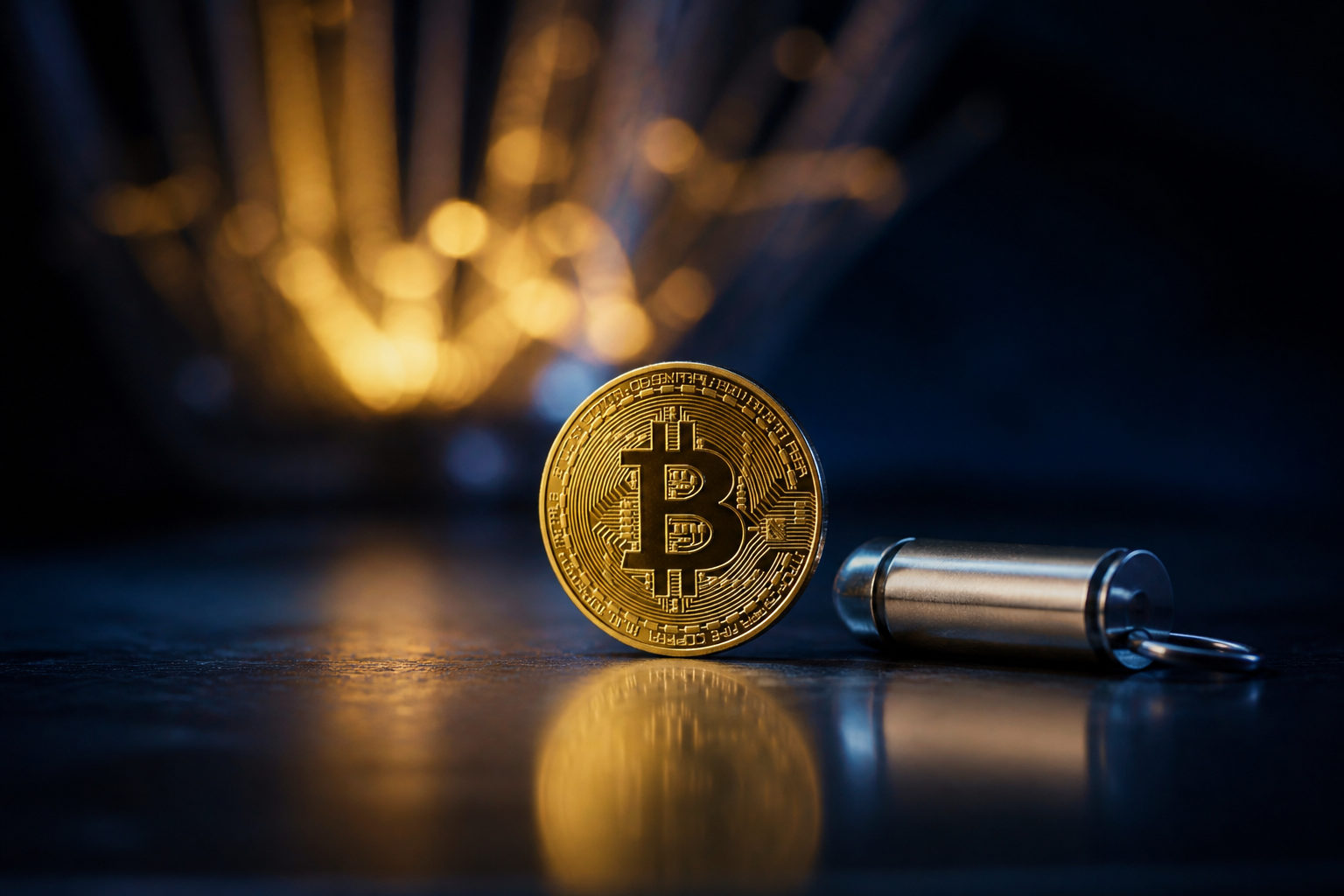
Are there any physical bitcoins? Strictly speaking, no. Bitcoin exists as a record on the blockchain, while coins, cards, and printed items are usually collectibles or containers for private keys.
What Bitcoin actually is
Bitcoin is a native digital asset of the blockchain network. Ownership does not depend on holding a metal object in your hand. It depends on control of the private key that can authorize movement of coins recorded on-chain.
That distinction sounds simple, yet it causes a lot of confusion for beginners. The word “coin” suggests something mintable and touchable, so many people picture a physical token with built-in value. Bitcoin does not work that way. There is no official physical version issued by the network, and there is no standard object that counts as BTC by itself.
What people call a physical bitcoin is usually one of two things: a souvenir that uses Bitcoin branding, or a physical item that stores access information tied to bitcoin on the blockchain. Those are very different products, and mixing them up leads to bad buying decisions.
What people mean when they say “physical bitcoin”
Several kinds of objects get grouped under this label, even though they serve different purposes.
- Souvenir coins: metal pieces with the Bitcoin symbol, often bought as gifts, desk items, or collectibles. They may look impressive, but they do not represent on-chain BTC on their own.
- Paper wallets: printed sheets containing a public address and a private key or related recovery information. The paper is physical; the value comes from the secret data written on it.
- Metal backup plates: metal storage tools used to preserve a seed phrase or recovery words. They are backup media, not bitcoins in metal form.
- Sealed cards or metal tokens tied to a private key: some products claim to come “loaded” with bitcoin. In practice, the object is only acting as a carrier for key material that controls a balance on the blockchain.
- Hardware wallets: physical devices used to store signing credentials and approve transactions. The device is tangible, but the bitcoin is still on-chain.
Once these categories are separated, the core idea becomes clear: being able to hold an object does not mean you are holding bitcoin itself. The real issue is whether you have exclusive, secure control over the relevant key.
Why beginners often get this wrong
Language is part of the problem. “Bitcoin” sounds close enough to ordinary money that people expect a physical counterpart. Marketing adds another layer. A polished metal token with sealed packaging feels more “real” than a wallet app, so new users often trust the form they can touch over the system they cannot see.
Hardware wallets create another common misunderstanding. People buy a device, plug it in, and naturally assume their bitcoin is stored inside it like files on a drive. What the device actually protects is the signing authority. If the wallet is lost but the recovery phrase remains safe, access can often be restored. If the recovery phrase leaks, the device itself does not save the owner.
Collectible products blur the line even more. Some buyers care about design, rarity, or presentation. Others think they are buying a straightforward bitcoin holding. Those are separate decisions. A collectible can have appeal as an object even when it has no on-chain value at all.
How to evaluate an item that claims to contain bitcoin
Start by asking what exactly is being transferred to you. If the seller is only offering a coin-shaped object with a Bitcoin logo, you are buying merchandise. If the item includes a public address but no private key under your control, you still are not buying spendable BTC. If it supposedly contains a sealed private key, the next question is whether anyone else could have viewed, copied, or recorded that key before it reached you.
Independent verification matters. An item advertised as carrying bitcoin should allow the holder to check the associated address on the blockchain. If the balance cannot be verified by the buyer without relying on the seller’s word, the risk is obvious.
There is also a practical security issue. Even if a physical item appears unopened, that does not prove the key was never exposed during manufacturing, packaging, transport, or resale. For that reason, anyone who acquires a funded physical key carrier should usually move the balance to a freshly generated wallet address under their own setup as soon as practical.
This is where many newcomers focus on the wrong details. The material, weight, finish, and packaging may matter for a collectible. They do not tell you whether the underlying access credentials are safe.
Physical carrier versus bitcoin itself
A useful mental model is to split the topic into layers. There is the blockchain record, there is the secret needed to control that record, and there is the object used to store or present that secret. Problems begin when all three are treated as if they were the same thing.
| What you see | What it really is | Is it bitcoin itself? |
|---|---|---|
| Souvenir metal coin | Collectible or display item | No |
| Paper wallet | Physical carrier for key information | No |
| Hardware wallet | Signing and key-management device | No |
| Sealed card or token | Possible carrier of private-key control | No |
| On-chain balance | Digital asset record controlled by a key | Yes |
That framework helps with almost every beginner question. A paper wallet can be physical without making bitcoin physical. A hardware wallet can be tangible without turning BTC into an object inside a gadget. A commemorative coin can look expensive and still represent nothing on-chain.
FAQ
Can a physical bitcoin coin be used directly for payment?
Usually no. Bitcoin payments require control of a private key and an on-chain transaction. A metal token by itself has no payment function unless it is tied to valid key material, and even then the transfer still happens digitally.
Does a hardware wallet count as a physical bitcoin?
No. A hardware wallet is a physical security device used to manage signing credentials. The bitcoin remains on the blockchain rather than inside the device.
Is a paper wallet a physical form of bitcoin?
It is a physical form of key storage, not a physical form of BTC. The paper only matters because it may contain secret information that controls bitcoin recorded on-chain.
If I buy a card that says it comes with bitcoin, what should I do first?
Check whether you can independently verify the associated blockchain address. If the balance is real and you gain control of the key material, moving the funds to a new wallet you created yourself is usually the safer next step.
Do physical bitcoin items have collectible value?
Some do, but collectible value and bitcoin ownership are separate issues. You can buy an object for design or novelty, yet that does not mean you acquired BTC in a secure or usable form.
If your goal is to own bitcoin, focus on wallet setup, private-key control, and independent verification. If your goal is to buy something tangible, treat it as a collectible or a key carrier and judge it on that basis.