
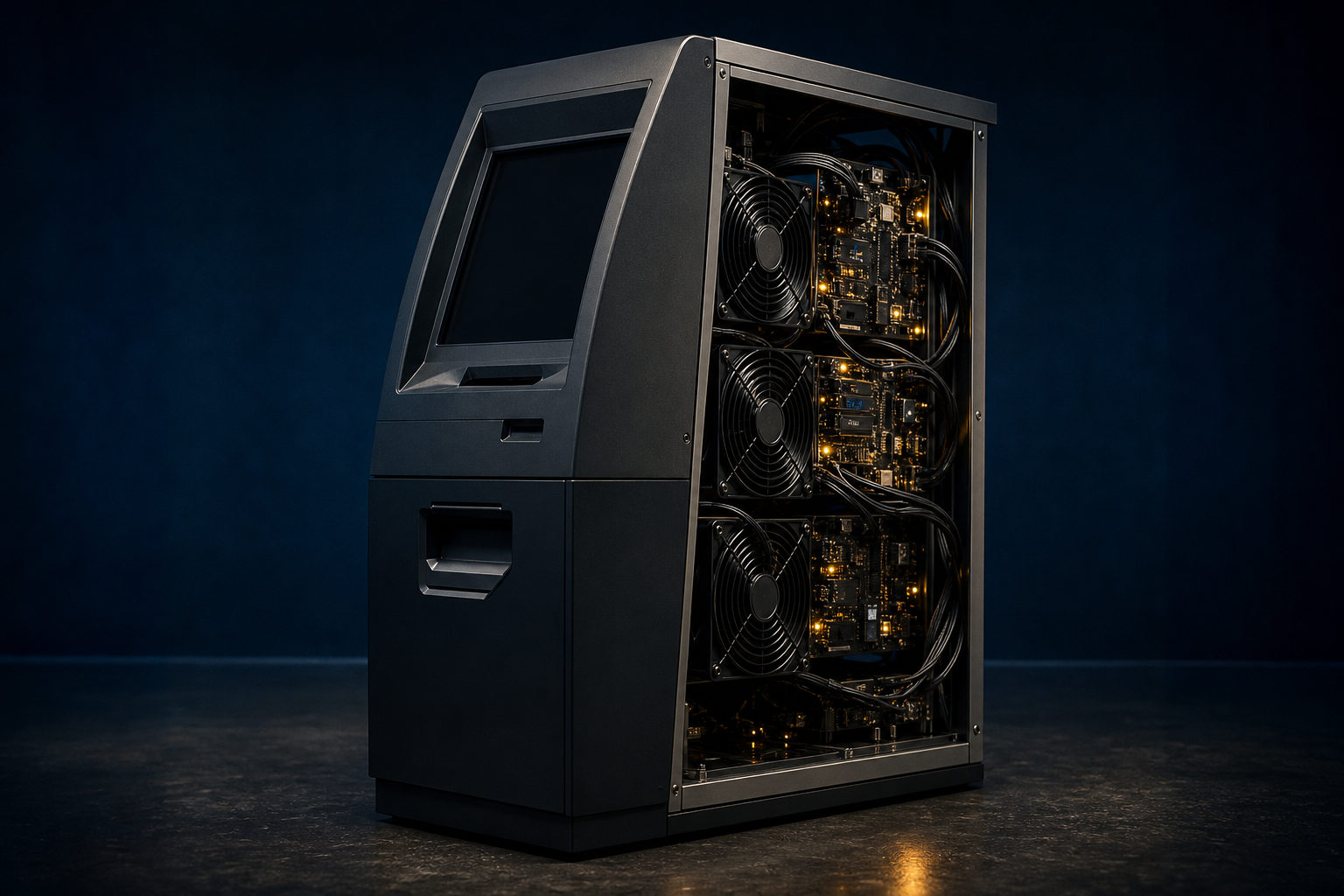
How does a bitcoin machine work? In most cases, people mean one of two very different devices: a Bitcoin ATM that helps users buy or sell bitcoin, or a mining machine that helps process transactions and add blocks to the network.
Two different meanings of “bitcoin machine”
The phrase sounds simple, but it often causes confusion. A person standing in front of a kiosk in a store is thinking about a machine that accepts payment and sends bitcoin to a wallet. Someone reading about mining is thinking about specialized hardware that competes to add new blocks.
These devices share the word “bitcoin,” yet they do different jobs. A Bitcoin ATM is a user-facing terminal. A mining machine is part of the network’s back-end security and recordkeeping process.
| Machine type | Main purpose | Typical user | Core action |
|---|---|---|---|
| Bitcoin ATM | Buy bitcoin, and sometimes sell it | Retail user | Collect payment, read wallet address, send transaction |
| Mining machine | Help confirm transactions and produce blocks | Miner or operator | Validate transactions, build candidate blocks, perform hashing |
How a Bitcoin ATM works
A Bitcoin ATM is easiest to understand as a bridge between a payment method, an operator’s wallet system, and the Bitcoin network. The machine on the floor is only the visible part of the process. Much of the real work happens in the operator’s software and wallets behind the screen.
Step 1: The machine starts with the transaction type
Users usually begin by choosing whether they want to buy or sell. Not every machine supports both directions, so the first practical question is what the terminal actually offers. That choice determines the rest of the flow.
Step 2: It needs a destination wallet address
If the user is buying bitcoin, the machine must know where to send it. The common method is scanning a wallet QR code from a phone. Some systems allow manual entry, but that raises the chance of an address mistake, and a Bitcoin transaction is generally not reversible once it is sent.
Step 3: The operator runs identity and risk checks
Many machines ask for a phone number, a one-time code, or some other form of verification. The exact process depends on the operator and local rules, but the idea is straightforward: the terminal is not just vending a digital item, it is connecting money movement with compliance controls and fraud screening.
Step 4: Payment is accepted and an order is created
When the user inserts cash or follows the payment instructions, the machine records the request. It does not create bitcoin inside the cabinet. Instead, it tells the operator’s back-end system that a purchase has been funded and that a matching amount should be sent to the user’s wallet address.
Step 5: The back end broadcasts a Bitcoin transaction
Once the payment side is confirmed, the operator’s wallet infrastructure creates a transaction and broadcasts it to the Bitcoin network. At this point, the ATM has done its front-desk job. The actual movement of bitcoin happens on-chain through the operator’s wallets and the network’s validation rules.
Step 6: The user waits for network confirmation
After broadcast, the transaction enters the pool of pending transactions. Miners then select transactions and include them in new blocks. Bitcoin produces a new block about every 10 minutes, so settlement speed depends on network conditions and fee settings rather than the screen alone.
| What the user sees | What the system is doing | What to check |
|---|---|---|
| Select buy or sell | Load the correct transaction workflow | Confirm the machine supports the service |
| Scan wallet QR code | Capture the destination address | Make sure it is your wallet |
| Enter verification details | Run compliance and fraud controls | Use only a trusted machine |
| Insert cash or complete payment | Create and record the order | Keep the receipt or confirmation details |
| See a sent notice | Broadcast a Bitcoin transaction | Track confirmation status after broadcast |
How a bitcoin mining machine works
If the phrase refers to a mining machine, the mechanism is completely different. A miner does not serve a walk-up customer. It serves the network by taking pending transactions, checking them against Bitcoin’s rules, and trying to build a valid block.
You can picture it as a machine that keeps trying different combinations until one result satisfies the network’s requirement. First, it gathers unconfirmed transactions. Then it checks whether the signatures are valid, whether the inputs can be spent, and whether the data fits the protocol rules. After that, it packages valid transactions into a candidate block.
The mining hardware then performs repeated hashing on the block header, changing values and trying again and again. The goal is to find a hash that meets the current difficulty target. The machine is not “guessing the future.” It is performing a huge amount of rule-based computation in a competition shared by miners across the network.
When a miner finds a valid result, it broadcasts the block to other nodes. Those nodes verify the block independently. If the block passes validation, it is added to the chain and the included transactions gain a confirmation.
| Mining stage | What happens | Why it matters |
|---|---|---|
| Collect transactions | Receive pending transactions from the network | Prepare a candidate block |
| Validate transactions | Check signatures, spendability, and format | Filter out invalid entries |
| Assemble a block | Organize transactions and block data | Create a valid submission attempt |
| Hash repeatedly | Run repeated calculations on the block header | Try to meet the difficulty requirement |
| Broadcast the result | Send the new block to the network | Seek acceptance by other nodes |
Why people mix them up
The confusion comes from the word “machine.” A Bitcoin ATM feels physical, so people may assume the bitcoin is stored inside it the way cash sits inside a traditional dispenser. That is not how it works. The machine is mainly an interface; control of bitcoin lives in wallet keys and on-chain records, not inside the kiosk.
Mining hardware causes a different misunderstanding. Some beginners think it is just a regular computer with a program running in the background. In reality, the device is built around one narrow task: repeated hashing for Bitcoin mining. The machine’s value comes from doing that task efficiently and continuously.
| Question | Bitcoin ATM | Mining machine |
|---|---|---|
| Who interacts with it directly? | Retail users | Miners and operators |
| Main result | A purchase, sale, or transfer process | Participation in block production |
| Does it need a wallet? | Usually yes, for receiving bitcoin | Yes, for receiving mining proceeds, but not for walk-up buying |
| Connection to Bitcoin network | Creates or relays a user transaction | Validates and packages transactions into blocks |
| Most important thing to understand | Where the bitcoin is being sent | How block competition and validation work |
What actually matters to a beginner
If your goal is to use a machine to get bitcoin, focus on the ATM path: wallet address, payment confirmation, fees shown on the screen, and transaction status after broadcast. Those are the practical checkpoints that affect whether the transfer reaches you correctly.
If your goal is to understand the Bitcoin system itself, focus on the mining path: transactions are checked, grouped into blocks, and accepted only when the network agrees that the block is valid. That is the piece that explains why Bitcoin can keep a shared record without a central operator.
FAQ
Does a Bitcoin ATM keep bitcoin inside the machine?
Usually no. The terminal is mostly a front-end device, while the operator’s wallet system creates and sends the on-chain transaction to the address you provided.
Can I use a bitcoin machine without my own wallet?
In most practical cases, you should have a wallet ready first. The machine needs a destination address, and using your own wallet gives you direct control over receipt, backup, and later use.
Why does the machine say the transaction is complete when my wallet shows nothing yet?
That often means the transaction has been created and broadcast, but it is still waiting for confirmation in a block. Checking the transaction status is more useful than relying only on the wallet’s main screen.
Does a mining machine simply create bitcoin by running?
No. It competes for the chance to add a valid block under Bitcoin’s rules. Any payout is tied to successful block production and acceptance by the network, not to the machine being switched on by itself.
If I only want to understand how bitcoin gets sent, should I study ATMs or miners?
Start with the ATM process because it shows the user side of payment, address handling, and transaction broadcast. Then move to mining if you want to understand how that broadcast becomes part of the blockchain record.
Before using any bitcoin machine, identify whether it is a customer-facing ATM or a mining device, then verify the wallet address, the fee display, and the transaction status. Those checks prevent most beginner mistakes.
Disclaimer: This article is for informational and educational purposes only and is not investment, financial, or legal advice. Crypto assets are highly volatile and you could lose your entire investment. Do your own research and decide carefully.