
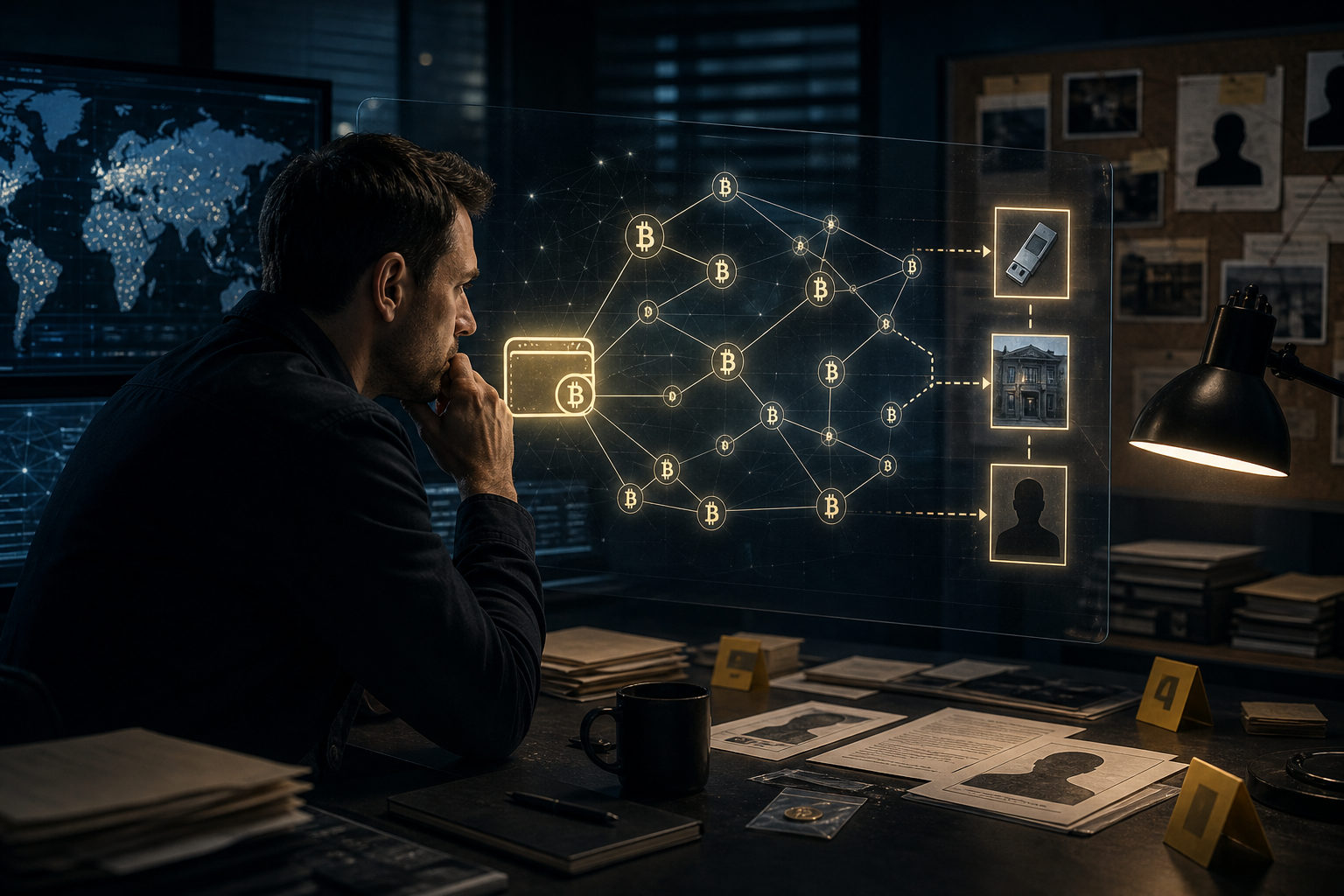
Police trace bitcoin ransomware payments by following public blockchain records and then tying wallet activity to exchange accounts, devices, logs, and other real-world identity clues.
Many people hear that a ransomware gang wants payment in bitcoin and assume the money becomes untraceable at once. That is not how bitcoin works. A bitcoin address does not usually show a legal name, but every transfer is recorded on a public blockchain. Investigators do not need a name at the start. They need a payment address, a transaction trail, and one point where that trail touches a person, a service, or a device.
A simple way to think about it is this: bitcoin is closer to a public system of aliases than a system of invisibility. You may not know who is behind an address on day one, yet you can still see where funds came from, where they moved, and which other addresses were involved. Once one piece of that chain is tied to a real operator, the rest of the activity can become much easier to interpret.
Why bitcoin is not the same as total anonymity
A common misunderstanding is that because bitcoin addresses look like random strings, they hide everything that matters. In reality, they hide one thing at first: direct identity. They do not hide transaction history. The blockchain works like a shared ledger that keeps a permanent record of transfers between addresses.
Imagine someone walking through a crowded square wearing a numbered mask. You do not know the person’s name right away, but you can still watch where that mask goes, who it meets, and what it hands over. If police later learn who wore that mask at even one point, a lot of the earlier and later movement can be revisited with much more confidence.
That is why investigators often care less about instant attribution and more about preserving the first usable clues. In a ransomware case, that often means the ransom note, the demanded bitcoin address, any chat or email contact, the victim’s transfer record, and the malware sample itself. The address is not the end of the trail. It is often the beginning.
How police usually trace ransomware bitcoin payments
Real investigations do not follow one rigid script, but the core method is consistent. Police combine blockchain analysis with records from companies, seized devices, server logs, and communications data. Each source answers a different question. Together, they can show not only where the funds moved, but who likely controlled them.
Step one: preserve the earliest evidence
The first job is to lock down the original material. That can include the ransom message, payment instructions, the bitcoin address or addresses provided by the attackers, communications with the victim, and the victim’s own wallet records. If payment has already happened, investigators also want the transaction identifier and the timeline of what happened next.
This matters because ransomware operators often move funds quickly. If the victim delays reporting, deletes records, or wipes affected systems too soon, key evidence can disappear. Even when the money has already moved, the first address given to the victim is still valuable because it anchors the case to a specific point on the blockchain.
Step two: map the transaction path
Attackers rarely keep all ransom proceeds in one address. They may split funds, combine them, move them again, or route them through several services. Investigators examine the visible path and look for patterns that suggest common control. They are trying to sort many scattered transactions into something more meaningful: first receipt points, collection points, split points, and likely exit points.
This is a bit like reviewing camera footage across a city. One car alone may not tell you much. A convoy moving in a repeated pattern tells you more. On the blockchain, repeated timing, repeated transfer behavior, and links among addresses can help investigators build a clearer picture of how a group manages funds.
Step three: find where the funds touch the real world
This is often the turning point. Criminals may move bitcoin through many addresses, but at some stage they often need to store it, trade it, distribute it, or spend it using a service that keeps records. Centralized exchanges are the most familiar example. If ransom proceeds move into an account at such a service, investigators may be able to connect that deposit to account information, access logs, devices, or later withdrawal activity.
Not every account detail is automatically true, of course. A fake name on an account does not solve the case. Still, login history, device fingerprints, email use, linked accounts, and withdrawal behavior can become powerful when matched against the blockchain trail and other evidence.
Step four: compare blockchain findings with device and network forensics
Blockchain analysis explains how the money moved. Device and network forensics help answer who moved it. If police seize a computer, phone, server, or cloud account tied to a suspect, they may look for wallet software, copied addresses, fragments of seed phrases, screenshots, browser records, chat discussions about payments, or files that mention specific wallets.
Even partial evidence can matter. A suspect may not keep a full wallet file on a laptop, yet the device may still contain copied addresses, account notifications, saved exchange sessions, or conversations about dividing proceeds. When these fragments line up with the blockchain timeline, they can strongly support attribution.
What often creates a break in real cases
People searching for real cases often expect a dramatic technical breakthrough. In practice, many breaks come from ordinary mistakes and ordinary recordkeeping. The blockchain does not usually need to be “cracked.” It needs to be interpreted alongside the rest of the case.
- Address reuse or repeated payment habits: when the same group repeats the same collection method, the pattern becomes easier to spot.
- Funds entering a service that keeps customer records: this can connect public addresses to private account activity.
- Overlap with malware, server, or communication evidence: the same actors may reuse email accounts, infrastructure, or operational habits.
- Internal profit sharing: the more people involved in dividing proceeds, the more devices, messages, and errors exist.
- Strong records from victims: screenshots, emails, wallet logs, and system logs can supply the clean starting point investigators need.
The basic point is simple. Police do not solve these cases by looking at one wallet and magically reading a name. They build a chain of proof. One piece says where the bitcoin went. Another says who logged in. Another says which machine was used. Another says how the extortion demand was delivered. The more those pieces agree, the stronger the case becomes.
Can criminals hide the trail by moving funds around?
They can make tracing harder. They cannot make the earlier record vanish. Splitting payments into smaller amounts, using many fresh addresses, or routing funds across multiple services can slow analysis and add noise. For readers new to the topic, think of it as moving cash from bag to bag while changing streets again and again. The path becomes messy, but every move still leaves a mark on the map.
That distinction matters. Complexity is not the same as invisibility. If the funds later pass through a point where investigators can collect account records, device evidence, or operational mistakes, the earlier path may be reconstructed with much better clarity. A long route can delay attribution. It does not guarantee safety for the operator.
Cross-border movement does not automatically prevent tracing either. The blockchain is global, and ransomware investigations often involve victims, companies, and authorities in more than one place. That does not mean every case ends with seizure or identification. It means the use of bitcoin by itself does not create a perfect shield.
What victims should do so they do not destroy useful evidence
Victims often hurt later tracing efforts by cleaning up too fast. In a ransomware event, the first priority is not to become your own evidence-destruction team. Preserving the right records can make a major difference.
- Keep the ransom note and payment instructions: save the message exactly as received, including the bitcoin address and any contact details.
- Preserve transaction records: if payment occurred, keep wallet logs and the transaction identifier.
- Save communications and logs: emails, chat records, system logs, server logs, and alerts may all help build the timeline.
- Do not rush to wipe affected systems: quick cleanup can remove artifacts that connect the attack to a device or account.
- Contact law enforcement and incident response professionals early: early reporting can help preserve both digital evidence and financial traces.
Victims should also be cautious with anyone who claims they can definitely recover ransom funds for a fee. Public blockchain data is real, but tracing and recovery are not the same thing. A visible trail does not guarantee that funds can be frozen or returned.
FAQ
Can police tell who owns a bitcoin address right away?
Usually no. A bitcoin address does not normally display a legal identity on its own, so investigators must connect it to exchange records, devices, communications, or other evidence before they can identify the controller.
If the ransom is split into many transfers, can it still be traced?
Yes, though the work becomes harder. Every transfer still appears on the blockchain, and if later movements touch a service or device tied to a suspect, investigators may reconstruct the earlier path.
Does moving funds to another platform break the trail?
Not by itself. A platform change adds another layer, but it does not erase prior blockchain records; if one platform later provides account or access data, the wider flow can still make sense.
Should a victim report the case after paying?
Yes. Reporting can preserve evidence, help investigators flag suspicious addresses, and support broader case matching even if the funds are not recovered at once.
Can ordinary people investigate a ransomware payment on the blockchain themselves?
They can view public transactions, but that is only one part of the job. The hard part is deciding which addresses are related and linking on-chain activity to people, accounts, devices, and service records.
If you are dealing with a bitcoin ransom demand, preserve the address, the ransom note, wallet records, and system logs before changing anything on the affected machines; those basic records often decide whether investigators can connect the blockchain trail to a real operator.
Disclaimer: This article is for informational and educational purposes only and is not investment, financial, or legal advice. Crypto assets are highly volatile and you could lose your entire investment. Do your own research and decide carefully.